

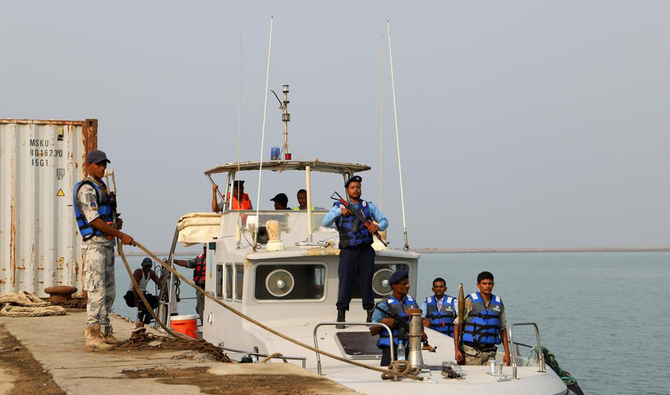

AL-MUKALLA: The Yemeni Coast Guard in the eastern province of Mahra on Friday intercepted a boat carrying almost 1,000 kilograms of drugs and arrested six Iranian and Pakistani sailors.
The government-run Mahra Media Centre said that local coastguards, backed by Arab coalition forces in the province, seized the boat off the coast of Mahra, arresting six sailors on board.
In the province’s Nishtoun port, where the seized boat was forced to dock, security forces found 730 kilograms of cannabis resin and 216 kilograms of crystal methamphetamine, tightly bound in plastic bags.
The seized drugs are worth $6,600,000, and investigators are currently questioning the sailors to determine where the drugs came from and their final destination.
The center quoted Ahmed Ali Rafet, a local security officer, as saying that security forces in the province have been put on heightened alert to foil any other attempt to smuggle drugs into Yemen through the province’s coast, urging locals to alert them about similar shipments of drugs or arms.
The latest announcement about the seized drugs comes as the Arab coalition works to revive the Yemeni coastal authority, which had crumbled when the Houthis seized control of Sanaa and later expanded militarily across Yemen six years ago.
The coalition has trained and armed hundreds of guards and provided them with fast boats. The forces have been deployed along the country’s long coastline.
Yemeni military and security officials say that the Houthis receive their smuggled shipments of arms through many coastal points on the Red Sea and the Arab Sea, including some informal ports in the province of Mahra.
In September, members of a detained arms ring that had smuggled Iranian weapons to the Houthis for years confessed that they had disguised themselves as fishermen in Mahra, where they transported many shipments of arms from Iran to the Houthis through different locations in the province.
Dozens of Houthis and government forces have been killed in the continuing fighting in the provinces of Marib, Jouf and Sanaa since Thursday, local army commanders and media reports said.
Yemen’s Defense Ministry said on Friday that at least three dozen Houthis had been killed in heavy fighting in the mountainous Nehim district, in the province of Sanaa.
State media broadcast footage showing what appeared to be government forces trading heavy machine guns with the Houthis as smoke billowed from the battlefield.
Warplanes from the Arab coalition reportedly supported government troops by hitting Houthi gatherings and military equipment.
The ministry said the Houthis lost several armored vehicles and heavy military equipment in the fighting in Nehim.
In the neighboring Marib province, the commander of the 7th Military Region has vowed to keep fighting until the Houthis are defeated, denying media reports that the Houthis had recaptured a military base in the province.
Maj. Gen. Ahmed Hassan Jibran said that the Houthis suffered major defeats on the battlefield in Marib, adding that the strategic Mas military base was still under the control of government forces.
Last week, Houthi media outlets said their forces seized control of the Mas military base, northwest of Marib, publishing images of their fighters chanting their slogans inside a military base.
Gen. Jibran said the Houthis fabricated the images to “compensate” for their losses on the battlefields. State media did not elaborate on the deaths of government forces during the fighting.
For several months, the Houthis have been relentlessly attacking army troops and allied tribesmen in Marib in an attempt to break defense lines before invading major oil and gas facilities in the province.
The current bloody conflict in Yemen began in late 2014 when the Houthis seized control of the capital, Sanaa, forcing Yemeni President Abed Rabbo Mansour Hadi into decamping to Aden and later fleeing the country after Houthi militias bombed the presidential palace in the city.
A massive aerial bombardment by the Arab coalition shored up government forces, enabling them to reverse Houthi gains across the country.


