

Pakistani PM’s commerce adviser due in Kabul today for trade talks

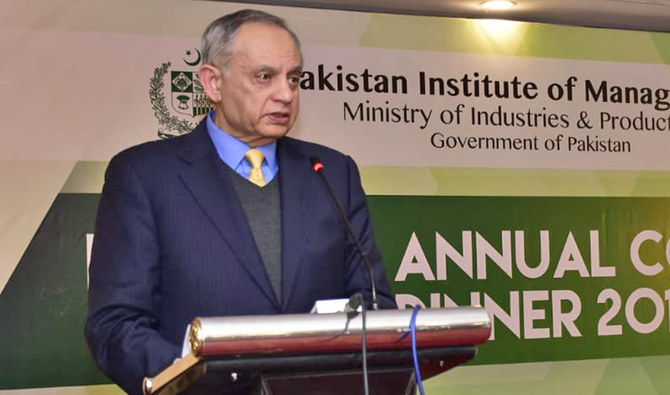
Prime Minister Imran Khan’s adviser on commerce and industry, Abdul Razak Dawood, is addressing an annual conference organized by the Ministry of Industries in Islamabad in 2019. (PID/File)
Short Url
Updated 02 March 2021
Follow

Pakistani PM’s commerce adviser due in Kabul today for trade talks

  • Abdul Razak Dawood says Islamabad wants to increase bilateral trade to $5 billion in five years
  • Experts say trade volume can be enhanced to $10 billion if bottlenecks removed 

KARACHI: Prime Minister Imran Khan’s adviser on commerce and industry, Abdul Razak Dawood, will leave for Kabul on a three-day visit today, Thursday, for talks on enhancing trade between the two neighbors.
Pakistan has said it plans to increase the volume of bilateral trade with Afghanistan, which stood at $2 billion in 2019, to $5 billion in the next five years.
Dawood’s visit comes just weeks after his Afghanistan counterpart, Nisar Ahmad Faizi Ghoryani, met Prime Minister Imran Khan to discuss trade ties.
Traders have long urged officials in Kabul and Islamabad to ease border measures to expedite the movement of goods between the two countries, a process that has slowed down even further in recent months due to new rules introduced to curb the spread of the coronavirus pandemic.
“The agenda of the visit will focus on three points,” Dawood told Arab News on Wednesday. “Number one is bilateral trade and how we are going to improve it between the two countries; the next one is the Afghan Transit Trade (ATT); and the third is to focus on many technical issues at the border crossing that need attention.”
“Our [bilateral trade] target for the next five years is $5 billion,” Dawood said. ”It used to be $2 billion or so and went down, though now it is back up again. We will do it.”


He said Pakistan had already taken several measures to address border problems, adding that more initiatives would be discussed during his meeting with Afghan officials.
“Border issues need to be resolved, though a lot of them have already been sorted out and only a few of them are left,” Dawood said.
On the Afghanistan-Pakistan Transit Trade Agreement (APTTA), which allows Kabul to use Pakistan’s land to transport goods to India, the adviser said the pact would be reviewed in February 2021.
“The ten-year agreement is coming to end, and we will start it with another agreement that both sides are negotiating to finalize,” Dawood said.
Signed in 2010, under APTTA goods are taken to the Wagah crossing point using Pakistan’s territory from where Indian trucks transport them to their intended destinations. Pakistan does not allow import of goods from India to Afghanistan via land route.
Dawood said he would also take a delegation of Pakistani businessmen to Afghanistan during his next visit to help them explore new opportunities, though his three-day visit starting today will only include government-to-government interactions.
Stakeholders say the potential for bilateral trade between Afghanistan and Pakistan is much more than $5 billion.
“There are a lot of issues when it comes to bilateral and trilateral trade. We have to export to the Central Asian countries, but there are issues. We have issues of transit trade and exports,” Mohammad Zubair Motiwala, chairman of the Pakistan-Afghanistan Joint Chamber of Commerce and Industry, told Arab News.
“The $5 billion [target] is the minimum potential of bilateral trade,” he added. “If trade-related issues are resolved, the volume can even be enhanced to $10 billion.”


IMF team expected in Islamabad today for loan reviews amid reform scrutiny

Updated 8 sec ago
Follow

IMF team expected in Islamabad today for loan reviews amid reform scrutiny

  • Talks to cover third review of $7 billion bailout and second climate resilience assessment
  • Analysts flag revenue shortfall and energy reforms as potential sticking points in negotiations

KARACHI: An International Monetary Fund (IMF) staff mission is expected to arrive in Islamabad today, Wednesday, to begin discussions on key program reviews that will determine Pakistan’s continued access to funding under its $7 billion bailout and a parallel climate resilience facility.

The visit, confirmed last week by IMF communications director Julie Kozack, will cover the third review under the Extended Fund Facility (EFF) and the second review under the Resilience and Sustainability Facility (RSF), which supports climate-vulnerable countries.

“We do have a staff team that is expected to visit Pakistan starting February 25th for discussions on the third review under the EFF and the second review under the RSF,” Kozack said at a regular press briefing last week.

The talks come at a sensitive moment for Islamabad, which has spent the past year implementing tax increases, subsidy rationalization and tight monetary policy to stabilize an economy that teetered on the brink of default in 2023.

IMF officials have credited those measures with producing measurable gains. Kozack said Pakistan’s policy efforts under the EFF had helped stabilize the economy and rebuild confidence, pointing to a primary fiscal surplus of 1.3 percent of GDP in the last fiscal year, contained inflation and the country’s first current account surplus in 14 years.

The review is expected to probe fiscal discipline and energy sector reforms, two areas that have historically complicated negotiations between Islamabad and the Fund.

Analysts told Arab News last week that while approval of the next tranche is likely, discussions might not be straightforward.

“This is expected to be a smooth sailing. However, questions might arise,” Shankar Talreja, head of research at Karachi-based Topline Securities Limited, said earlier.

He pointed to a revenue shortfall of Rs336 billion ($1.2 billion) against IMF targets and raised the possibility that the Fund may seek clarification over the government’s recent reduction in electricity tariffs for export-oriented industries, a move designed to support manufacturing but with fiscal implications.

A positive outcome of the review is vital for continued disbursements under the EFF and RSF programs. It will also be important to sustain investor confidence as the country seeks to consolidate its fragile economic recovery.

A successful staff-level review leads to a provisional agreement between the two sides, which then requires approval by the Fund’s Executive Board before the disbursement of the next tranche.