
VIENNA: Austrian police on Monday raided more than 60 addresses allegedly linked to extremists and seized millions of euros in cash, with orders for 30 suspects to be questioned.
The operation came a week after a convicted Daesh group supporter killed four people in a shooting rampage in the heart of Vienna, but prosecutors said the raids were not linked to the attack.
Interior Minister Karl Nehammer said the police action was aimed at “cutting off the roots of political extremism.”
“We are acting against these criminal, extremist and inhuman organizations with all our strength,” he said in a statement.
The Styria region prosecutors’ office said it was “carrying out investigations against more than 70 suspects and against several associations which are suspected of belonging to and supporting the Muslim Brotherhood and Hamas organizations.”
“In the case of 30 of the suspects, orders have been given for them to immediately be presented for questioning,” it added.
It said “the operation has no connection to the terror attack in Vienna of November 2” but was rather the result of “intensive and comprehensive investigations carried out for more than a year.”
Among the alleged offenses are forming a terrorist association, financing of terrorism and money laundering.
The raids took place in the Styria, Carinthia, Lower Austria and Vienna regions.
More than 930 police officers took part in the operation, codenamed “Luxor,” and millions of euros in cash were seized, Austria’s top security chief Franz Ruf told a press conference.
The prosecutors’ statement said the operation “was not targeted at Muslims or Islam as a religious community.”
“On the contrary these measures are also intended to protect Muslims, whose religion is abused for the purposes of an ideology hostile to the constitution,” it said.
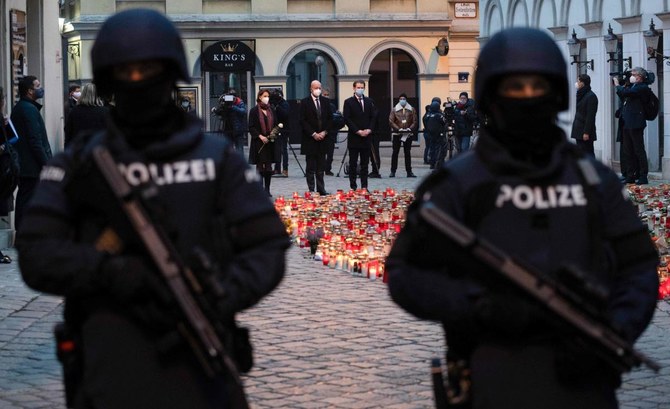
Last Monday’s shooting was the first major attack of its kind in Austria for decades and the first blamed on a militant.
The gunman was identified as Kujtim Fejzulai, 20, a dual Austrian-Macedonian national who was convicted and imprisoned last year for trying to go to Syria to join Daesh.
Austria has acknowledged security lapses in the run-up to the attack, including failing to act on warnings from Germany and Slovakia about Fejzulai and his contacts.
The head of Vienna’s anti-terror agency was suspended last week after further revelations came to light about intelligence failings.
“We have to build up comprehensive know-how, we don’t have this in Austria to that extent,” Ruf said, referring to the country’s intelligence services.
Ruf confirmed on Monday that Fejzulai — who was released early from prison in December — had a meeting in July with German and Swiss extremists in Vienna.
Among those present were also some of Fejzulai’s contacts who were detained in the aftermath of the shooting.
Despite that meeting, and the fact Fejzulai tried to buy ammunition in Slovakia, he was allowed to remain free on probation as the relevant information was not passed on to the justice system.
Last week the government also ordered the closure of two mosques in Vienna frequented by the attacker.
Meanwhile, European Council President Charles Michel and France’s European Affairs Minister Clement Beaune are visiting Vienna on Monday to meet Chancellor Sebastian Kurz and to discuss cross-border cooperation in the fight against terror.
On Tuesday Kurz will go to Paris to meet French President Emmanuel Macron — whose country has been hit by a spate of extremist attacks — before a video conference which will also be attended by German Chancellor Angela Merkel, Michel and European Commission President Ursula von der Leyen.