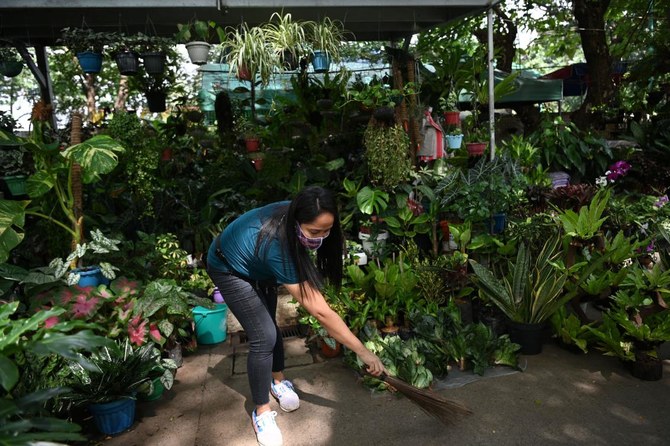
‘Plantdemic’ hits Philippines as demand for greenery grows

1 / 3
A gardening craze in the Philippines has resulted to a spate of plant thefts from public parks, prompting authorities to tighten security and issue a plea for people to leave the greenery alone. (AFP)
2 / 3
Newly-bought plants are loaded into a taxi at a nursery in Manila. (AFP)
3 / 3
Above, a plant vendor cleans the surroundings of her nursery in Manila. (AFP)
Short Url
Updated 09 November 2020
Follow

‘Plantdemic’ hits Philippines as demand for greenery grows

  • ‘It’s unbelievable. People are super interested in plants these days’
  • Stress of lockdown and financial pressure caused by the pandemic have prompted many Filipinos to seek solace in their gardens

MANILA: A gardening craze dubbed “plantdemic” has spread across the Philippines after coronavirus restrictions fueled demand for greenery, sending plant prices soaring and sparking a rise in poaching from public parks and protected forests.
Photos of delicate flowers and broad-leafed foliage cultivated in backyards and on balconies have flooded social media as housebound Filipinos turn to nature to relieve stress and boredom.
“It’s unbelievable. People are super interested in plants these days,” said landscape gardener Alvin Chingcuangco, who has seen prices for some varieties of monsteras reach $1,140 each, compared with $16 before the pandemic.
Manila plant seller Arlene Gumera-Paz said her daily turnover tripled after she reopened her doors following months of lockdown.
Demand remained robust even as prices for the most popular varieties of indoor plants, such as alocasias, spider plants and peace lilies, doubled or even quadrupled.
“It’s hard to understand people. When plants were cheap, they were ignored,” said the 40-year-old, who buys her plants in bulk from growers in nearby provinces.
But as demand has grown, authorities have warned that many plants on the market may not have been legally obtained.
Rangers patrolling the forests of Zamboanga in the country’s south for illegal loggers and wildlife poachers were ordered to watch out for plant thieves, after officials noticed some species posted on social media could only be found in the region’s protected areas.
“Prior to the pandemic we hadn’t observed many plant poachers,” said Maria Christina Rodriguez, Zamboanga regional director for the Department of Energy and Natural Resources.
“This only became popular during lockdown.”
Removing threatened species from forests is illegal under Philippine law and carries hefty penalties. Collecting other native plants is allowed but only with a permit.
Thieves are targeting plant varieties popular on social media, such as staghorn ferns and pitcher plants, Rodriguez said.
But catching offenders is difficult — once the plant has been dug up and sold “it is hard for us to prove that it came from forests or our protected areas,” she added.
A spate of plant thefts from public parks in the northern city of Baguio prompted authorities to tighten security and issue a plea on Facebook for people to leave the greenery alone.
So far only five people have been caught for stealing flowers, said Rhenan Diwas, officer in charge of the Baguio City Environment and Parks Management Office.
“Maybe it’s because of boredom or they want to generate income,” he said.
The stress of lockdown and financial pressure caused by the pandemic have prompted many Filipinos to seek solace in their gardens, earning themselves the nicknames “plantitos and plantitas,” or plant uncles and aunties.
“The safest way to make yourself happy is through growing little things,” said Norma Karasig Villanueva, former president of the Philippine Horticultural Society.
Long-time gardener Ivy Bautista, 30, said tending her plants helped to “kill boredom” and earn some money by selling cuttings from her extensive collection.
But she opposes the “insane” prices charged by other sellers, fearing it could drive plant poaching.
“It’s ridiculous, a plant that I purchased for 400 pesos ($8.29) is now selling for 5,000 pesos ($103.63),” said Bautista.
In an editorial titled “Plantdemic” last month, the Philippine Daily Inquirer decried the high prices being charged and urged buyers to get their plants from sellers “with legitimate, lawful sources.”
Rodriguez in Zamboanga said she welcomed the interest in gardening, but wished they would plant flowers or edibles instead of native flora.
“Be responsible plantitos and plantitas and be mindful of where the plants are coming from,” she said.
“We’re really serious about this because it creates an imbalance in the ecosystem once the species are plucked out of their natural habitat.”


US, Ukraine hail ‘productive’ Miami talks but no breakthrough

Updated 6 sec ago
Follow

US, Ukraine hail ‘productive’ Miami talks but no breakthrough

  • Representatives from Ukraine, Russia, and Kyiv’s European allies, held separate talks hosted by US special envoy Steve Witkoff
  • Russia's delegation said recent proposed changes to Trump's “20-point plan”  to end the war were a non-starter

MIAMI, Florida: US and Ukrainian envoys issued a joint statement on Sunday that hailed “productive and constructive” talks in Miami but did not announce any apparent breakthrough in efforts to end the war with Russia.

Top representatives from both Ukraine and Russia, as well as Kyiv’s European allies, have been in southern Florida over the past several days for a series of separate talks hosted by US President Donald Trump’s special envoy, Steve Witkoff.
The meetings were the latest in a weeks-long diplomatic blitz over plans to end the war, after Washington last month presented a 28-point proposal widely seen as echoing the Kremlin’s demands.
It has since been redrafted following Ukraine and Europe’s involvement, though its contents have not been publicly disclosed.
“Over the last three days in Florida, the Ukrainian delegation held a series of productive and constructive meetings with American and European partners,” Witkoff and Ukraine’s top negotiator, Rustem Umerov, said in separate statements on X.
They said a bilateral US-Ukraine meeting focused on developing and aligning positions on “four key documents” — a “20-point plan,” a “Multilateral security guarantee framework,” a “US Security guarantee framework for Ukraine” and an “economic & prosperity plan.”
“Particular attention was given to discussing timelines and the sequencing of next steps,” they said, without announcing any further meetings.
National security advisers from Kyiv’s European allies “also joined the discussions to align on a shared strategic approach between Ukraine, the United States, and Europe,” the statements added.
Russian envoy Kirill Dmitriev was also in southern Florida and met with the US delegation, which included billionaire real estate developer Witkoff and Trump’s son-in-law Jared Kushner.
Witkoff on Sunday similarly said that the meetings with Dmitriev were “productive and constructive.”
Earlier, the Kremlin said recent proposed changes to the plan to end the war were a non-starter.
Dmitriev “should receive information about what has been developed by the Americans and Europeans” in the plan and report that back to Moscow later, Kremlin’s spokesman Dmitry Peskov told state TV.
Moscow, which invaded Ukraine in February 2022, sees Europe as pro-war and argues that its participation in the talks only hinders them.

War rages on 

While little is known of the latest peace plans, Kyiv is likely to be expected to surrender some territory — a prospect resented by many Ukrainians — in exchange for US security guarantees.
Though envoys from both Moscow and Kyiv were in town, the Kremlin had earlier ruled out three-way talks.
Ukrainian President Volodymyr Zelensky earlier described the talks as “constructive” and said they were “moving at a fairly rapid pace.”
He nevertheless cautioned that “much depends on whether Russia feels the need to end the war for real.”
He also hailed this week as “historic” for Ukraine, thanking Europe for pledging $100 billion of funding over the next two years.
Moscow’s troops have been steadily advancing at the eastern front in recent months. Putin on Friday hailed the Russian army’s territorial gains — and threatened more in the coming weeks.
Just over the week, “Russia has launched approximately 1,300 attack drones, nearly 1,200 guided aerial bombs, and 9 missiles of various types” against Ukraine, Zelensky said.
Most of them have pummeled the Black Sea region of Odesa, where relentless strikes wrought havoc on ports, bridges and energy facilities, killing eight people Saturday.
In the eastern Sumy region, Russian troops attempted a breakthrough in an area previously spared from an intense ground offensive. Russian forces forcibly moved 50 people from a local village, said Kyiv.
“Russian invaders have stolen five dozen civilian people, mostly elderly women, from a tiny Ukrainian village Grabovske, right across the state border in the Sumy region,” Foreign Minister Andriy Sybiga said.
Russia made no comment on the matter.