

Indonesia keen to learn from Saudi G20 presidency

Indonesia supports the initiative by the Saudi presidency to support existing efforts to prevent land degradation and habitat loss. (Shutterstock)
Short Url
Updated 09 November 2020
Follow

Indonesia keen to learn from Saudi G20 presidency

  • The Kingdom did not let the pandemic become an unfortunate moment, says envoy

RIYADH: With the whole world experiencing a swift digital transformation amid the coronavirus disease (COVID-19) pandemic, Saudi Arabia, as the G20 host, shoulders the responsibility to help the world move forward by swiftly adopting new health protocols and setting an example, said Indonesian Ambassador to Saudi Arabia Agus Maftuh Abegebriel.

In an interview with Arab News, Abegebriel said: “Saudi Arabia did not let the pandemic become an unfortunate moment. The G20 swiftly adopted new health protocols, and an online mechanism was prepared for the upcoming summit in November. The extraordinary summit in March ran well online — evidence of how well Saudi Arabia handled the G20’s meetings during the pandemic. I hope that we can learn from the Saudi presidency for handling the G20 in 2023.

“The G20 was born out of crisis back in 1999, and was again challenged in 2008-2009 by the global financial crisis. That crisis came alongside the European sovereign debt crisis, and several eurozone members were unable to repay or refinance their government debt. World GDP growth had fallen from 4.3 percent in 2007 to 1.8 percent in 2008, and then continued to minus 1.6 percent in 2009.

“The G20 has played an essential role in enabling international cooperation, and taken responsibility for global leadership in times of crisis. World GDP growth in 2010 successfully returned to 4.3 percent, with an average level of 2-3 percent in the next several years,” he added.

“Now, COVID-19 has had a more adverse impact on activity in 2020 than anticipated, and the recovery is projected to be slower than previously predicted,” he said.
“It is important to collaborate to ensure universal and equitable access to vaccines. It is important to work together to safeguard the global economy and avoid global depression. It is important to send a strong message that global recovery after the pandemic must be aligned with the 2030 UN Sustainable Development Goals to create more inclusive and sustainable growth,” he added.

Abegebriel continued that the G20 Summit in Riyadh would face major issues and high expectations, especially in areas devastated by COVID-19.

“G20 members face many common and pressing challenges, even more now with COVID-19. Consequently, the theme brought by Saudi Arabia, “Realizing opportunities of the 21st century for all,” is … relevant with the situation today. This is the time when countries share their collective efforts and responsibilities to address those challenges together, to make sure no one is left behind,” said the ambassador.

Abegebriel underscored that empowering people needed good decisions, and that the pandemic had reversed decades of progress on closing the gender gap in the labor market. It was important, he said, to put this issue in every aspect of new policy.

“We view that achieving women’s empowerment is essential to achieve sustainable and equitable development, which is in line with the Agenda 2030 framework,” he said.



Indonesian Ambassador to Saudi Arabia Agus Maftuh Abegebriel. (Photo/Supplied)

Furthermore, the environment and its preservation remains of major importance. “We support the initiative by the Saudi presidency to support existing efforts to prevent land degradation and habitat loss, as well as the initiative to accelerate scientific knowledge and technology development in support of coral reef survival, conservation, resilience, adaptation and restoration,” he said.

On an urgent need for the G20 to take steps that lead to more employment and growth, the envoy said: “Absolutely, in the long run, the deep recessions triggered by this pandemic (are) most likely to leave an eternal scar across sectors and fields, such as the disruption of global trade, fragmentation of supply chains, lower investment and affect people-to-people connectivity.”

Pressure on weak health care systems, loss of trade and tourism, declining remittances, subdued capital flows and tight financial conditions amid mounting debt will daunt many countries, he added. The pandemic has gravely impacted the labor market, especially for the most vulnerable: Low-paid workers, young people, women, under-represented groups, the self-employed and informal sector workers.

“Strengthening social protection systems is vital to prevent a more severe situation that could occur during the crisis period,” he said.

“There are reasons why the G20 Summit hosted by Saudi Arabia is historic. First, the summit is being held amid the deepest global recession in decades. Second, this summit is the first in the history of G20 convened online. As Saudi Arabia is the only country in the Middle East to be a member country of the G20, it is important to represent and show Saudi leadership in the region. We congratulate the Kingdom for its able leadership and its utmost effort in leading this forum to ensure the relevance of the G20 during the crisis,” Abegebriel said.

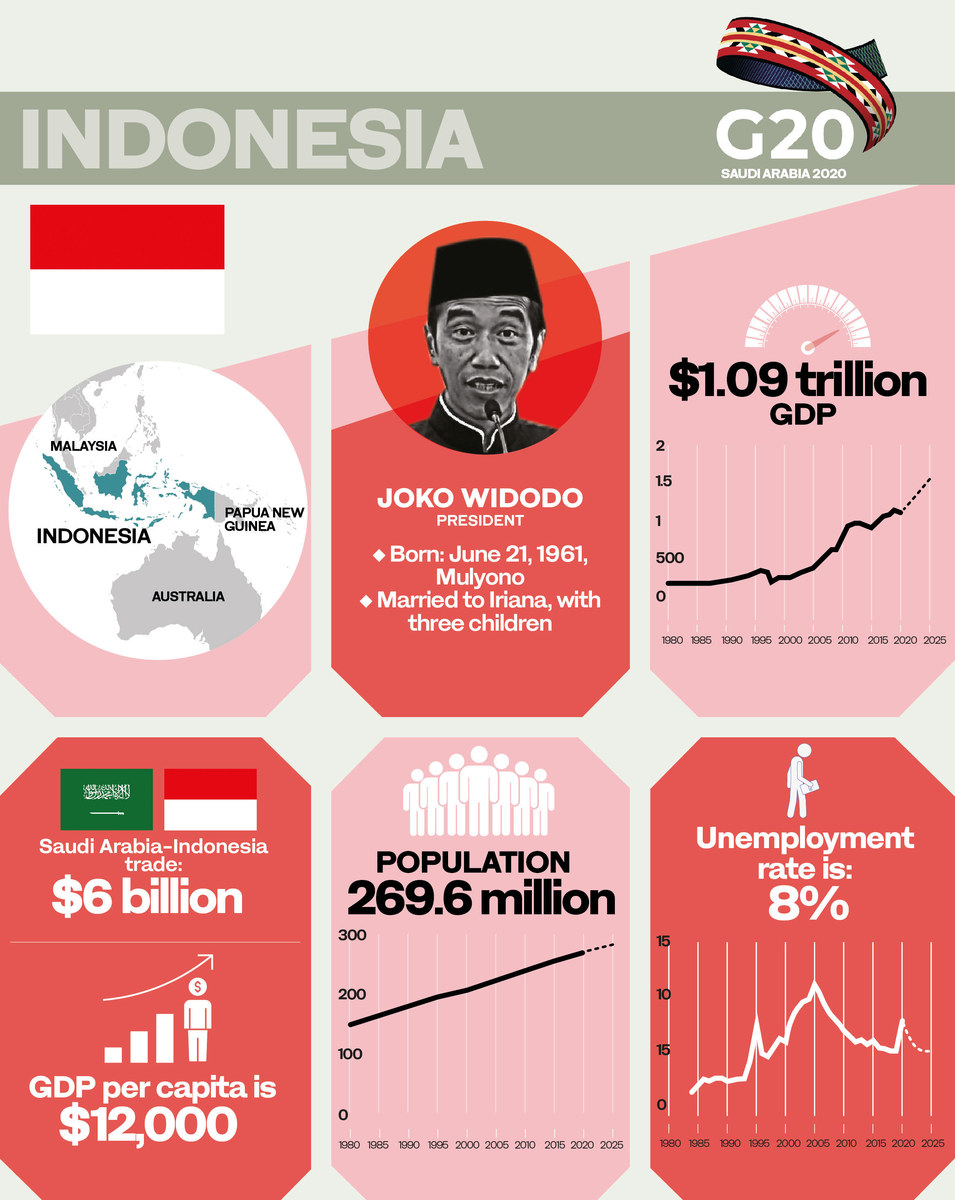
“Indonesia, which has a predominantly Muslim population, has a strong relationship with Saudi Arabia. The state visits by President Joko Widodo in 2015, 2018 and 2019 mark the importance of Saudi Arabia for the people of Indonesia. The historic visit by King Salman to Indonesia in 2017 showed the remarkable cooperation between the two countries,” he added. “I hope cooperation between Saudi Arabia and Indonesia will strengthen.

“Saudi Arabia has prepared the G20 Summit very well. Indonesia is keen to learn from Riyadh, to prepare ourselves for hosting the G20 Summit in 2023.”


Over 3k flights cancelled across the Middle East after attack on Iran by the US, Israel

Updated 01 March 2026
Follow

Over 3k flights cancelled across the Middle East after attack on Iran by the US, Israel

RIYADH: US and Israeli strikes on Iran led to widespread airspace shutdowns in the Middle East, canceling and rerouting thousands of flights and paralyzing key international travel corridors.

Flight cancellations affected seven airports across the Middle East, including Dubai and Abu Dhabi in the UAE, Doha in Qatar, and Manama in Bahrain.

Emirates Airlines said in a statement: “Due to multiple regional airspace closures, Emirates has temporarily suspended all operations to and from Dubai, up until 1500 hrs UAE time on Monday, 2 March.”

A flydubai spokesperson said the situation is evolving, and the airline is closely monitoring developments while coordinating with authorities to adjust its flight schedule.

“Our teams are working diligently to implement comprehensive welfare for all affected customers. The safety of our passengers and crew remains our highest priority,” the spokesperson said.

He added: “We are currently experiencing a high volume of calls and appreciate our customers’ patience while our teams work to assist everyone as quickly as possible.”

Qatar Airways announced that the airport will remain closed until at least the morning of March 2.

“Qatar Airways flights to, and from, Doha have been temporarily suspended due to the closure of Qatari airspace,” the airline said.

It added: “Qatar Airways will resume operations once the Qatar Civil Aviation Authority announces the safe reopening of Qatari airspace.”

Saudia also said in an official statement that it had canceled a number of flights due to developments in the region and the closure of airspace.

The organization said the decision was taken in line with aviation safety and security standards, noting that its Emergency Coordination Center is closely monitoring developments with relevant authorities.

Saudia urged passengers to verify the status of their flights before heading to the airport and said guests would be notified of updates through the contact details associated with their bookings.

The carrier added that further information would be announced in a subsequent statement if available.

Air Arabia also said its flights were experiencing cancellations, delays, or rerouting as a result of the evolving situation and airspace closures.

Airlines cited airspace closures and safety concerns as the main reasons for flight disruptions, urging passengers to check official channels for updates as the situation develops.

Israeli airspace also remained closed on March 1st. Israeli airline El Al said it was preparing a recovery effort to bring home Israelis stranded abroad once the airspace reopened.

Travelers were either stranded or diverted to other airports on Feb. 28 after Israel, Qatar, Syria, and Iran as well as Iraq, Kuwait and Bahrain, closed their airspace.

After the UAE announced a temporary partial airspace closure, FlightRadar24 recorded no flights over the country.

The closures affected key hub airports in Dubai, Abu Dhabi, and Doha. Emirates, Qatar Airways, and Etihad, airlines that operate from these hubs, normally handle around 90,000 passengers daily, with even more traveling to other Middle Eastern destinations, according to aviation analytics firm Cirium.

Airports hit by attacks

Two airports in the UAE reported incidents as the government there condemned what it called a “blatant attack involving Iranian ballistic missiles” on Feb.28.

Dubai International Airport, the UAE’s largest and one of the world’s busiest, reported four injuries, while Abu Dhabi’s Zayed International Airport said a drone attack killed one person and injured seven others. Strikes were also reported at Kuwait International Airport.

Though Iran did not publicly claim responsibility, the scope of retaliatory strikes that Gulf nations attributed to Iran extended beyond the US bases that it previously said it would target.

Flight delays, cancellations are likely to continue

“For travelers, there’s no way to sugarcoat this,” said Henry Harteveldt, an airline industry analyst and president of Atmosphere Research Group.

“You should prepare for delays or cancellations for the next few days as these attacks evolve and hopefully end,” he added.

To avoid conflict zones, airlines are rerouting Middle East flights over Saudi Arabia, adding hours and fuel costs, which could push ticket prices higher if the tensions persist.

The extra flights will strain air traffic controllers in the Kingdom, who may need to slow traffic for safety. Meanwhile, countries that closed their airspace will lose out on overflight fees from passing airlines.

Mike McCormick, former head of air traffic control at the FAA and now a professor at Embry-Riddle Aeronautical University, said some countries may reopen parts of their airspace in the coming days once US and Israeli officials provide airlines with details on military flight zones and Iran’s missile capabilities.

“Those countries then will be able to go through and say, ok, we can reopen this portion of our space but we’ll keep this portion of our airspace closed,” McCormick said.

“So, I think what we’ll see in the next 24 to 36 hours is how the use of airspace evolves as the kinetic activity gets more well-defined and as the capability of Iran to actually shoot missiles and create additional risk is diminished due to the attacks,” he added.

But it is unclear how long the disruption to flight operations could last. For comparison, the Israeli and US attack on Iran in June 2025 lasted 12 days.