

UK terror inmates set for release: Report

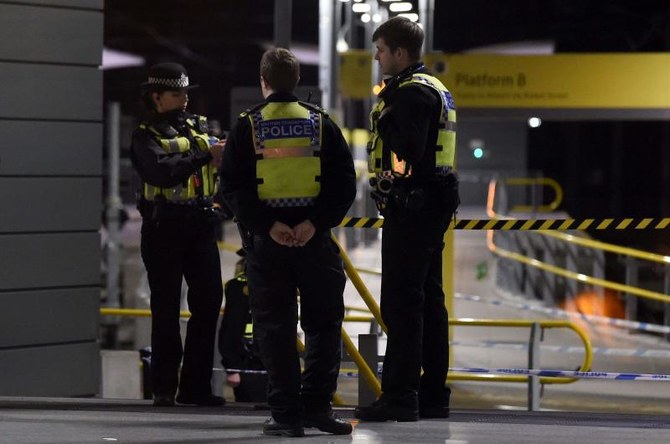
File photo of police officers standing near a cordon at Manchester Victoria Station, in Manchester on January 1, 2019, following a stabbing on December 31, 2018. (AFP)
Short Url
Updated 08 November 2020
Follow

UK terror inmates set for release: Report

  • About 110 convicted extremists could soon walk British streets as country raises threat level to severe

LONDON: Some of the UK’s most dangerous terror inmates could be freed as early as next month as they become eligible for parole, The Times newspaper reported.

Many convicted terrorists must serve at least two-thirds of their sentence before being considered for release by the UK Parole Board. 

Officials revealed that 110 prisoners had reached the two-thirds threshold and have been referred for parole for potential early release.

A spokesman for the Parole Board said its members had received “rigorous training” in handling terrorism cases, and inmates that pose a risk would not be released.

The UK last week raised its terror threat level to severe, meaning an attack is “highly likely.”

Britain’s youngest Daesh supporter, who plotted to behead police at an Australian Anzac Day parade while aged 14, could be among the first to be released.

Other jailed terrorists who could leave prison include a Briton who downloaded terror material online, and a man who tried to join Daesh.

The UK’s first Al-Qaeda-inspired terrorist was released from prison earlier this year. Moinul Abedin, 47, was jailed for 20 years in 2002 after stockpiling bomb-making chemicals in Birmingham. He was freed following a parole hearing in February.

The Anzac Day terrorist, now 20, became eligible for parole last month. Known by the initials “RXG,” he was granted lifelong anonymity by the UK High Court.

In 2015, he was jailed for life and ordered to serve a minimum five-year term after using social media and encrypted messaging from his bedroom in the UK to encourage an 18-year-old Australian to attack police officers at an Anzac Day parade in Melbourne. The plot failed and both perpetrators were jailed.

An assessment carried out in 2018 by a forensic psychologist said: “RXG appears to have left his ‘terrorist identity’ behind and is well on the way to developing a new stable and pro-social identity.”

If freed, RXG is likely to be monitored and will face tough restrictions, including an internet ban.

The Parole Board spokesman said: “Parole reviews are undertaken thoroughly and with extreme care. Protecting the public is our number one priority.”


Lawsuit challenges Trump administration’s ending of protections for Somalis

Updated 8 sec ago
Follow

Lawsuit challenges Trump administration’s ending of protections for Somalis

  • The lawsuit cites a series of statements Trump has made describing Somalis as “garbage” and “low IQ people” who “contribute nothing.”

BOSTON: Immigrant rights advocates filed a lawsuit on Monday seeking to stop US President Donald Trump’s administration from next ​week ending legal protections that allow nearly 1,100 Somalis to live and work in the United States. The lawsuit, brought by four Somalis and two advocacy groups, challenges the US Department of Homeland Security’s decision to end Temporary Protected Status for Somali immigrants, whom Trump has derided in public remarks. Outgoing Homeland Security Secretary Kristi Noem in January announced that TPS for Somalis would end on March 17, arguing that Somalia’s conditions had improved, despite fighting continuing between Somali forces and Al-Shabab militants. The plaintiffs, who ‌include the groups ‌African Communities Together and Partnership for the Advancement ​of ‌New ⁠Americans, in the ​lawsuit filed ⁠in Boston federal court argue the move was procedurally flawed and driven by a discriminatory, predetermined agenda.
The lawsuit cites a series of statements Trump has made describing Somalis as “garbage” and “low IQ people” who “contribute nothing.”
The plaintiffs said the administration is ending TPS for Somalia and other countries due to unconstitutional bias against non-white immigrants, not based on objective assessments of country conditions.
“The termination of TPS for Somalia is racism masking as immigration policy,” ⁠Omar Farah, executive director at the legal group Muslim Advocates, said ‌in a statement.
DHS did not respond to ‌a request for comment. It has previously said TPS ​was “never intended to be a de ‌facto amnesty program.”
TPS is a form of humanitarian immigration protection that shields eligible migrants ‌from deportation and allows them to work. Under Noem, DHS has moved to end TPS for a dozen countries, sparking legal challenges. The administration on Saturday announced plans to pursue an appeal at the US Supreme Court in order to end TPS for over 350,000 Haitians. It ‌also wants the high court to allow it to end TPS for about 6,000 Syrians.

SOMALI COMMUNITY TARGETED
Somalia was first designated ⁠for TPS in ⁠1991, with its latest extension in 2024. About 1,082 Somalis currently hold TPS, and 1,383 more have pending applications, according to DHS. Somalis in Minnesota in recent months had become a target of Trump’s immigration crackdown, with officials pointing to a fraud scandal in which many people charged come from the state’s large Somali community. The Trump administration cited those fraud allegations as a basis for a months-long immigration enforcement surge in Democratic-led Minnesota, during which about 3,000 immigration agents were deployed, spurring protests and leading to the killing of two US citizens by federal agents.
In November, Trump announced he would end TPS for Somalis in Minnesota, and a month later said ​he wanted them sent “back to where they ​came from.”
The US Department of State advises against traveling to Somalia, citing crime and civil unrest among numerous factors.