

Pakistani man from scarred borderlands finds refuge, and acclaim, in landscape painting 

1 / 5
In this undated photograph, artist Safeer Khan is seen working on a landscape in his native town in Gomal Valley, Pakistan. (Photo courtesy: Safeer Khan)
2 / 5
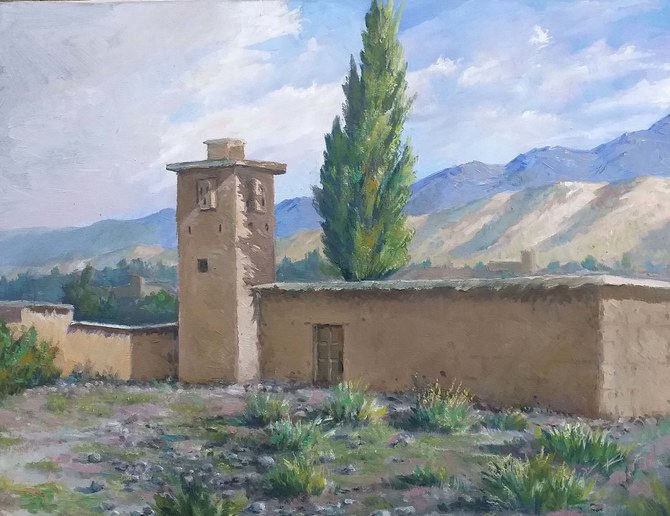
An undated photo of a landscape painting produced by artist Safeer Khan depicts houses in Kaniguram Valley in South Waziristan tribal district, Pakistan. (Photo courtesy: Safeer Khan)
3 / 5
An undated photo of a landscape painting by artist Safeer Khan captures village life in South Waziristan tribal district, Pakistan (Photo courtesy: Safeer Khan)
4 / 5
An undated photograph of a landscape painting by artist Safeer Khan in 2019 portrays the natural beauty of South Waziristan tribal district in Pakistan. (Photo courtesy: Safeer Khan)
5 / 5
This undated photograph shows a house in South Waziristan, Pakistan, painted by artist Safeer Khan. (Photo courtesy: Safeer Khan)
Short Url
Updated 05 November 2020
Follow

Pakistani man from scarred borderlands finds refuge, and acclaim, in landscape painting 

  • Safeer Khan grew up poor in a tiny settlement of mud houses in Tank district of Khyber Pakhtunkhwa province 
  • With his family unable to afford his education, Khan was forced to drop out of high school until art saved his life

TANK: Safeer Khan grew up poor in a tiny settlement of mud houses in Pakistan’s Tank district of Khyber Pakhtunkhwa province, which borders Afghanistan and bears the deep scars of decades of militant violence. 
With his family unable to afford his education, Khan was forced to drop out of high school and had few prospects for a future.
But art saved his life, says the 26-year-old man who is now a landscape painter and recently found social media fame. 
“Safeer was in a miserable condition when he first met me,” Khan’s art teacher Ajab Khan told Arab News. “He had dropped out of school due to financial constraints, but I encouraged him to continue his education since I could see immense potential in him. I knew he was highly imaginative.”
Khan first began to produce commercial images and painted signboards until 2011. Now, under the tutelage of his teacher, he focuses on landscapes, inspired by the natural beauty and culture of Pakistan’s mountainous tribal regions. In 2018, he won a prize at a ceremony arranged by the Abasin Arts Council in Peshawar. He has also won prizes in similar competitions in cities like Faisalabad and Dera Ismail Khan.
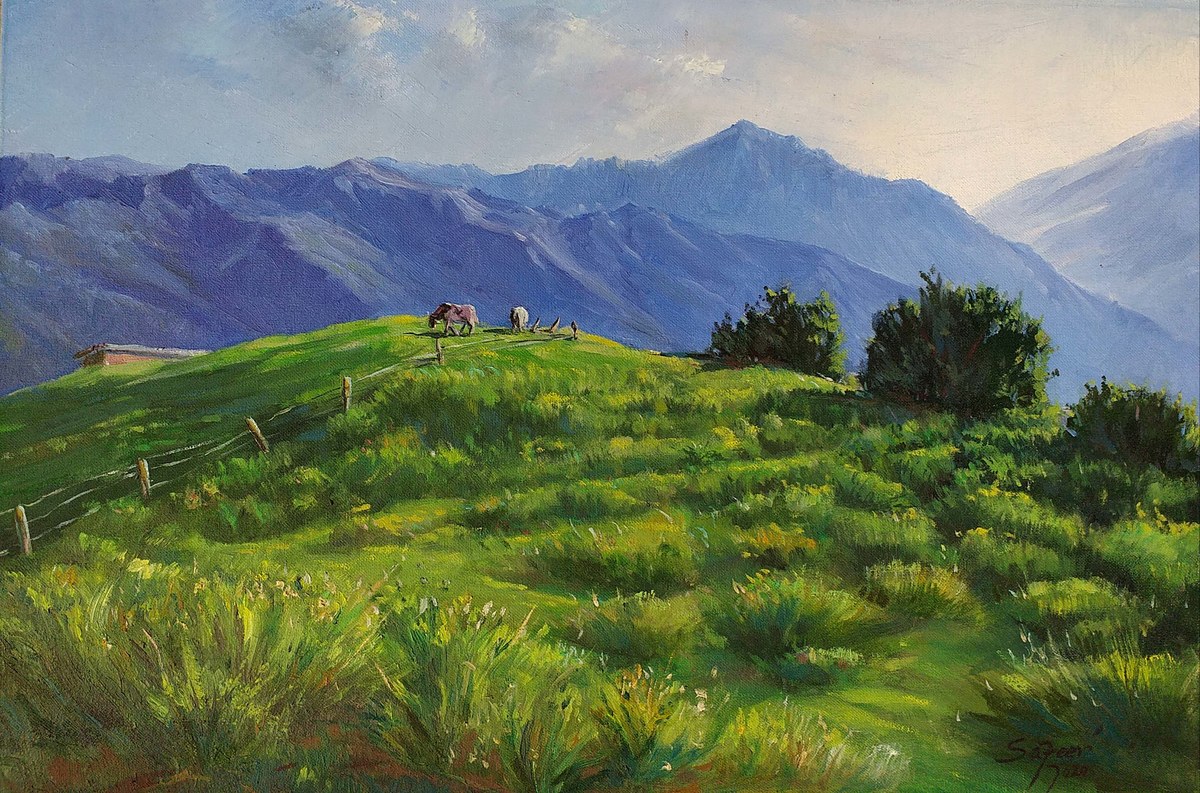


An undated photograph of a landscape painting by artist Safeer Khan shows animals in a meadow in South Waziristan tribal district, Pakistan. (Photo courtesy: Safeer Khan)

“My ambition is to exhibit my work in museums and art galleries in Islamabad and abroad,” said Khan, who now has a master’s degree in the Pashto language and a diploma in drawing. “However, I can’t make that happen on my own and need government support.”
“I’ve embarked on this journey, though I know my destination is far away,” he added.

Khan’s work betrays little of the hardships and violence of the region from where he belongs. 
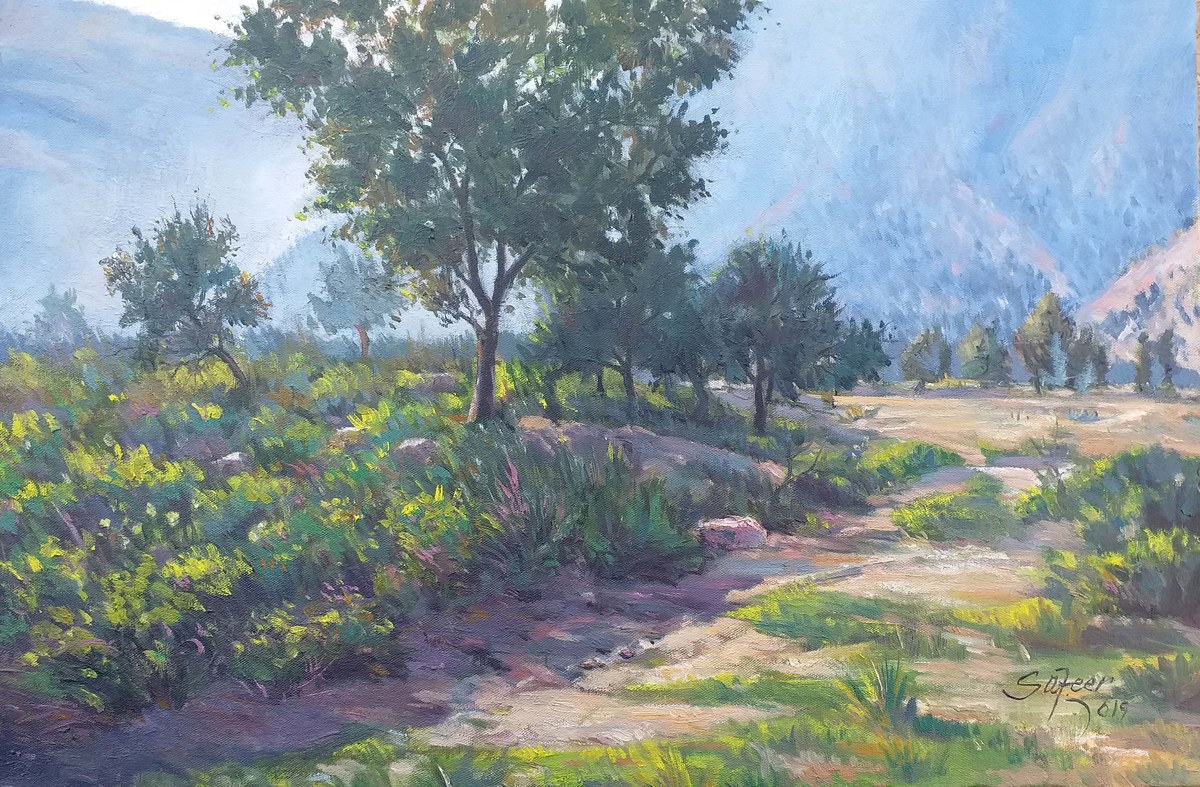


An undated photograph of a landscape painting produced by artist Safeer Khan shows South Waziristan’s natural beauty. (Photo courtesy: Safeer Khan)

Inspired by South African landscapist Anton Benzon, popular for his bold brushstrokes and passion for strong colors, the young Pakistani artist too has his own way of looking at the world around him, and mostly paints calm and serene scenes from pastoral and countryside life in his home region.
Khan’s teacher Ajab said his student loved his land, people and culture.
“All these ingredients are immensely important for an artist,” he added. “However, his future will be bleak if he continues to live in his native town since no one around him will have any appreciation for his talent.”


Pakistan accuses India of manipulating Chenab flows, seeks clarification under Indus Waters Treaty

Updated 1 min 25 sec ago
Follow

Pakistan accuses India of manipulating Chenab flows, seeks clarification under Indus Waters Treaty

  • Foreign office spokesperson says sudden variations in river flows threaten agriculture, food security and livelihoods downstream
  • He also condemns a niqab-removal incident in India, calling it part of a broader pattern of religious intolerance and Islamophobia

ISLAMABAD: Pakistan said on Thursday it had observed abrupt variations in the flow of the River Chenab during the ongoing month, accusing India of manipulating river flows at a critical point in the agricultural cycle and saying it had written to New Delhi seeking clarification.

Local media reported quoted Pakistani officials as saying India released about 58,000 cusecs of water at Head Marala on Dec. 7–8 before sharply reducing flows to roughly 870–1,000 cusecs through Dec. 17, far below the 10-year historical average of 4,000–10,000 cusecs for this period.

Pakistan’s Foreign Office spokesman Tahir Andrabi told a weekly media briefing in Islamabad India had failed to share prior information or operational data on the Chenab flows, a practice he said New Delhi had previously followed under the 1960 Indus Waters Treaty. New Delhi said earlier this year it had put the treaty “in abeyance” following a gun attack in Indian-administered Kashmir that it blamed on Pakistan, a charge Islamabad denied, calling instead for an impartial and transparent international investigation.

Pakistan also described India’s unilateral suspension of the treaty as a violation of international law and an “act of war.”

“Pakistan would like to reiterate that the Indus Waters Treaty is a binding international agreement, which has been an instrument of peace and security and stability in the region,” Andrabi said. “Its breach or violation, on one hand, threatens the inviolability of international treaties in compliance with international law, and on the other hand, it poses serious threats to regional peace, principles of good neighborliness, and norms governing interstate relations.”

Andrabi said Pakistan viewed the sudden variations in the Chenab’s flow with “extreme concern and seriousness,” saying the country’s Indus Waters Commissioner had written to his Indian counterpart seeking clarification in line with procedures outlined in the treaty.

“Any manipulation of river flow by India, especially at a critical time of our agricultural cycle, directly threatens the lives and livelihoods, as well as food and economic security of our citizens,” he continued. “We call upon India to respond to the queries raised by Pakistan.”

He said Pakistan had fulfilled its obligations under the Indus Waters Treaty and urged the international community to take note of India’s “continued disregard” of a bilateral treaty and to counsel New Delhi to act responsibly under international law.

Andrabi maintained Pakistan remained committed to peaceful resolution of disputes with India but would not compromise on its water rights.

In the same briefing, he also condemned an incident in which the chief minister of the Indian state of Bihar was seen in a video forcibly removing the niqab of a Muslim woman during a public interaction, followed by remarks by a minister in Uttar Pradesh who mocked the episode, saying it reflected a broader pattern of religious intolerance and Islamophobia and warranted strong condemnation.