

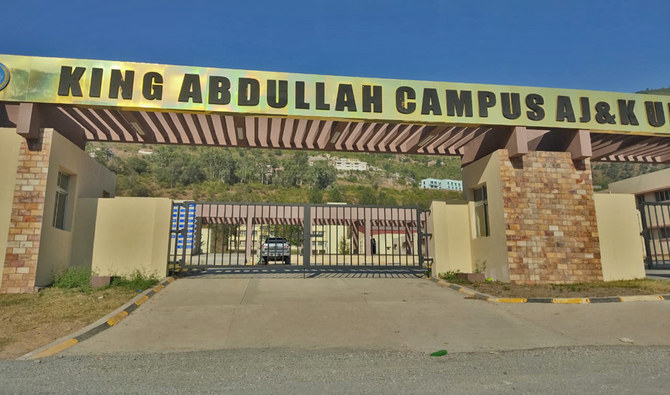
Saudi-funded 'King Abdullah Campus' under construction in Azad Kashmir

The under-construction King Abdullah Campus can be seen in Chhatar Kalas in Azad Kashmir, Pakistan, in this undated photo. (Photo courtesy: University of Azad Jammu and Kashmir)
Short Url
Updated 02 November 2020
Follow

Saudi-funded 'King Abdullah Campus' under construction in Azad Kashmir

  • New addition to University of Azad Jammu and Kashmir will help the facility expand academic activities and operate at full capacity, administration says
  • Saudi Arabia has funded several projects in Azad Kashmir in the past, especially after the devastating 2005 earthquake

ISLAMABAD: University of Azad Jammu and Kashmir has said a new state of the art “King Abdullah Campus” was under construction at Chhattar Kalas and would help the university expand its academic activities and operate at full capacity.
Azad Jammu and Kashmir is a multicampus and multi-disciplinary public sector university established in 1980. It has three main campuses in Muzaffarabad, Neelam valley and  Jhelum.
In a statement detailing new additions to the university, the administration said: “A new state of the art King Abdullah Campus at Chhatar Kalas is under construction which will help us in near future to further expand our academic activities and operate at our full capacity.”
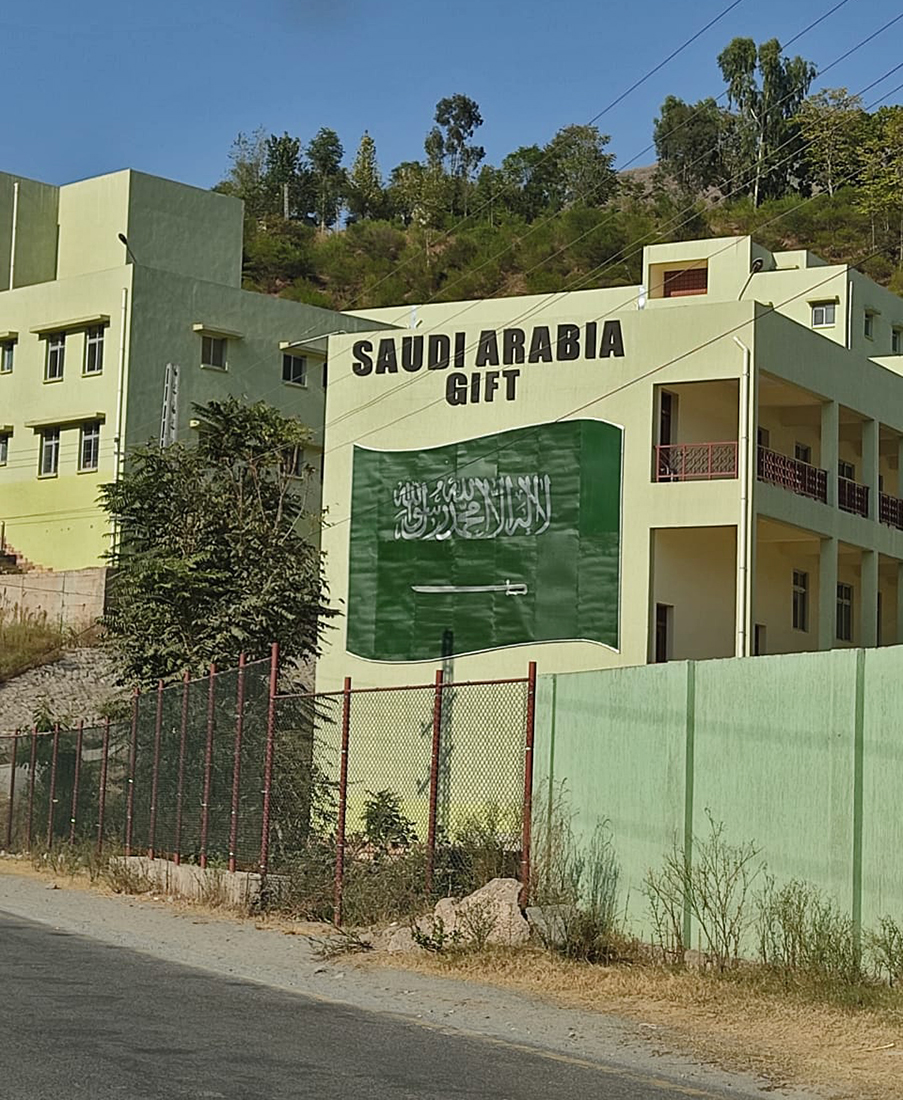


The under-construction King Abdullah Campus can be seen in Chhatar Kalas in Azad Kashmir, Pakistan, in this undated photo. (Photo courtesy: University of Azad Jammu and Kashmir)

Saudi Arabia has funded several projects in Azad Kashmir in the past, especially after a devastating earthquake in 2005 wrought widespread death and destruction in Kashmir and parts of Pakistan’s northwestern Khyber Pakhtunkhwa province.
In April 2019, Pakistan’s Earthquake Reconstruction and Rehabilitation Authority (ERRA) and the Saudi Fund for Development (SFD) completed a complex to house government offices in Rawalakot city in Azad Kashmir. 


Pakistan PM urges unity, economic resilience in New Year message

Updated 4 sec ago
Follow

Pakistan PM urges unity, economic resilience in New Year message

  • Sharif says Pakistan stabilized economy, countered security threats in 2025
  • The prime minister vows reform, unity and diplomacy as the country enters 2026

ISLAMABAD: Prime Minister Shehbaz Sharif urged national unity, economic resilience and a continued focus on reform in a New Year message on Wednesday, saying the country had weathered security and economic challenges in 2025 and must now build on its gains as it enters 2026.

Sharif’s statement comes as Pakistan seeks to consolidate macroeconomic stabilization and navigate a volatile regional and global environment. He framed the year ahead as one requiring cohesion, discipline and sustained reform, while reaffirming Islamabad’s commitment to diplomacy and multilateral engagement.

“Over the past year, we responded to the aggression of enemies and countered the menace of terrorism with matchless courage and bravery, both on the battlefield and in negotiation rooms,” the prime minister said in a post on social media platform X.

“We have also taken meaningful steps to strengthen economic fundamentals, improve governance, expand social protection, and lay the groundwork for long-term development,” he added. “Our efforts are guided by our collective resolve to build a stable, self-reliant, and prosperous Pakistan that delivers opportunity and dignity to every citizen.”

Sharif said Pakistan had begun to restore confidence through fiscal discipline, structural reforms and renewed momentum in investment, exports and energy security, crediting the public’s “hard work, patience, and sacrifices” for recent progress.

On foreign policy, he said the country would continue to prioritize dialogue and cooperation amid rising instability.

“At a time of global uncertainty and conflict, Pakistan will continue to advocate dialogue over confrontation, development over division, and cooperation over unilateralism,” he said.

“With unity, discipline, and hard work, we shall build a Pakistan that is economically strong, socially just, and resilient in the face of challenges,” Sharif added.