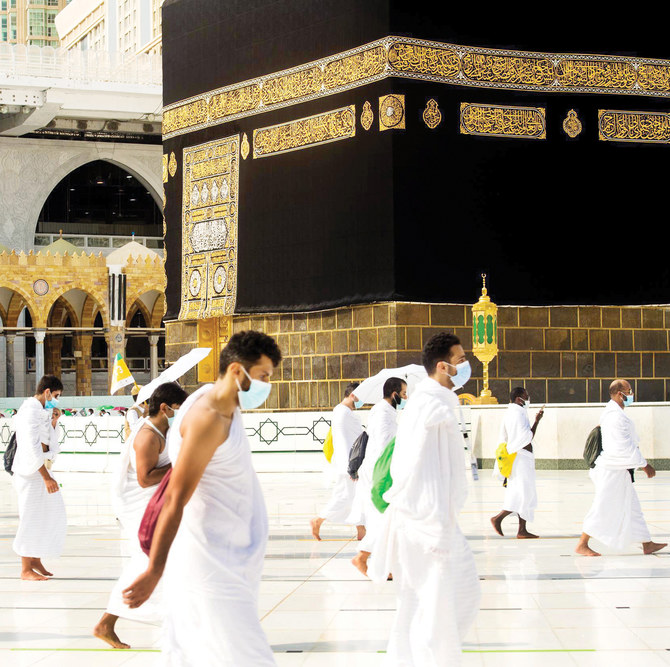
10k foreign pilgrims arrive on first day of Umrah resumption

As per protocol, 500 groups of international pilgrims are dispersed throughout the day, each with 20 pilgrims. (SPA/file)
Short Url
Updated 01 November 2020
Follow

10k foreign pilgrims arrive on first day of Umrah resumption

  • They can stay for up to 10 days, three of which are in isolation

MAKKAH: Some 10,000 international pilgrims are arriving in Saudi Arabia after a seven-month hiatus to perform Umrah and visit the Prophet’s mosque on the first day of the third stage of the resumption of Umrah.

According to Deputy Minister of Hajj and Umrah Dr. Amr Al-Maddah, the 10,000 pilgrims arriving from abroad must first obtain a permit. Upon arrival, pilgrims must isolate for three days before being transported to Miqat sites, principle boundaries at which pilgrims intending to perform Umrah must change into Ihrams.
They can stay in the Kingdom for up to 10 days, three of which are in isolation. As per protocol, 500 groups of international pilgrims are dispersed throughout the day, each with 20 pilgrims. The maximum age limit for international pilgrims is set at 50.
The deputy minister added that countries are subject to continuous evaluation by the Saudi Center for Disease Prevention and Control and the Ministry of Health as part of the government’s approved standards and protocols. Visas for pilgrims arriving from countries that are seeing a noticeable increase in numbers will be placed on hold until further assessment.

FASTFACT

More than 1.4 million are using the Eatmarna app as downloads near 3 million. One million permits have been issued for performing prayers and Umrah.

With the start of the third stage, the holy mosques will be working at 100 percent operation, a pivotal stage for companies in the sector.  Al-Maddah added that if at any stage there is a cause for concern or danger to pilgrims, the ministry will evaluate the situation and return to previous stages and decrease capacity.
Currently, Saudia is the only certified airline allowed to transport pilgrims to and from the Kingdom. Pilgrims arriving from countries from which the carrier does not operate must arrange through a third party, accounted for by the Kingdom.
Pilgrims must have a health guide provided by Umrah companies to monitor each group throughout their visit. Pilgrims must also have full health insurance that includes emergency treatment if infected and a possible PCR test.



Saudi Arabia launches initiative to reroute Gulf cargo to Red Sea ports

Updated 13 March 2026
Follow

Saudi Arabia launches initiative to reroute Gulf cargo to Red Sea ports

  • The initiative comes as shipping through the Strait of Hormuz has been severely disrupted by the widening conflict in the region
  • Since the US and Israel struck Iran last month, Tehran has moved to restrict passage through the waterway


RIYADH: Saudi Arabia has launched an initiative to redirect shipping from ports in the Arabian Gulf to its Red Sea ports amid the ongoing US-Israel-Iran war.

Transport Minister Saleh Al-Jasser, who also chairs the Saudi Ports Authority (Mawani), launched the Logistics Corridors Initiative alongside Zakat, Tax and Customs Authority Governor Suhail Abanmi, Mawani President Suliman Al-Mazroua, and other officials, the Saudi Press Agency reported.

The initiative will establish dedicated operational corridors to receive containers and cargo redirected from ports in the Kingdom's Eastern Region and other Gulf Cooperation Council states to Jeddah Islamic Port and other Red Sea coast ports.

Al-Jasser said the Kingdom was committed to ensuring supply-chain stability and the smooth flow of goods through global trade routes. Jeddah Islamic Port and other west coast ports, he added, were already playing a key role in accommodating shipments redirected from the east, while also linking Gulf cargo to regional and international markets.

The initiative comes as shipping through the Strait of Hormuz has been severely disrupted by the widening conflict in the region. Iran has long threatened to close the strait — the world's most critical oil and gas chokepoint, through which roughly a fifth of global oil supplies pass — in the event of a war.

Since the US and Israel struck Iran last month, Tehran has moved to restrict passage through the waterway, sending freight rates soaring and forcing shipping companies to seek alternative routes.

Saudi Arabia's Red Sea ports offer a viable bypass, connecting Gulf cargo to global markets without passing through the strait.