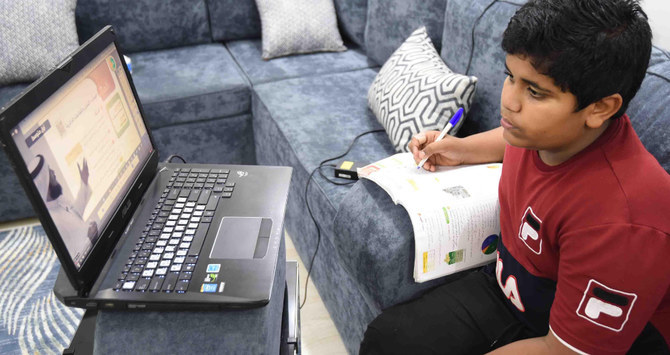
RIYADH: The Saudi Ministry of Education’s online education platform Madrasati is currently hosting over 850,000 virtual classrooms allowing teachers and students from across the Kingdom to interact on a daily basis.
The platform provides students with virtual classes, homework assignment and delivery tools and is used in conjunction with the iEN YouTube channel and the iEN national education portal.
School leaders consistently monitor the educational process via Madrasati, prepare class schedules, communicate with absent students, and provide technical support for students and their parents.

Saudi e-learning platform hosts 850k classes daily
https://arab.news/g3n4s
Saudi e-learning platform hosts 850k classes daily
Saudi Arabia’s KAUST named FIFA’s first research institute in MENA
- KAUST President Prof. Sir Edward Byrne said that the university’s selection as the fifth FIFA Research Institute in the world — and the first in the region — marks a significant achievement, reflecting Kingdom’s growing presence in international football
RIYADH: FIFA has designated the King Abdullah University of Science and Technology as its first research institute in the Middle East and Asia to support the development of innovative football research, the Saudi Press Agency reported on Tuesday.
The recognition highlights KAUST’s commitment to integrating sports, academic research and industry through advanced, high-level initiatives grounded in rigorous scientific methodologies, contributing to the advancement of football studies.
KAUST President Prof. Sir Edward Byrne said that the university’s selection as the fifth FIFA Research Institute in the world — and the first in the region — marks a significant achievement, reflecting Saudi Arabia’s growing presence in international football.
The accreditation aligns with national efforts to invest in research and development and promote the knowledge economy, supporting Saudi Vision 2030’s goals of building an advanced sports system based on innovation and sustainability.
The collaboration’s first project focuses on developing advanced AI algorithms to analyze historical FIFA World Cup broadcast footage, transforming decades of match videos into structured, searchable data, according to the KAUST website.
This work opens new opportunities to apply state-of-the-art computer vision techniques and deepen understanding of how football has evolved over time.
The second project uses player and ball tracking data from the FIFA World Cup 2022 in Qatar and the FIFA Women’s World Cup 2023 in Australia and New Zealand to compile comprehensive datasets capturing in-game dynamics.
These datasets provide deeper insights into human movement, playing techniques and performance dynamics through AI-driven analysis.