

After rare diagnosis, Pakistani top diplomat becomes voice of male breast cancer awareness

1 / 2
A rare male breast cancer survivor turned cancer awareness activist, Aizaz Ahmed Chaudhary, receives a shield from CEO Serena hotels Aziz Boolani in recognition of his services on October 13, 2020. (Photo courtesy: Serena Hotel)
2 / 2
A rare male breast cancer survivor turned cancer awareness activist, Aizaz Ahmed Chaudhary, participates in a special breast cancer awareness talk organized by Raabta in Islamabad on October 13, 2020. (Photo courtesy: Serena hotel)
Short Url
Updated 27 October 2020
Follow

After rare diagnosis, Pakistani top diplomat becomes voice of male breast cancer awareness

  • Former foreign secretary Aizaz Ahmad Chaudhry was diagnosed with male breast cancer in June 2013 and has survived to tell the tale
  • Breast cancer in males constitutes less than one percent cases globally but in Pakistan the figure is above three percent, experts say

ISLAMABAD: In June 2013, diplomat Aizaz Ahmad Chaudhary was about to address a seminar in Islamabad when he got the call he had been expecting, and dreading, for weeks.

“It’s cancer,” the doctor on the other end of the line told Chaudhary, who was then the spokesperson for the foreign office and went on to become foreign secretary, the senior-most diplomat in Pakistan. 

Chaudhry said he delivered the lecture, as planned, and then went to the hospital to receive an unlikely diagnosis: he had breast cancer, an illness that develops in men in less than one percent of all cases.

According to the Pakistan Medical Association, Pakistan has the highest rate of breast cancer in Asia, with approximately 90,000 new cases diagnosed every year, of which 40,000 people die. One out of every nine women in Pakistan are likely to suffer from the illness, but early diagnosis can push survival rates to 90 percent. 

It is for this reason that Chaudhry, now retired and currently serving as director-general of Islamabad’s prestigious Institute of Strategic Studies (ISSI), has become a voice for breast cancer awareness and the need for its early detection and diagnosis. 
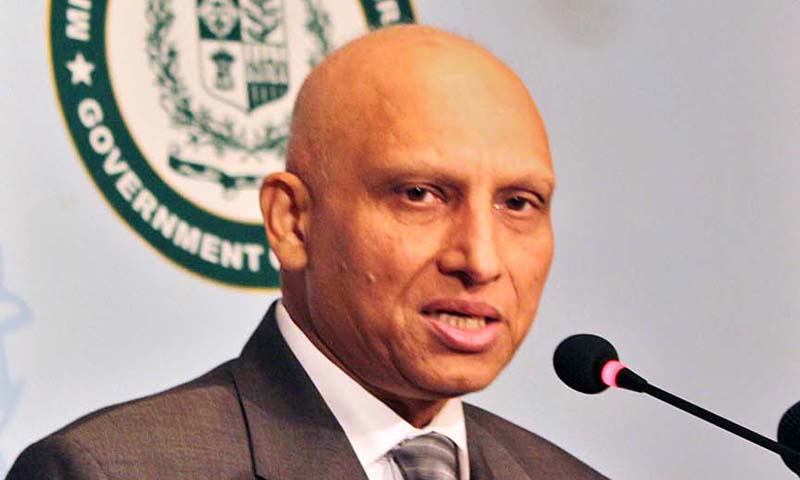


A rare male breast cancer survivor turned cancer awareness activist, Aizaz Ahmed Chaudhary, addresses a news briefing as spokesperson of the foreign ministry in Islamabad on August 20, 2013. (Photo courtesy: Ministry of Foreign Affairs)

“I decided to participate in breast cancer awareness programs as I felt it was my moral duty to tell my fellow citizens that it can be treated and defeated with early detection, courage and determination,” Chaudhry, who served at the foreign office for 37 years, with a final posting as Pakistan’s ambassador to the United States, told Arab News in an interview this week. 

One of his chief concerns is spreading awareness that while breast cancer is more than 100 times more common in women, men can also develop the illness. 

“Anyone can get it and one should not feel shy about it and go for diagnostics if there is any unusual growth,” Chaudhary said, saying the illness was sometimes riskier in men because in the absence of the dense breast tissue that women have, it could quickly spread to the ribs.

Speaking about his journey, the diplomat said he first noticed a small tumor on his left breast in May 2013, which a doctor initially misdiagnosed as an allergy. 

“I went to another doctor who conducted a fine needle test which proved that it was cancer,” Chaudhry said. “This neglect of one month took my cancer from stage one to stage two and had it been a few more months, I may not have survived.”

Chaudhry says he did not take leave throughout this treatment and continued to address press briefings at the foreign office, as its spokesperson. 

He is currently the president of the Patient Welfare Society at the Nuclear Medicine, Oncology and Radiotherapy Institute (NORI), a cancer hospital in the federal capital run by the Pakistan Atomic Energy Commission (PAEC).
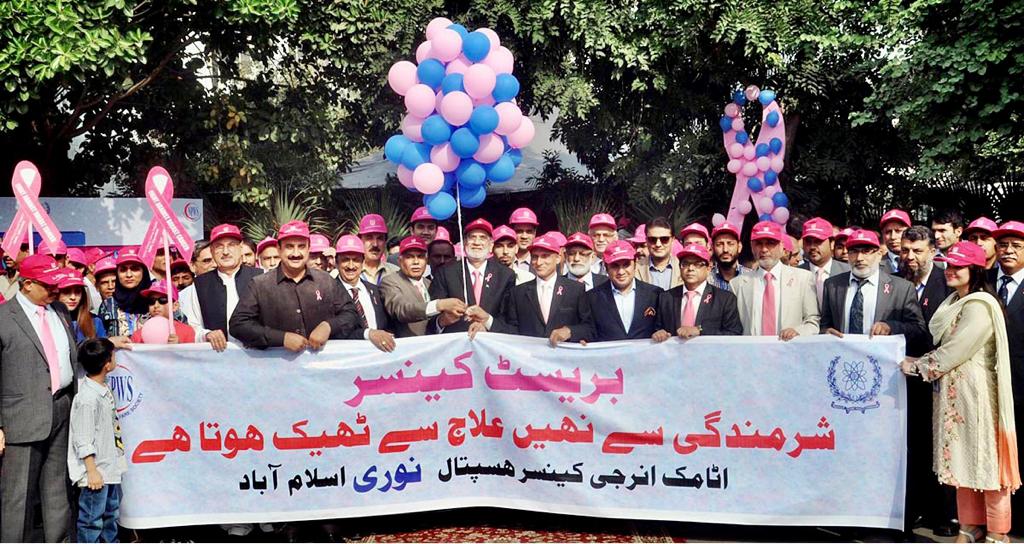


 Aizaz Ahmed Chaudhary, then foreign secretary of Pakistan, participates in a breast cancer awareness walk organized by NORI hospital in Islamabad on October 29, 2016. (Photo courtesy: Online photo by S M Sohail)

“Cancer treatment is very expensive, especially medicines for chemotherapy are really costly,” he said. “Our [NORI] society provides free medicines to needy patients and residence and food to their attendants,” he added, saying building more cancer hospitals was an urgent need in Pakistan. 

Dr. Muhammad Faheem, a director at the NORI hospital, said Chaudhary had taken a lead in gathering donations and working to improve facilities at the hospital. 

“If you look into international statistics, breast cancer in males constitutes less than one percent,” Faheem said. “In Pakistan, this percentage is higher, above three percent.”


IMF warns against policy slippage amid weak recovery as it clears $1.2 billion for Pakistan

Updated 11 December 2025
Follow

IMF warns against policy slippage amid weak recovery as it clears $1.2 billion for Pakistan

  • Pakistan rebuilt reserves, cut its deficit and slowed inflation sharply over the past one year
  • Fund says climate shocks, energy debt, stalled reforms threaten stability despite recent gains

ISLAMABAD: Pakistan’s economic recovery remains fragile despite a year of painful stabilization measures that helped pull the country back from the brink of default, the International Monetary Fund (IMF) warned on Thursday, after it approved a fresh $1.2 billion disbursement under its ongoing loan program.

The approval covers the second review of Pakistan’s Extended Fund Facility (EFF) and the first review of its climate-focused Resilience and Sustainability Facility (RSF), bringing total disbursements since last year to about $3.3 billion.

Pakistan entered the IMF program in September 2024 after years of weak revenues, soaring fiscal deficits, import controls, currency depletion and repeated climate shocks left the economy close to external default. A smaller stopgap arrangement earlier that year helped avert immediate default, but the current 37-month program was designed to restore macroeconomic stability through strict monetary tightening, currency adjustments, subsidy rationalization and aggressive revenue measures.

The IMF’s new review shows that Pakistan has delivered significant gains since then. Growth recovered to 3 percent last year after shrinking the year before. Inflation fell from over 23 percent to low single digits before rising again after this year’s floods. The current account posted its first surplus in 14 years, helped by stronger remittances and a sharp reduction in imports. And the government delivered a primary budget surplus of 1.3 percent of GDP, a key program requirement. Foreign exchange reserves, which had dropped dangerously low in 2023, rose from US$9.4 billion to US$14.5 billion by June.

“Pakistan’s reform implementation under the EFF arrangement has helped preserve macroeconomic stability in the face of several recent shocks,” IMF Deputy Managing Director Nigel Clarke said in a statement after the Board meeting.

But he warned that Islamabad must “maintain prudent policies” and accelerate reforms needed for private-sector-led and sustainable growth.

The Fund noted that the 2025 monsoon floods, affecting nearly seven million people, damaging housing, livestock and key crops, and displacing more than four million, have set back the recovery. The IMF now expects GDP growth in FY26 to be slightly lower and forecasts inflation to rise to 8–10 percent in the coming months as food prices adjust.

The review warns Pakistan against relaxing monetary or fiscal discipline prematurely. It urges the State Bank to keep policy “appropriately tight,” allow exchange-rate flexibility and improve communication. Islamabad must also continue raising revenues, broadening the tax base and protecting social spending, the Fund said.

Despite the progress, Pakistan’s structural weaknesses remain severe.

Power-sector circular debt stands at about $5.7 billion, and gas-sector arrears have climbed to $11.3 billion despite tariff adjustments. Reform of state-owned enterprises has slowed, including delays in privatizing loss-making electricity distributors and Pakistan International Airlines. Key governance and anti-corruption reforms have also been pushed back.

The IMF welcomed Pakistan’s expansion of its flagship Benazir Income Support Program, which raises cash transfers for low-income families and expands coverage, saying social protection is essential as climate shocks intensify. But it warned that high public debt, about 72 percent of GDP, thin external buffers and climate exposure leave the country vulnerable if reform momentum weakens.

The Fund said Pakistan’s challenge now is to convert short-term stabilization into sustained recovery after years of economic volatility, with its ability to maintain discipline, rather than the size of external financing alone, determining the durability of its gains.