ISLAMABAD: Pakistan’s former Prime Minister Nawaz Sharif is all set to address a multi-party opposition rally in Quetta city on Sunday through video link from London, amid a security alert issued by the National Counter Terrorism Authority (NACTA).
Sharif has been in London since November last year for medical treatment after securing an eight-week medical bail from a local court in a corruption case. Khan’s government has in recent weeks been seeking the extradition of Sharif from the UK.
“Nawaz Sharif will be addressing the rally and arrangements for it are being finalized,” Talal Chaudhry, a close aide to the former three-time elected premier and senior member of Pakistan Muslim League-Nawaz (PML-N) party, told Arab News on Saturday.
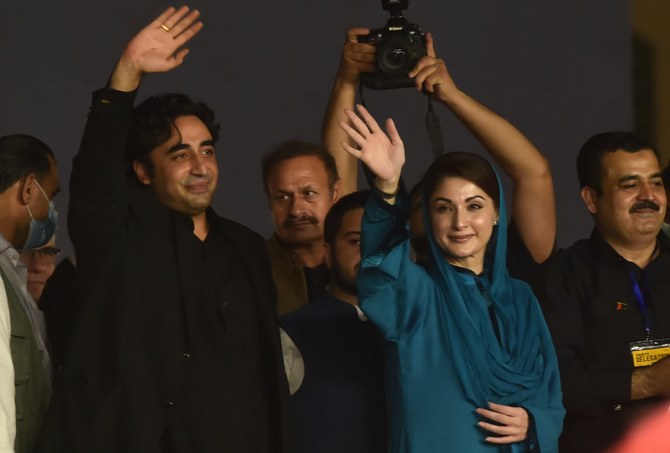
“We have reached Quetta along with Maryam Nawaz and other leaders for the rally,” Chaudhry said. “The enthusiasm and passion of the people is quite high here.”
The country’s 11-opposition party alliance-- the Pakistan Democratic Movement (PDM) – is holding nationwide protest rallies to oust the government of Prime Minister Imran Khan, which they accuse of being a product of rigging in the 2018 general elections. The government denies the charge.
The anti-government movement kicked off with a rally in Gujranwala city on Oct. 16 where, in an unprecedented moment, Sharif named sitting army officers and accused the military establishment of toppling his government, pressuring the judiciary and orchestrating Imran Khan’s rise to power in 2018, the same year Sharif was convicted on corruption charges and sentenced to seven years in prison.
On Friday, in a television interview, Prime Minister Imran Khan said that recent meetings between the army chief and PML-N leaders were ‘a big mistake.’
But Chaudhry said the meetings had been held ‘in the name of Kashmir and Gilgit-Baltistan.’
“If he [Khan] thinks something wrong is done through the meetings, he should initiate action,” he said.
Meanwhile, the Balochistan government flagged Quetta’s security as a concern on Friday after the National Counter Terrorism Authority issued an alert, and urged opposition parties to delay their rally in the “wider interest of the public.”
“When this threat has been eradicated or when the planners and masterminds are arrested ... they (PDM) can hold a rally. This will be better as they will get more time to prepare,” Liaquat Shahwani, the Balochistan government spokesperson, said on Friday in a press conference.
But opposition parties remain adamant to go ahead as per schedule, dismissing the security threat as a political ploy to call off their campaign.
“The government will say this when we are engaged in political activity against it,” Chaudhry Manzoor, a senior Pakistan Peoples Party’s [PPP] leader, told Arab News.
Chaudhry said the burden of responsibility fell on the shoulders of the provincial government.
“It is the responsibility of the government to ensure fool-proof security [of the opposition gathering],” he said. “We can’t delay or suspend our anti-government movement just on the basis of the threats.”
Political analysts say the threat is real and should be taken seriously in restive Balochistan province, where security forces and civilians routinely come under attack by militants.
“There is a potent context to the security alert [to the opposition rally] as our security forces have been under attack in Balochistan and Khyber Pakhtunkhwa, trying to exploit our internal fault lines,” Imtiaz Gul, a political analyst, told Arab News.
“Whenever there is a meeting like this, it also serves as a fault line which can be easily attacked,” he warned.


![]()

Quetta: Opposition holds third protest today asking for government to go
Short Url
https://arab.news/2agyz
Quetta: Opposition holds third protest today asking for government to go
- Shrugging off security threats, the top leadership of Sharif’s party has reached the restive Balochistan capital
- PM should ‘initiate action’ if he thinks something wrong was said in meetings between COAS and PML-N, says Talal Chaudhry
Latest updates


© 2026 SAUDI RESEARCH & PUBLISHING COMPANY, All Rights Reserved And subject to Terms of Use Agreement.