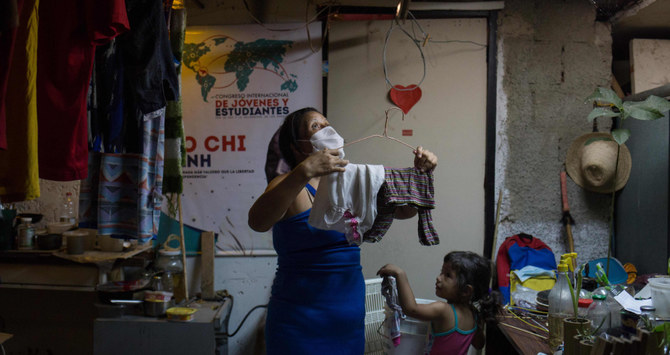
CARACAS: Sunlight cannot penetrate, the air is fetid and fellow residents include rats and cockroaches — but that’s how 14 families are “dying slowly” in government accommodation in Venezuela’s capital Caracas.
They live on the ground floor of a ministry building a stone’s throw from the Miraflores presidential palace.
“Here, we’re dying slowly. It’s shameful that humans” have to live this way, resident Johan Medina told AFP, as his skinny arms rested on the wheelchair he’s used since an accident seven years ago damaged his spine.
There are hundreds of families living in state-supplied shelters in crisis-wracked Venezuela.
Many lost their homes to flood damage, although six years of economic meltdown under President Nicolas Maduro has also left millions in abject poverty, while basic services have been paralyzed.
They’re hoping for state aid from the socialist government that boasts of having delivered three million homes since launching a massive housing plan in 2011 under the late president Hugo Chavez — figures disputed by the opposition.
At the entrance to the building that houses the women’s ministry, among other state institutions, there are pictures of Chavez and his successor Maduro.
Signs on the walls read: “No more Trump,” and “Vote Chavez.”
With no services such as running water, residents like Medina are particularly vulnerable to the coronavirus pandemic — but that’s the least of the 31-year-old’s worries.
“Why bother using a mask?” he said bitterly, pointing to filth and stagnant water around him.
It’s mandatory to wear face masks in the country of 30 million that has registered 86,000 cases and 736 deaths, according to official figures.
The first residents were brought to the ministry building by a socialist organization called the Popular Organized Anti-Corruption Interpellation that has an agreement allowing it to use state facilities for free.
The group, which did not reply to AFP requests for comment, organizes assemblies and then puts up participants that have come from afar for the night on mats.
At some point, “people started living” there after being told they would be rehoused, said Norelis, a 40-year-old teacher living with her daughter.
Conditions worsened, and now “it’s like a sewer;” but Norelis, who declined to give her surname, still hopes to be moved to “a dignified site.”
Government officials come and go in the 11-story building constructed in 1956.
“They pass in front of your face all day long,” said Medina, who arrived five years ago after a friend told him he could get help there.
He was run over by a motorcycle in April 2013 just hours after voting in Maduro’s first presidential election.
With no alternative housing options materializing, Medina and Norelis fear they will be turned out onto the streets. Their accommodation was never meant to be permanent.
“We feel marginalized,” said Norelis.
Lacking ventilation, the building can provoke respiratory problems among inhabitants.
“My daughter completely lost her sense of smell about a year ago,” Carla, who declined to give her full name, told AFP.
“We live in a room that was meant to be a bathroom. When the plumbing is flushed, imagine the smell,” added the agroecology expert, who currently works as a waitress.
She’s put up blinds and mosquito nets to try to keep out the cockroaches. She also has to deal with rats.
Carlos, who has lived in the shelter the longest, insists that everyone there is waiting to be rehoused as part of the “Housing Mission” launched almost a decade ago.
A strict curfew is imposed by authorities.
“At 7:00 p.m. they close it up with a padlock and if you’re outside, you stay outside. At 6:00 am, they reopen,” said Carlos, 49, who also withheld his surname.
“It’s like a day release prison.”


Venezuelans ‘dying slowly’ in rat- and roach-infested homes
https://arab.news/9c9wd
Venezuelans ‘dying slowly’ in rat- and roach-infested homes



Trump’s Iran war violates international law, experts say
- Mary Ellen O’Connell, a professor at the University of Notre Dame, said the attack on Iran “had no justification under international law“
- “The US probably could have prevented any Israeli attack on Iran by virtue of the leverage afforded by critical US military support,” said Finucane
WASHINGTON: The United States insists it attacked Iran to curb “direct threats” from the Islamic republic, but legal experts say the dangers cited by Washington do not justify war under international law.
US and Israeli forces launched a massive air campaign against Iran on February 28, with Washington saying it aimed to curb nuclear and missile threats from Tehran. Yet the war has also decapitated the country’s government, and President Donald Trump is now demanding “unconditional surrender.”
The White House laid out Washington’s justification for the war during a news conference this week.
“This decision to launch this operation was based on a cumulative effect of various direct threats that Iran posed to the United States of America, and the president’s feeling, based on fact, that Iran does pose (an) imminent and direct threat,” Press Secretary Karoline Leavitt said Wednesday.
She went on to cite Iranian sponsorship of “terrorism,” its ballistic missile program and its alleged efforts to “create nuclear weapons and nuclear bombs.”
But Mary Ellen O’Connell, a professor at the University of Notre Dame, said the attack on Iran “had no justification under international law.”
“The law is clear that international disputes are to be resolved using peaceful means — negotiation, mediation, the intervention of international organizations,” said O’Connell, an expert in international law on the use of force and international legal theory.
The Trump administration has offered “vague mentions of imminent attacks by Iran and to prevent Iran from acquiring a nuclear weapon,” while the UN Charter “requires, at the least, that evidence of a significant attack by Iran be underway,” she said.
- ‘Even less plausible’ -
“No shred of such evidence has been provided. Nor is there any right whatsoever to start a war over a weapons program.”
While Leavitt cited threats from missiles and militants, US Secretary of State Marco Rubio offered a different justification for the war earlier in the week: fears that an Israeli attack would trigger reprisals against US forces.
Brian Finucane, senior adviser for the International Crisis Group’s US Program, said there were several issues with Rubio’s explanation, including that the Trump administration has since offered other rationales for the war.
“The US probably could have prevented any Israeli attack on Iran by virtue of the leverage afforded by critical US military support,” said Finucane, who previously worked in the Office of the Legal Adviser at the US Department of State.
The Iran war is not the only legally dubious military intervention by the Trump administration.
In early September, the United States began carrying out strikes on alleged drug-smuggling boats in the Caribbean and later the eastern Pacific — a campaign that has killed more than 150 people.
The US government has yet to provide definitive evidence that the vessels it targets are involved in drug trafficking, and legal experts and rights groups say the strikes likely amount to extrajudicial killings.
Trump also ordered strikes on Iranian nuclear sites last year, and sent US forces into Caracas in early January to seize leftist Venezuelan leader Nicolas Maduro, who is now on trial in the United States.
Finucane said Trump’s Friday demand for “unconditional surrender” by Iran “further undercuts prior justifications for US military action.”
“The administration has not even bothered to argue that Operation Epic Fury complies with international law, but certainly statements like this make any such argument even less plausible,” he said, referring to the Iran operation.


