

A ‘Saad’ day for Lebanon: Hariri’s fourth term as PM met with skepticism

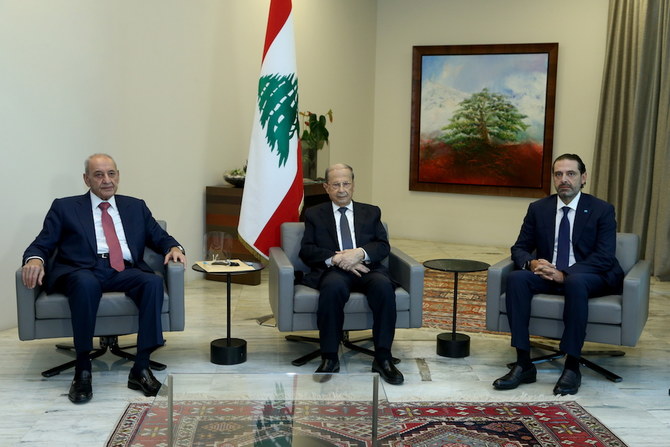
Berri, Aoun, and Hariri pose for a familiar picture as Hariri is named as the next prime minister. The decision angered Lebanese desperate to see new faces at the top. (AFP)
Short Url
Updated 22 October 2020
Follow

A ‘Saad’ day for Lebanon: Hariri’s fourth term as PM met with skepticism

  • Lebanese voice their anger at the return of the Future movement leader
  • Appointment shows calls for radical change in governance have gone unheard

BEIRUT: The decision to name Saad Hariri as Lebanon’s next prime minister on Thursday was met with anger, derision and ridicule from jaded Lebanese.

Hariri will hold the position for the fourth time despite months of widespread protests calling for a radical change to how the country is governed.

The massive August explosion in Beirut, which was blamed on corruption among officials, added to the anger towards Lebanon’s ruling class - a patchwork of sectarian, dynastic fiefdoms.

However, it appears the weeks of wrangling to find a new government after the previous one stood down in the aftermath of the blast has not produced the sea change many in the country had hoped for. 

Opinion

This section contains relevant reference points, placed in (Opinion field)

The sight of Hariri, who leads the Sunni Future movement, sitting grim-faced next to 85-year-old President Michel Aoun and the Hezbollah aligned parliament speaker Nabih Berri, did little to bring hope to Lebanese suffering under a dire economic meltdown.

“Hariri’s return as PM is a serious slap in the face to all victims of Aug. 4,” Fatima Al-Mahmoud, a freelance journalist, wrote on Twitter in reference to the explosion that killed almost 200 people.

“Their blood has gone in vain and no one will pay the price.”


Myriam Sassine, a Beirut-based film producer, said Hariri’s return showed there is nothing but “disappointment and heartbreak” in Lebanon.

“A year after October’s revolution and the resignation of Saad Hariri, Saad Hariri comes back as PM and savior,” she said. “The only change that happened is that we got robbed, violated and murdered while they're stronger than ever.”


Even the UN’s Special Coordinator for Lebanon Jan Kubis expressed his disappointment at the move.

He said the decision to bring back Hariri was taken by the country’s traditional political forces “regardless of their numerous failures in the past and deep skepticism about the future.”

“It is up to them to help Hariri, the designated PM rapidly create an empowered, action-oriented government, to start delivering the well-known reforms. Do not count on miracles, foreign elections or external donors – the rescue must start in Lebanon, by Lebanon,” Kubis said.


Amid the anger there was also ridicule, as many took to social media to mock Hariri’s return.

“Hariri is like every ex that cheats on you and then cries for a second chance,” wrote one Twitter user.

Others played a game of “spot the difference” with the official photo released today of Hariri, Aoun and Berri, compared to the images used during his previous appointments.


Hariri, 50, stepped down as prime minister almost a year ago as anti-government protests against economic conditions and calling for an overhaul of the system of government raged across the country.

Hariri was replaced by Hassan Diab, whose ineffectual tenure came to an end days after the explosion. The relatively unknown Mustapha Adib lasted for just a month after he took the position from Diab.

The pressure on Lebanon’s leaders has not just come from within. French President Emmanuel Macron set a series of conditions to make sure any new government enacted reforms to stop Lebanon’s slide to financial ruin.

Hariri was returned to the post after he secured the backing of a majority of MPs.

He said he would form a cabinet of “non politically aligned experts with the mission of economic, financial and administrative reforms contained in the French initiative roadmap.”


Gaza’s Nasser Hospital condemns move by MSF to suspend most services

Updated 16 sec ago
Follow

Gaza’s Nasser Hospital condemns move by MSF to suspend most services

  • On Saturday, MSF said the security breaches, arrests and intimidation put staff and patients at serious risk
  • Nasser Hospital rejects the claims, and says civilian police are inside to protect patients and staff
CAIRO: One of Gaza’s last functioning large hospitals condemned the move by an international organization to pull out of operations over concerns about armed men, claiming on Sunday that the hospital had installed civil police for security. The move comes as at least 10 Palestinians were killed in clashes with the Israeli military in Gaza.
Doctors Without Borders, also known by its acronym MSF, said in a statement Saturday that all its noncritical medical operations at Nasser Hospital were suspended due to security breaches that posed “serious” threats to its teams and patients. MSF said there had been an increase in patients and staff seeing armed men in parts of the compound since the US-brokered October ceasefire was reached.
Nasser Hospital said Sunday that the increase in armed men was due to a civilian police presence aimed at protecting patients and staff and said MSF’s “allegations are factually incorrect, irresponsible, and pose a serious risk to a protected civilian medical facility.”
Nasser Hospital one of few functioning hospitals left in Gaza
Nasser Hospital in Khan Younis is one of the territory’s few functioning hospitals. Hundreds of patients and war-wounded have been treated there daily, and the facility was a hub for Palestinian prisoners released by Israel in exchange for Israeli hostages as part of the current ceasefire deal.
“MSF teams have reported a pattern of unacceptable acts including the presence of armed men, intimidation, arbitrary arrests of patients and a recent situation of suspicion of movement of weapons,” the organization said. The suspension occurred in January but was only recently announced.
Nasser Hospital staff say that in recent months it has been repeatedly attacked by masked, armed men and militias, which is why the presence of an armed civilian police force is crucial. Hamas remains the dominant force in areas not under Israeli control, including in the area where Nasser Hospital is located. But other armed groups have mushroomed across Gaza as a result of the war, including groups backed by Israel’s army in the Israeli-controlled part of the strip.
Throughout the war, which began with the Hamas-led attack on Israel on Oct. 7, 2023, Israel has repeatedly struck hospitals, including Nasser, accusing the militant group of operating in or around them. Hamas security men often have been seen inside hospitals, blocking access to some areas.
Some hostages released from Gaza have said they spent time during captivity in a hospital, including Nasser Hospital.
Ten Palestinians killed in strikes across Gaza
At least 10 Palestinians were killed Sunday by Israeli fire in the Gaza Strip, hospital authorities said.
The dead include five men, all in their 20s, who were killed in an Israeli strike in the eastern part of Khan Younis city, according to the Nasser Hospital, which received the bodies. The strike hit a group of people in an area close to the Yellow Line which separates Israeli-controlled areas from the rest of Gaza, it said.
The Israeli military did not comment on the strike but has said in the past it will attack militants if its troops are threatened, especially near the Yellow Line.
Rami Shaqra said his son, Al-Baraa, was among the militants who were securing the area from potential attacks by the Israeli forces or Israeli-backed armed groups, when they were hit by the Israeli military. He said that they were killed by an airstrike.
Associated Press footage from the morgue showed at least two of the men had headbands denoting membership in the Qassam Brigades, the militant arm of Hamas. In northern Gaza, a drone strike hit a group of people in the Falluja area of Jabaliya refugee camp, killing five people, according to the Shifa Hospital.
The Israeli military said it was striking northern Gaza in response to several ceasefire violations near the Yellow Line, including militants attempting to hide in debris and others who attempted to cross the line while armed.
The Oct. 10 US-brokered ceasefire deal attempted to halt a more than two-year war between Israel and Hamas. While the heaviest fighting has subsided, the ceasefire has seen almost daily Israeli fire.
Israeli forces have carried out repeated airstrikes and frequently fire on Palestinians near military-held zones, killing 601 Palestinians, according to Gaza health officials. The ministry, which is part of the Hamas-led government, maintains detailed casualty records that are seen as generally reliable by UN agencies and independent experts. But it does not give a breakdown of civilians and militants.
Militants have carried out shooting attacks on troops, and Israel says its strikes are in response to that and other violations. Four Israeli soldiers have been killed.