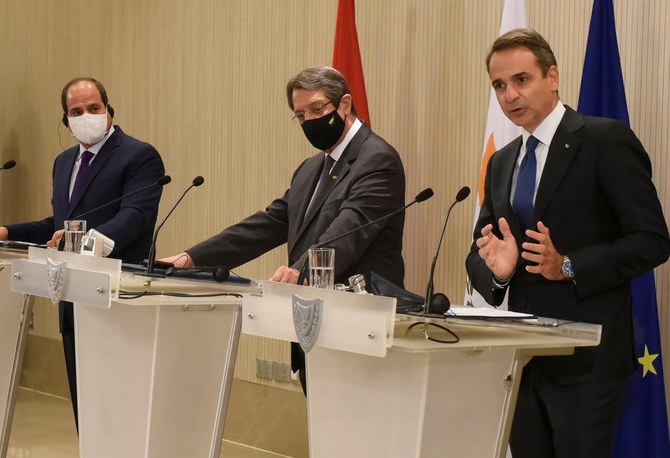
NICOSIA: Greece’s Prime Minister Kyriakos Mitsotakis accused Turkey of “imperialist fantasies” in the eastern Mediterranean during a meeting on Wednesday with the leaders of Cyprus and Egypt.
Mitsotakis said Turkey had been using “extreme rhetoric” and taking unilateral actions while ignoring international order as well as appeals for dialogue from the European Union, Russia and the United States.
The Greek leader said Turkey had been entertaining “imperialist fantasies with aggressive actions from Syria to Libya, from Somalia to Cyprus and the Aegean to the Caucasus.”
Mitsotakis made the remarks at a trilateral meeting in Nicosia with Cyprus President Nicos Anastasiades and Egyptian President Abdel Fattah El-Sisi.
In a joint statement, the three leaders “condemned Turkey’s actions in Varosha” in violation of UN Security Council resolutions on the former Cyprus seaside resort.
The breakaway Turkish Republic of Northern Cyprus earlier this month reopened Varosha, which Greek Cyriot residents abandoned during the Turkish invasion and occupation of the island’s northern third in 1974.
Cyprus, Egypt and Greece also denounced Turkey’s “unilateral provocations” over energy exploration in disputed waters of the eastern Mediterranean and its role in war-torn Libya and Syria.
Mitsotakis said such actions involved “drawing arbitrary maps or signing invalid memoranda” as in the case of Libya.
The three countries hold regular summits as part of their closer energy cooperation as they seek to create a regional energy hub, along with Israel, supplying gas to Europe.
“Our meeting today takes place at a particularly difficult time for the Middle East and the eastern Mediterranean,” Anastasiades told reporters.
“Turkey is constantly escalating tensions and undermining regional stability... Turkey is violating the sovereign rights of Cyprus and Greece,” he said.
The situation was compounded last November when Turkey and Libya’s UN-recognized government signed an accord on maritime boundaries.
Greece, Cyprus and Egypt denounced the agreement as “illegal” for infringing on their economic rights in the gas-rich Mediterranean Sea.
It prompted Egypt and Greece to sign a maritime demarcation deal in August.
El-Sisi on Wednesday praised the agreement with Greece as an example of what could be achieved when “international law and institutions were respected.”
Turkish President Recep Tayyip Erdogan has dismissed the Egypt-Greece agreement as worthless and vowed to keep in place his disputed pact with the Tripoli government.
He has also vowed to continue Turkey’s search for oil and gas in the eastern Mediterranean.
The row over gas exploration in the eastern Mediterranean saw NATO allies Greece and Turkey stage rival military drills in August.
At a summit this month, the European Union threatened sanctions if Turkey failed to stop what the bloc says is illegal drilling and energy exploration activities in waters claimed by Cyprus and Greece.


![]()

Greece accuses Turkey of ‘imperialist fantasies’
Short Url
https://arab.news/m8h9c
Greece accuses Turkey of ‘imperialist fantasies’
- Mitsotakis said Turkey had been entertaining ‘imperialist fantasies with aggressive actions from Syria to Libya, from Somalia to Cyprus and the Aegean to the Caucasus’
- The three leaders ‘condemned Turkey’s actions in Varosha’ in violation of UN Security Council resolutions on the former Cyprus seaside resort


Latest updates



© 2026 SAUDI RESEARCH & PUBLISHING COMPANY, All Rights Reserved And subject to Terms of Use Agreement.