

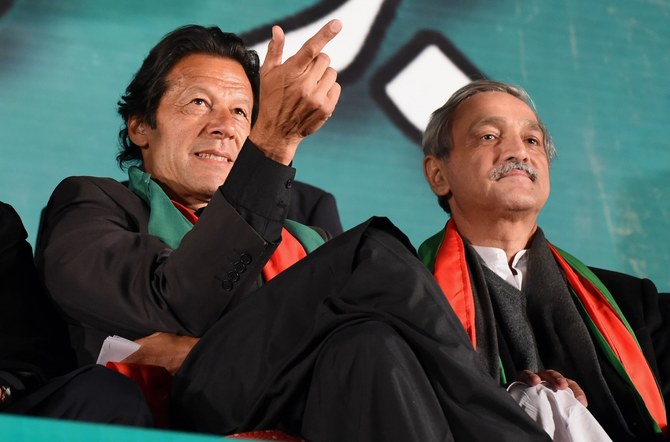

ISLAMABAD: For nearly a decade, of all the friends and confidants in Prime Minister Imran Khan’s inner circle, sugar baron Jahangir Khan Tareen was his closest.
Today, Tareen and Khan are no longer even on talking terms, officials close to both say, as the wealthy businessman and one of the largest sugar producers in Pakistan ponders his political future at a farmhouse outside London.
There is no doubt he is in self-imposed exile, indefinitely.
Tareen left for London in June this year amid a high-profile investigation into a sugar case that accuses him of being one of the major beneficiaries of government subsidies on sugar exports and of profiting from increasing prices in the local market.
PM Khan, who in the past had stood by Tareen even when he was barred by the country’s top court from holding public office over corruption allegations, has pushed for an investigation into the scam.
After that, said Ishaq Khan Khakwani, a senior member of the ruling Pakistan Tehreek-i-Insaf party, things got “personal” for Tareen.
But relations between the two leaders began to go sour much before the sugar scam — perhaps just a few months after Imran Khan took oath as prime minister in 2018.
“When people form governments, there is a lot of palace intrigue,” said Khakwani. “Everyone wants the ear of the ruler. Thus, a tussle begins.”
The first major tussle, it seems, was over an IMF bailout.
Khan inherited an economy in shambles when he came to power, with major financing gaps, a large fiscal and current account deficit, a low level of reserves and an overvalued currency.
Seeking a bailout from the IMF seemed to be the only solution, and one that Tareen supported. But finance minister at the time, Asad Umar, was opposed to the idea, Khakwani said.
Lengthy negotiations with the IMF kicked off and dragged on, with no agreement in sight when in April 2019, Umar, himself a close aide to the PM, was replaced as the finance minister in a surprise move. Insiders in the PTI say Umar’s tough talking with the IMF had put Tareen and other wealthy business owners at unease, afraid he would not be able to get the right deal to shore up the economy.
With Umar gone, the IMF approved a three-year, $6 billion loan a few months later, in July.
In an interview to Voice of America, science minister and close PM aide Chaudhry Fawad Hussain claimed it was indeed Tareen who had Umar removed from the finance ministry portfolio. When Umar returned to the cabinet in November as planning minister, Hussain said, the former finance chief launched his own efforts to have Tareen ousted from Khan’s inner circle.
“When Umar returned [to the cabinet],” the minister said, “he put in a lot of effort and had Tareen removed.”
Umar and Tareen did not respond to repeated requests for comment.
The final straw came when the sugar scam broke, and Khan personally pushed for a probe, and many government officials began to publicly distance themselves from Tareen.
“An inquiry is okay if it probes all 88 sugar mills in the country,” Khakwani said. “But only Tareen’s office was raided. His staff was humiliated.”
Come 2020, the wealthy businessman was seen as a liability that would hurt the PTI’s anti-corruption mantra and thus he was cast out of the prime minister’s palace, analysts say.
“It [the sugar report] was the government’s first major scandal where the government was accused of wrongdoing, in which those connected to the government were seen to have benefited,” political talk show host Arifa Noor said. “So the prime minister was criticized for his government being guilty of financial impropriety.”
Hamid Khan, a founding member of the PTI and a senior lawyer who is now largely estranged from PM Khan, said the PTI leader should have distanced himself from Tareen much sooner:
First, when an internal party report in 2015 demanded that Tareen be stripped of his post as PTI general secretary over his alleged role in rigging intra-party polls; and second, in 2018, when the Supreme Court declared Tareen “dishonest” and barred him from holding public office over corruption allegations.
But both times, Khan stood by Tareen.
“He always protected him,” Hamid Khan told Arab News. “Back in 2015, Khan told a gathering of the party that he cannot leave these people.”


