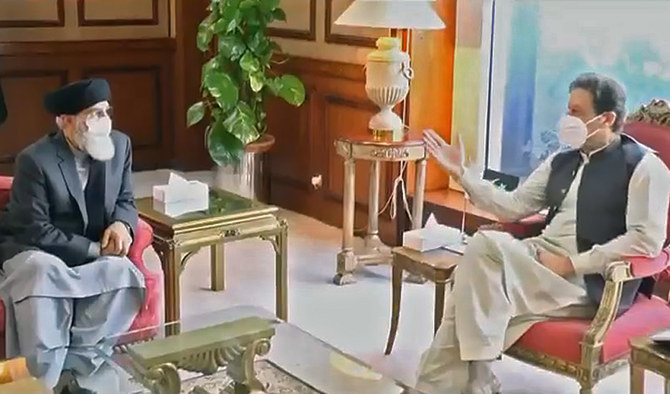
ISLAMABAD: Prime Minister Imran Khan on Tuesday expressed his best wishes for the successful outcome of the Afghan peace process during his meeting with Gulbuddin Hekmatyar, an Afghan politician and leader of the Hizb-e-Islami faction, while pointing out that Pakistan had the highest stake in the region’s peace and stability, a statement released by the foreign office said.
Hekmatyar twice served as Afghanistan’s prime minister in the 1990’s, and is on a three-day visit to Pakistan where he has met high-profile government functionaries.
Khan underscored the “historic bonds of friendship and brotherhood” between the two neighboring countries and reaffirmed his country’s resolve to foster closer cooperation with Afghanistan.
“The Prime Minister noted that Intra-Afghan Negotiations provided a historic opportunity for the Afghan leadership to establish lasting peace,” said the official handout. “Underlining the positive contribution made by Pakistan in facilitating the Afghan peace process, the Prime Minister hoped that the Afghan parties would work to secure an inclusive, broad-based and comprehensive political settlement.”
The Hizb-e-Islami chief’s visit comes nearly three weeks after a high-profile Afghan official, Abdullah Abdhullah, undertook an official trip to Islamabad.
Khan warned Hekmatyar against the “damaging role of ‘spoilers’, within and outside Afghanistan,” said the statement.
The prime minister also “reaffirmed Pakistan's full support for Afghanistan on the path of reconstruction and economic development and dignified return of Afghan refugees.”
He added that his country would continue to facilitate “people-to-people exchanges, promote Afghan investments, and enhance programs for human resource development and capacity-building of Afghans, especially in the education and health sectors.”
The Afghan politician appreciated Islamabad’s positive role in facilitating the Afghan peace process, said the official statement, adding that he thanked Pakistan for its contribution to Afghanistan's socio-economic development and hosting millions of refugees for over four decades.


Pakistan has high stakes in regional peace and stability, PM Khan tells Afghanistan’s Hekmatyar
https://arab.news/vwnf6
Pakistan has high stakes in regional peace and stability, PM Khan tells Afghanistan’s Hekmatyar

- Says his country hopes for an inclusive, broad-based and comprehensive political settlement in Afghanistan
- Warns the visiting Afghan dignitary against the damaging role of ‘spoilers’ both within and outside the wartorn country
Pakistan law minister urges media caution on foreign policy debate amid Middle East tensions
- Azam Nazeer Tarar says constitutional limits must be respected when discussing diplomatic matters
- He says people can express themselves but sensitive external issues fall outside freedom of expression
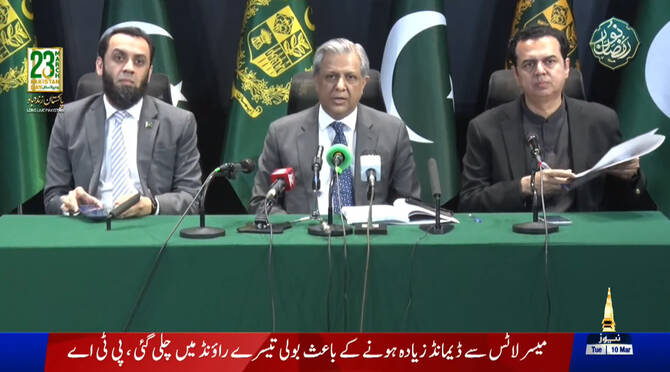
ISLAMABAD: Federal Minister for Law and Justice Azam Nazeer Tarar urged journalists on Tuesday to exercise caution when discussing the country’s foreign policy, saying constitutional limits must be respected as regional tensions rise following the escalating conflict in the Middle East.
Tarar said citizens have the right to receive accurate information and express their views, but warned that public debate on sensitive diplomatic matters could cross constitutional boundaries and trigger legal consequences.
His remarks come as tensions in the Gulf have intensified after coordinated strikes by the United States and Israel against Iran on Feb. 28, followed by retaliatory Iranian attacks targeting American bases and infrastructure in several Arab states.
The crisis has complicated diplomatic balancing for countries such as Pakistan that maintain ties across the region.
“Journalism is such a profession, and particularly given the way information flows today, it is the right of every person living in Pakistan that correct information should reach them, and every individual also has the right to express what is in their heart,” Tarar told the media.
“However, we cannot ignore constitutional limits and restrictions,” he said, adding that criticism often arises when authorities register criminal cases or initiate prosecution after those limits were crossed.
The minister said debate that frames Pakistan’s foreign policy choices in binary terms — such as whether the country stands with Iran or Gulf states — risks undermining delicate diplomatic relations.
He maintained even the Constitution of Pakistan does not permit people to casually comment on such issues, adding that the public should trust the state in managing these matters.
“Your constitution, which is the fundamental document and the social contract with the state, the agreement between the state and its citizens about how life is to be conducted here, also obliges you to exercise great caution in such discussions and commentary, as they do not fall within the bounds of freedom of expression,” he said.
The remarks come amid debate in the country about limits of online free speech, as authorities frequently invoked the Prevention of Electronic Crimes Act (PECA) to pursue cases related to digital content.
Critics say the law has been used to curb dissent and intimidate journalists and activists, while the government maintains it is necessary to combat misinformation, cybercrime and threats to national security.
Tarar said legal action should not automatically be viewed as excessive if authorities enforce constitutional limits.
“Every profession also has a basic responsibility to conduct itself within the limits of the law,” he added.


