

Saudi Arabia reopens Rawdah for worshippers at Prophet’s Mosque

1 / 4
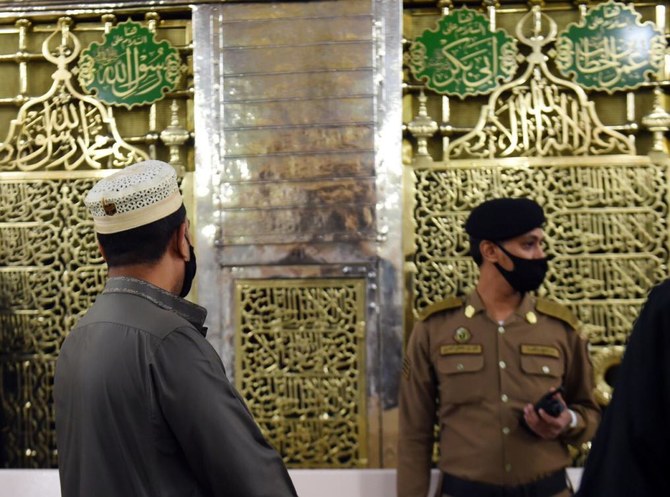
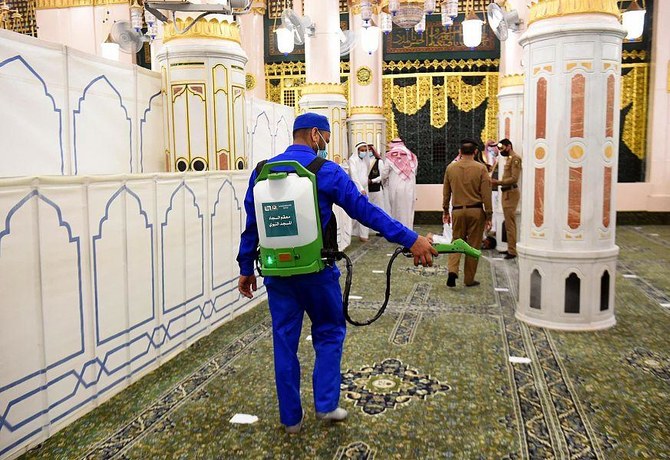
Saudi Arabia reopened the Rawdah in the Prophet’s Mosque on Sunday to the public following a closure to curb the spread of COVID-19. (SPA)
2 / 4
Saudi Arabia reopened the Rawdah in the Prophet’s Mosque on Sunday to the public following a closure to curb the spread of COVID-19. (SPA)
3 / 4
Saudi Arabia reopened the Rawdah in the Prophet’s Mosque on Sunday to the public following a closure to curb the spread of COVID-19. (SPA)
4 / 4
Saudi Arabia reopened the Rawdah in the Prophet’s Mosque on Sunday to the public following a closure to curb the spread of COVID-19. (SPA)
Short Url
Updated 19 October 2020
Follow

Saudi Arabia reopens Rawdah for worshippers at Prophet’s Mosque

  • Worshippers will also be able to pay their respects to the Prophet and his two companions at the Sacred Chamber
  • Men can visit the Rawdah after the first four prayers of whilst women can visit between sunrise and midday

JEDDAH: At dawn on Sunday, worshippers returned to visit and pray at the Holy Rawdah at the Prophet’s Mosque in Madinah for the first time in almost seven months. The holy place, the full name of which is Al-Rawdah Al-Sharifa (The Exalted Garden), was closed due to the COVID-19 outbreak in the Kingdom in March. Although the Prophet’s Mosque opened its doors to receive prayers in June, a ban on access to the Rawdah remained in place.
The Holy Rawdah lies between the Sacred Chamber (known as the Prophet’s house), and the Prophet’s Minbar (or pulpit). This southeastern section of the Prophet’s Mosque is where his house once stood, where he lived with his wife Aisha bint Abu Bakr and is buried. It is of extremely great religious value to Muslims. “Between my house and my pulpit lies a garden from the gardens of Paradise,” says a Hadith from Bukhari.
Worshippers were emotionally moved at being able to pray in the Holy Rawdah and to pay tribute to the Prophet (PBUH) and to his two companions, Abu Bakr Siddiq and Omar ibn Al-Khattab at their graves.
“I was blessed to be among the first group of female visitors to Rawdah on the first morning of Rabi Al-Awwal month,” Hanan Al-Jihani, 39, told Arab News. “It is an extraordinary experience on an exceptional day.”
Al-Jihani was able to book her slot through the Eatmarna app launched earlier last month. “They first made sure that my visit barcode was right and checked my body temperature, then we waited for a few minutes before we were allowed to enter Rawdah,” she added.
Al-Jihani recalled the warm welcome of female employees and the smell of Bakhour (incense) in the air across the mosque. “We ask God for help and success for the government and all security staff, employees, workers and volunteers serving the Holy Prophet’s Mosque.”
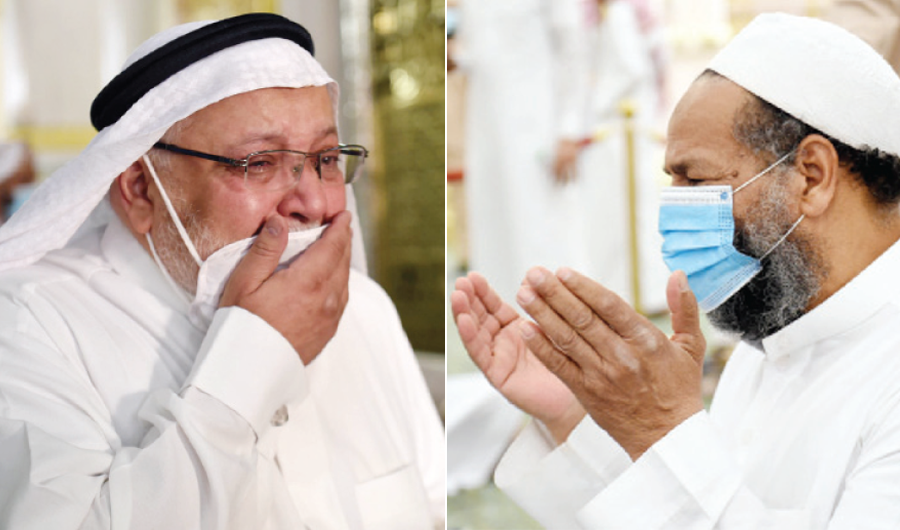

Eman Mahmoud, from Jeddah, said, “It is definitely a blessed day at the beginning of a blessed month when the Prophet, peace be upon him, was born. I couldn’t have been happier when I heard that we could finally visit the sacred chamber and greet our prophet, praise be to god,” she said.
The 50-year-old, who is a frequent visitor to Madinah and the Prophet’s Mosque, said that the past months have been difficult for everyone, “I cannot express how much I miss the old days at the Prophet’s Mosque. I hope the crisis ends soon and all Muslims can enjoy their heart-purifying spiritual experience at the mosque.”
The prophet was born on the 12th day of the Islamic month of Rabi Al-Awwal, which started on Sunday. Most Muslims around the world consider this month a blessed one and celebrate the Prophet’s birthday with various religious traditions.
Visits are based according to the restricted capacity of the Rawdah. Worshippers can apply for a permit through the Eatmarna app, where they are offered the option to pray in the Prophet’s Mosque, pray in Rawdah, or greet the Prophet.
Quba Mosque was also opened on Sunday at dawn prayers. “The mosque will be open from Fajr to Isha prayers while maintaining all precautionary measures,” said Wajab Al-Otaibi, general director of the Ministry of Islamic Affairs branch in Madinah.
“Last year, King Salman directed the opening of Quba Mosque 24 hours a day, but during the pandemic, the mosques were closed. Now, as we reopen the mosques, Quba will only receive visitors within the approved time, which is the five prayers and the times in between,” he said.
Worshipers should bring their own praying mats with them, Al-Otaibi added.
Quba Mosque, which lies to the south of Madinah, is the second most prestigious mosque in the city after the Prophet’s Mosque, but is the most important for having been built in the first year of the Islamic calendar.
The General Presidency of the Grand Mosque and the Prophet’s Mosque, in collaboration with the Ministry of Hajj and Umrah, the Ministry of Health and a number of security agencies, have made all preparations to serve the visitors and worshippers according to COVID-19 preventive measures.
Machinery haS been installed to sanitize the halls, floors, carpets, and Mosque gates with environmentally friendly materials.
The General Syndicate of Cars is providing buses to transport visitors and worshippers between parking lots allocated to them and the Grand Mosque.
Furthermore, 531 Umrah companies are getting ready to receive visitors from abroad in the third step in the phased restoration of Umrah services on Nov. 1.
Hani Al-Omairi, a member of the National Committee for Hajj and Umrah and of the Hotels Committee in Makkah, said that Umrah companies had organized specialized workshops to train their employees on how to act in crisis situations, crowd management, receiving visitors, at the airport and in hotels, supervising their entrance into the Grand Mosque, and taking appointments via the Eatmarna app.


National program identifies 165 native plants for afforestation efforts in Asir

Updated 29 December 2025
Follow

National program identifies 165 native plants for afforestation efforts in Asir

  • The survey is part of broader plans focused on restoring degraded land, using native vegetation 

JEDDAH: Saudi Arabia’s National Afforestation Program has identified more than 165 species of native plants suitable for afforestation in the Asir region, highlighting the ecological diversity of one of the Kingdom’s most environmentally varied areas, the Saudi Press Agency reported.

The findings form part of broader national efforts to expand vegetation cover, address land degradation, and support sustainability goals linked to the Saudi Green Initiative and Vision 2030.

According to the program, the identified species are distributed across a wide range of natural environments in Asir, including mountainous terrain, highlands, slopes, valleys, plains, rocky landscapes, and coastal areas stretching from the Red Sea to Tihama.

The species belong to numerous plant families, including Fabaceae, Anacardiaceae, Burseraceae, Capparaceae, Ebenaceae, Euphorbiaceae, Malvaceae, Myrtaceae, Oleaceae, and Primulaceae, among others.

Plants suitable for afforestation range from large and small trees to perennial and annual shrubs, herbs, succulents, bulbs, and climbing plants. 

Among the most notable species identified are the grey mangrove, mastic tree, mooring or ben tree, juniper, sycamore fig, wild olive, henna, wild jasmine, hawthorn, and arak.

The Saudi Arabian Botanical Society described the announcement as an important step in protecting plant diversity and strengthening the ecosystem conservation in the Kingdom. 

Munirah bin Hamad Al-Hazani, founder and president of the society, said that prioritizing native species is central to sustainable afforestation.

“Focusing on the cultivation of native plants adapted to diverse environments forms the cornerstone of sustainable afforestation projects, as it plays a pivotal role in enhancing vegetation cover, combating land degradation, and conserving natural and financial resources,” she told Arab News.

Al-Hazani added that long-term success depends on cooperation between government bodies and the nonprofit sector, alongside community involvement and environmental awareness programs.

The National Afforestation Program has increasingly emphasized community participation, working with government agencies, private companies, and nonprofit organizations to support planting initiatives and environmental education. Its approach includes promoting volunteerism and discouraging harmful environmental practices, while focusing on the use of native plants adapted to local conditions.

Parallel efforts are underway in other regions of the Kingdom to support vegetation restoration through research and infrastructure development. In Jouf, often referred to as the Kingdom’s food basket, the King Salman bin Abdulaziz Royal Reserve Development Authority has established a Central Nursery and a Wild Seeds Research and Production Station to address the growing demand for reliable sources of native seeds and seedlings.

The project was launched in 2023 under the directive of Prince Abdulaziz bin Saud bin Naif, the minister of interior and chairman of the authority’s board of directors. 

Since then, the facilities has become a key component of vegetation restoration efforts within the reserve.

The authority has focused on building operational capacity by recruiting and training specialists to manage cultivation and research activities. The research and production station includes 14 mother-seed production fields containing over 400,000 trees and shrubs. 

Planting began in late 2024, with more than 30 native plant species represented, selected for their role in the reserve’s natural ecosystem. 

The facility also includes two seed storage units with a combined capacity of 3,000 kilograms. Seeds are collected annually from multiple sites within the reserve and used for seedling production habitat rehabilitation.

The Central Nursery spans 6,000 square meters and includes 30 greenhouses spanning 1,500 square meters, as well as two shade houses used during summer months. A plant hardening facility, designed to prepare seedlings for natural environmental conditions, covers 10,000 square meters and is divided into seven sections. The nursery’s annual production capacity reaches 1.5 million seedlings, representing more than 15 native plant species. 

Together, these initiatives underscore the growing role of native plant research and propagation in Saudi Arabia’s afforestation strategy, particularly as the Kingdom works to balance environmental restoration with long-term sustainability goals.