



ISLAMABAD: Hizb-e-Islami chief Gulbuddin Hekmatyar arrived in Islamabad on Monday for talks on Pakistan’s role in the Afghan peace process.
A former warlord who fought against the Soviet invasion of Afghanistan in the 1980s and later served as the country’s prime minister, Hekmatyar is on a three-day visit in Pakistan at the invitation of the Foreign Office. He leads Hizb-e-Islami, a militia which is also a political party.
The visit comes nearly three weeks after the official Islamabad trip of High Council for National Reconciliation (HCNR) chairman Abdullah Abdullah — Afghanistan’s top envoy for the ongoing negotiations between the Kabul government and the Taliban — as Pakistan is engaged with all Afghan stakeholders for the sake of the peace process, the Pakistani ambassador to Kabul, Mansoor Khan told Arab News.
“We are in touch with President Ashraf Ghani and his government. We invited Dr. Abdullah Abdullah, who is chairman of HCNR and also a leading politician in Afghanistan coming from the Jamiat-i-Islami party and had a useful exchange of views with him about the peace process and bilateral relations. Now we will be hosting Gullbuddin Hekmatyar who hails from another leading Afghan party Hizb-e-Islami,” Khan said.
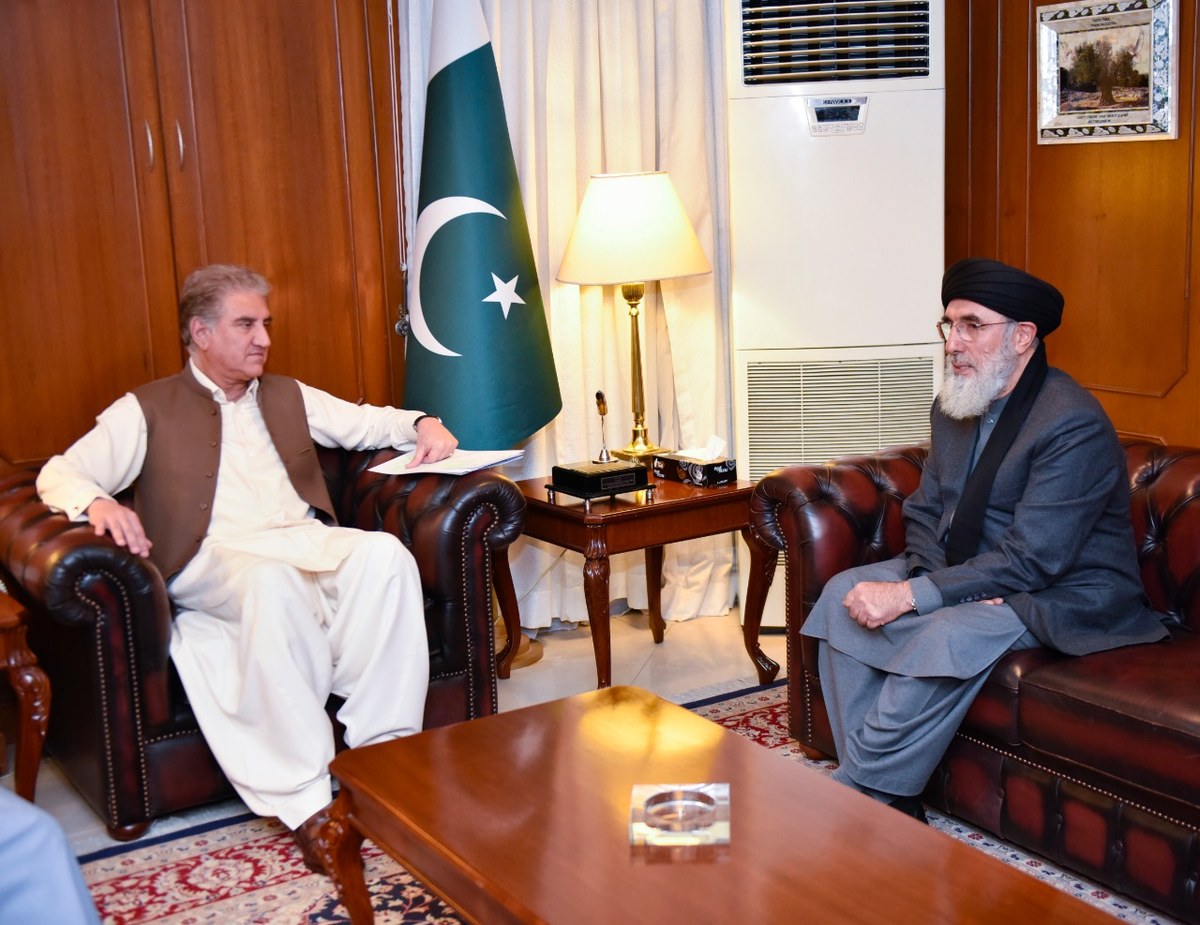
Hizb-e-Islami chief Gulbuddin Hekmatyar meets Pakistan’s Foreign Minister Shah Mahmood Qureshi in Islamabad on October 19, 2020. (Photo by Pakistan’s Foreign Office)
He added: “Pakistan has a policy of expanding its outreach to all Afghan leaders and politicians so that conditions for the intra-Afghan negotiations remain conducive and the process continues to move forward.”
Prior to intra-Afghan talks in Doha, Qatar, which started on Sept. 12, Pakistan also hosted a Taliban delegation to discuss the peace process.
Hekmatyar’s upcoming visit was announced by Pakistan’s special representative for Afghanistan, Mohammad Sadiq, who wrote in a Twitter post on Saturday that the Hizb-e-Islami leader will meet with the Pakistani prime minister, president and other top officials.
The Hizb chief will also meet the Jamaat-e-Islami chief, senator Siraj ul Haq, according to Hekmatyar’s schedule available to Arab News.
Hekmatyar’s son, Habib ur Rehman, who will be in the delegation, described the visit as very important because of Pakistan’s “key” role in the peace process.
“As Pakistan’s role is a key to the peace process, so we want to have a better understanding with Pakistan,” he told Arab News from Kabul on Sunday.
“We will discuss the difficulties in the peace process and how to remove the obstacles, and how to make the peace process successful,” he said.
Besides Hekmatyar’s son, the delegation will include several other top Hizb-e-Islami leaders.
According to Asif Khan Durrani, who has served as Pakistan’s ambassador to Iran, the United Arab Emirates and as deputy head of the Pakistani mission in Afghanistan, by inviting all Afghan leaders Pakistan shows its willingness to engage with all stakeholders of the peace process which it sees as Afghan-owned.
“Pakistan had previously put all eggs in one basket, which was a mistake. Every leader has importance in Afghanistan and inviting Hekmatyar after Dr. Abdullah Abdullah is a positive gesture,” Durrani told Arab News on Sunday.
“Whatever Afghans decide for their future is their prerogative and Pakistan should not be blamed in case Afghans leaders and the Taliban could not reach an agreement,” he said.


