STEPANAKERT: Armenia on Sunday accused Azerbaijan of violating a fresh humanitarian truce aimed at halting weeks of fighting over the Nagorno-Karabakh region that has claimed hundreds of lives.
Yerevan’s defense ministry spokeswoman Shushan Stepanyan said on Twitter that Azerbaijan had fired artillery shells and rockets in the early hours of Sunday, just minutes after the cease-fire went into effect from midnight (2000 GMT).
There was no immediate reaction from Azerbaijan.
Saturday’s cease-fire followed a major escalation that saw a missile strike kill 13 people including small children in the Azerbaijani city of Ganja, for which President Ilham Aliyev vowed to take “revenge.”
A previous truce brokered by Russia to allow the warring sides to exchange prisoners and bodies and begin “substantive” talks quickly broke down, with both accusing each other of violations.
Azerbaijan and the Armenian separatists who control its Karabakh region have been locked in a bitter impasse over the fate of the mountainous province since a war in the 1990s that left 30,000 people dead.
Clashes erupted again three weeks ago and have killed at least 700 people, threatened to draw in regional powers Russia and Turkey, and raised alarm over the failure of a decades-long international mediation.
The real death toll is probably much higher since Azerbaijan has not published fatalities among its soldiers.
With neither side making decisive gains — and a smokescreen of claims and counter-claims of victory blurring events on the frontline — there is no telling when the fighting will end.
The latest cease-fire came after Azerbaijan’s President Ilham Aliyev vowed to take revenge on Armenia after a missile strike killed 13 people including small children in the city of Ganja.
The early hours attack, which also saw a strike on the nearby strategic city of Mingecevir, came hours after Azerbaijani forces shelled Stepanakert, the capital of the ethnic Armenian separatist region.
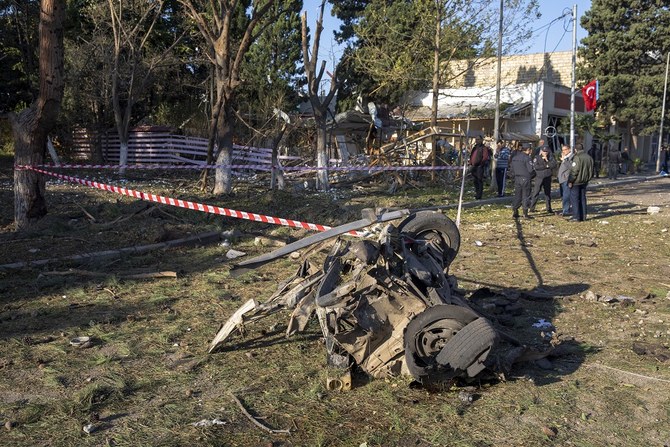
The explosions in Ganja levelled a row of houses and left more than 45 people injured in an attack Aliyev described as “a war crime.”
He said his army would “take revenge on the battlefield” and promised to capture Karabakh by driving out Armenian forces “like dogs.”
Prosecutors said that as the result of the attack on Ganjia 13 people died including small children.
An AFP team in Ganja saw rows of houses turned to rubble by the strike, which shattered walls and ripped roofs off buildings in the surrounding streets.
“We were sleeping and suddenly we heard the blast. The door, glass, everything shattered over us,” said Durdana Mammadova, 69, who was standing on the street at daybreak because her house was destroyed.
Nagorno-Karabakh’s military said for its part that Azerbaijani forces had stepped up their attacks on Friday across the front, shelling Stepanakert and a nearby town.
On Saturday, Karabakh separatist leader Arayik Harutyunyan had said before the truce took effect that “intensive fighting” continued “along the entire line of defense.”
The EU on Saturday condemned the strikes on Ganja and said the original cease-fire deal “must be fully respected without delay.”
“All targeting of civilians and civilian installations by either party must stop,” said a spokesperson for EU foreign affairs chief Josep Borrell.
Turkey, a staunch ally of Azerbaijan and widely accused of supplying mercenaries to bolster Baku’s forces, said the strikes were a war crime and called on the international community to denounce them.
Nagorno-Karabakh, a breakaway region of Azerbaijan mainly inhabited by ethnic Armenians and backed by Yerevan, has been the scene of deadly clashes since September 27.
It has remained under separatist Armenian control since a 1994 cease-fire ended the post-Soviet conflict.


![]()
Armenia accuses Azerbaijan of violating humanitarian truce

Short Url
https://arab.news/v55sy
Armenia accuses Azerbaijan of violating humanitarian truce
- Yerevan’s defense ministry spokeswoman said Azerbaijan had fired artillery shells and rockets in the early hours of Sunday
- Saturday’s cease-fire followed a major escalation that saw a missile strike kill 13 people including small children in the Azerbaijani city of Ganja


Latest updates






© 2026 SAUDI RESEARCH & PUBLISHING COMPANY, All Rights Reserved And subject to Terms of Use Agreement.