Pakistan rejects 'baseless' Armenia claims

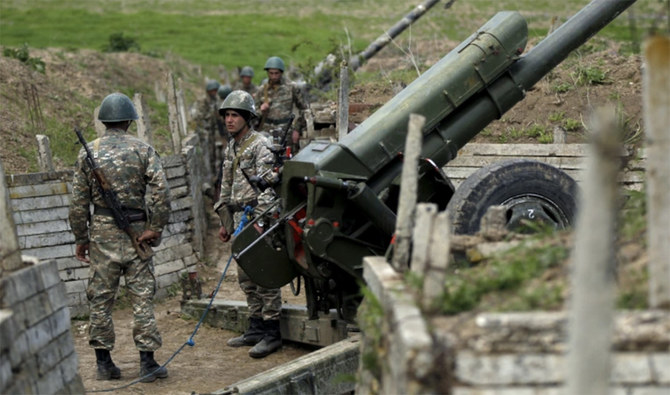
The defense ministry of the Nagorno-Karabakh region said on Friday it had recorded another 29 casualties among its military, pushing the military death toll to 633 since fighting with Azeri forces erupted on Sept. 27. (Reuters/File Photo)
Short Url
Updated 17 October 2020
Follow

Pakistan rejects 'baseless' Armenia claims

  • Reiterates to "stand by the brotherly nation of Azerbaijan"
  • Nagorno-Karabakh is internationally recognized as part of Azerbaijan but populated and governed by ethnic Armenians

LONDON: Pakistan has denied its involvement in the ongoing Armenia-Azerbaijan conflict, following a claim by the Armenian prime minister that Pakistani troops were fighting alongside Azerbaijani troops.

In an official statement released on Saturday, the Pakistani foreign office said it regretted Armenia’s decision to resort to “irresponsible propaganda” and that it would continue to “stand by the brotherly nation of Azerbaijan.”

The defense ministry of the Nagorno-Karabakh region said on Friday it had recorded another 29 casualties among its military, pushing the military death toll to 633 since fighting with Azeri forces erupted on Sept. 27.

The fighting has surged to its worst level since the 1990s, when some 30,000 people were killed.

Also on Friday, there were growing signs that a Russian-brokered cease-fire agreed upon last week to allow sides to swap detainees and bodies of those killed had all but broken down.

Nagorno-Karabakh is internationally recognized as part of Azerbaijan but populated and governed by ethnic Armenians.

Read the Pakistani statement in full below…

We have seen the transcript of Armenian prime minister’s interview on Oct. 15 with Russian TV referring to some unsubstantiated reports alleging involvement of Pakistani special forces alongside the Azerbaijani army in the ongoing conflict.

We categorically reject these baseless and unwarranted comments. President Ilham Aliyev of Azerbaijan has also clarified his stance on the matter stating that Azerbaijani forces are strong enough to defend their homeland and do not need the help of foreign forces.

It is regrettable that leadership of Armenia, to cover up its illegal actions against Azerbaijan, is resorting to irresponsible propaganda, which it must stop.

For our part, we wish to make clear that Pakistan has consistently extended diplomatic, moral and political support to Azerbaijan. Pakistan will continue to stand by the brotherly nation of Azerbaijan and support its right of self-defence against any aggression.

We believe that long-term peace and normalization of relations between the two parties would depend on the complete and comprehensive implementation of the UN Security Council resolutions and withdrawal of Armenian forces from Azerbaijani territories.


Russia committed ‘crimes against humanity’ in deporting Ukrainian children: UN inquiry

Updated 6 sec ago
Follow

Russia committed ‘crimes against humanity’ in deporting Ukrainian children: UN inquiry

  • The inquiry said Russia had deported or transferred “thousands” of children from occupied areas of Ukraine, of which it had so far confirmed 1,205 cases
  • “Four years on, 80 percent of the children deported or transferred in the cases investigated by the commission have not returned,” it said

GENEVA: Moscow’s deportation and forcible transfer of children from Ukraine to Russia amounts to a crime against humanity, a United Nations team of investigators said Tuesday.
The UN’s Independent International Commission of Inquiry on Ukraine said it had collected evidence leading it to conclude that “Russian authorities have committed the crimes against humanity of deportation and forcible transfer, as well as of enforced disappearance of children.”
The probe was established by the UN Human Rights Council shortly after Moscow launched its full-scale invasion of Ukraine in February 2022.
The inquiry said Russia had deported or transferred “thousands” of children from occupied areas of Ukraine, of which it had so far confirmed 1,205 cases.
“Four years on, 80 percent of the children deported or transferred in the cases investigated by the commission have not returned,” it said.
Moscow has failed to establish a system facilitating returns, and has instead focused on long-term placement of the children with families or institutions in Russia, while relatives were not informed of their fate.
The commission confirmed its previous finding that Russian authorities had unlawfully deported and transferred children — as a war crime — “and that they have unjustifiably delayed their repatriation, which is also a war crime.”
These measures “were not guided by the best interests of the child,” and have violated international law, the probe found.

- Putin cited -

It said the involvement of Russian President Vladimir Putin, “including through his direct authority over entities that have steered and executed this policy, has been visible from the outset.”
In 2023, the International Criminal Court issued a war crimes arrest warrant against Putin, accusing him of “unlawfully deporting” Ukrainian children.
The issue is highly sensitive in Ukraine and remains central to negotiations for a potential peace agreement between Kyiv and Moscow.
According to Kyiv, nearly 20,000 Ukrainian children have been forcibly removed since Russia’s full-scale invasion.
Russia insists it has moved some Ukrainian children from their homes or orphanages to protect them from hostilities.
As for Russian trials in the context of its invasion of Ukraine, the commission found that Russian authorities have “systematically fabricated evidence” and “systematically violated a range of fair trial guarantees,” while judges “have not acted with independence and impartiality.”

- ‘Extreme violence’ -

The commission also probed the situation of nationals from 17 countries who were recruited — either voluntarily or through deception — to fight with Russian troops in Ukraine.
They included men from Azerbaijan, Belarus, Brazil, Cuba, Egypt, Ghana, India, Iraq, Kazakhstan, Kenya, Nepal, Somalia, Sri Lanka, Tajikistan, Turkiye and Yemen.
“After training, usually lasting between one week and 30 days, they were forced to serve on frontlines in Ukraine, often assigned extremely dangerous duties,” the commission said in its report.
Commanders arbitrarily imposed “extreme violence” as punishment for refusing orders that meant almost certain death, with soldiers describing being treated like “cannon fodder,” sent on “meat assaults” without training or necessary equipment, and “forced to advance at all costs.”
“The evidence collected demonstrates abusive behavior, cruelty, humiliation, inhuman treatment, and a total disregard for human life and dignity, perpetrated with a sense of impunity,” the report said.
Regarding Ukraine, the report voiced concern about the overly broad definition and sometimes distorted interpretation of the crime of “collaboration.”
The commission also said reports regarding violent treatment of conscientious objectors during Ukrainian mobilization were “a source of concern.”
The report will be presented at the Human Rights Council in Geneva on Thursday.
Moscow does not recognize the commission and does not answer its requests for access, information and meetings.