

Bangkok shuts down transit systems as protests persist

1 / 2
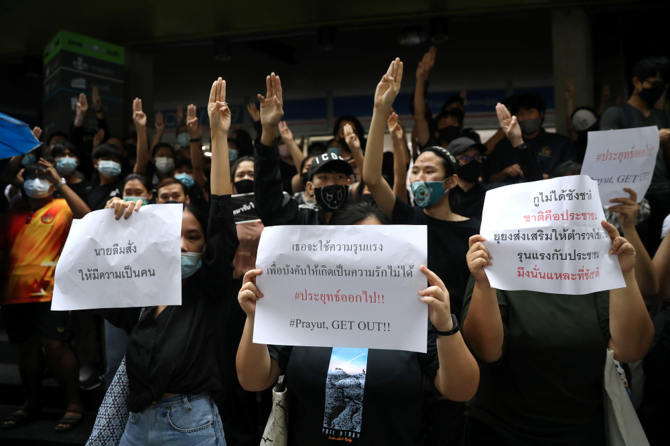
Pro-democracy protesters show the three-finger salute during an anti-government protest at Udom Suk station in Bangkok Oct. 17, 2020. (Reuters)
2 / 2
Thai police said that their response to Friday’s protest had been proportionate and in line with international norms. (Reuters)
Short Url
Updated 17 October 2020
Follow

Bangkok shuts down transit systems as protests persist

  • The protesters have been doing their best to elude the authorities
  • All stations of Bangkok’s elevated Skytrain mass transit system were ordered closed Saturday afternoon

BANGKOK: The authorities in Bangkok shut down mass transit systems and set up roadblocks Saturday as Thailand’s capital faced a fourth straight day of determined anti-government protests.

The protesters have been doing their best to elude the authorities, using social media to assemble followers before police have time to block them. The government has announced plans to take legal action against Twitter and Facebook accounts that announce the protests, but fresh calls to action were posted Saturday.

The protesters are calling for Prime Minister Prayuth Chan-ocha to leave office, the constitution to be amended to make it more democratic and the nation’s monarchy to undergo reform. The protests have been called in defiance of a state of emergency imposed on Thursday.

All stations of Bangkok’s elevated Skytrain mass transit system were ordered closed Saturday afternoon in an effort to thwart protests. A line of the underground MRT system was also shut, and police blocked off several roads. Organizers had called for their followers to meet at Skytrain stations pending further instructions.

Groups of protesters met at many of the stations that were closed, in effect establishing a protest presence across the city. In a further twist, organizers issued a fresh advisory for followers to gather at three stations outside the city’s central area, where access was easier, especially for people living in the suburbs.

Police on Friday had also tried to block demonstrators, but failed when protest organizers announced a last-minute switch of venue.

Friday’s rally was broken up by a large contingent of riot police backed by water cannons after at least 1,000 people had gathered. It was the first time the authorities have employed such forceful tactics against the student-led protests. Both Thursday’s and Friday’s protests were held in normally busy areas of central Bangkok.

“The government has been pushing us to the cliff and now we have nowhere to go. We need to stand right now; if not now, then we don’t know when,” said one protester, a 26-year-old who declined to give her name for fear of getting in trouble with the authorities..

Police took control of Friday’s rally site after about an hour, though continued to engage with some stragglers. Flash protests were launched in solidarity at several universities around the country.

“From the dispersal of protesters on the evening of October 16, we have learned that the government and military have established themselves as the enemy of the people,” said a statement issued after Friday’s events by the People’s Party, the umbrella organization for the protesters. Most of its top leaders have been arrested.

The call by the protesters for reform of the monarchy has significantly raised the political temperature in Thailand, angering many older conservative Thais for whom any critical discussion of the monarchy is tantamount to treason.

King Maha Vajiralongkorn and other key members of the royal family are protected by a lese majeste law that has regularly been used to silence critics who risk up to 15 years in prison if deemed to have insulted the institution.

Prayuth’s declaration of a state of emergency said the measure was necessary because “certain groups of perpetrators intended to instigate an untoward incident and movement in the Bangkok area by way of various methods and via different channels, including causing obstruction to the royal motorcade.”

He was referring to an incident Wednesday that showed some members of a small crowd heckling a motorcade carrying Queen Suthida and Prince Dipangkorn as it slowly passed.

On Friday, two activists were arrested under a law covering violence against the queen for their alleged part in the incident. They could face up to life in prison if convicted. They denied any wrongdoing.


Congo-Brazzaville president set to extend decades-long rule

Updated 2 sec ago
Follow

Congo-Brazzaville president set to extend decades-long rule

BRAZZAVILLE: At the age of 82 and after more than 40 years in power, Denis Sassou Nguesso is the clear favorite to win Sunday’s presidential election in Congo-Brazzaville.
With the opposition divided, sidelined and largely absent, observers say voter turnout could slump to a record low in the oil-rich but impoverished central African country.
Sassou Nguesso ranks as one of Africa’s longest-serving leaders, along with Equatorial Guinea’s Teodoro Obiang Nguema and Cameroonian President Paul Biya.
“Honestly, I don’t see the point of voting on March 15. Whether I vote or not, we’ll have the same winner,” said Cyril Massamba, who lives in the capital Brazzaville.
Sassou Nguesso, a career military officer, first led Congo under a one-party system from 1979 to 1992 before losing the first multi-party elections to former prime minister Pascal Lissouba, whom Sassou Nguesso then overthrew in a civil war in 1997.
He has maintained a firm grip over the former French colony, which gained independence in 1960 and has traditionally maintained close ties with both France and Russia.
Six candidates are bidding to unseat him but few have the resources to compete with the ruling Congolese Labour Party (PCT).
The party’s red Soviet-style flags and giant Sassou Nguesso portraits have filled city streets since the campaign began.
Lacking broad support, opposition candidates have been unable to rally behind a single challenger.
The two main opposition parties have chosen not to stand, one of them arguing that conditions for a free and transparent election have not been met, and urging supporters to vote “according to their conscience.”
“Denis Sassou Nguesso controls the entire electoral process,” said Clement Mierassa, an opposition figure, former minister and previous presidential candidate.
He argued that all those running against the president were just placeholders.
Two prominent candidates who challenged Sassou Nguesso in the disputed 2016 election remain in prison, serving 20-year sentences for “endangering state security.”

- Turnout fears, unemployment -

“I’ll go to a polling station the day my own child is a candidate,” joked shopkeeper Monique Ouollo.
Sassou Nguesso has urged his supporters to turn out and vote in Sunday’s first round, telling a rally in Pointe?Noire: “No abstention!” No date has yet been given for a second round of voting.
But many young people in the port city voiced frustration over chronic unemployment and the lack of economic prospects in a country rich in oil and gas.
Despite GDP growth of 2.9 percent in 2025, about half the population of six million lives below the poverty line, according to the World Bank.
Congo-Brazzaville depends heavily on hydrocarbons, which account for more than three-quarters of export earnings.
Authorities say proven oil reserves will last another 25 years at current production rates and aim to reach 500,000 barrels a day by 2030.
Gas production reached three million tons of LNG last year.
Although it has 10 million hectares of arable land, only about four percent is farmed, mostly for low-yield subsistence crops.
The country imports much of its food, leaving households exposed to swings in global prices, shipping costs and exchange rates.
Officials hope Congo’s location — between the Congo Basin and the Atlantic Ocean — will help turn it into a regional trading hub, tapping existing rail and road networks to boost links with neighbors.

- Diplomatic balancing act -

At Sassou Nguesso’s first campaign rally last month, foreign paramilitaries were spotted on rooftops nearby, including a sniper.
Their presence fueled speculation about Russian mercenaries providing security, mirroring arrangements in the Central African Republic.
A ruling party official confirmed to AFP that the men were Russian personnel, without detailing their mission.
Seen as a relatively stable hub in a volatile region, Congo-Brazzaville retains close ties with Paris, its largest development aid donor, and is home to around a hundred French companies.
But Russia is also a longstanding partner: Congo was allied with the Soviet bloc from 1968 to the early 1990s.
Though Sassou Nguesso maintains tight control over the security apparatus, some of his allies acknowledge that fears of a power grab remain.
The president told AFP in an interview in early March that he does not intend to “remain in power forever.”