

Pakistan’s leading think tank establishes Center for Middle East and Africa

Pakistan's foreign secretary Sohail Mahmood inaugurates the Centre for Middle East and Africa at the Institute of Strategic Studies Islamabad on October 15, 2020. (Picture Courtesy: Institute of Strategic Studies Islamabad)
Short Url
Updated 16 October 2020
Follow

Pakistan’s leading think tank establishes Center for Middle East and Africa

  • The country’s future economic and strategic prospects are closely linked with the Middle East, says the foreign secretary
  • The center’s director says she wants to generate quality research and analysis on issues related to the Middle East and Africa

ISLAMABAD: The Institute of Strategic Studies Islamabad (ISSI), a non-profit research organization established in 1973, has set up a separate unit that will focus on the Middle East and Africa to help policymakers refine their understanding of the two regions.
The ISSI works closely with the country’s foreign policy establishment, and its decision to set up the Center for Middle East and Africa (CMEA) is widely viewed as an indication that Pakistan wants to further strengthen its diplomatic ties with countries in the two territories.
“It was a longstanding demand of our foreign ministry,” Amina Khan, director of the center, told Arab News on Friday. “It was established in view of Pakistan’s important relations with countries in the Middle East and Africa.”
She said the center aimed to generate quality research and analysis to provide better policy input to those dealing with these regions.
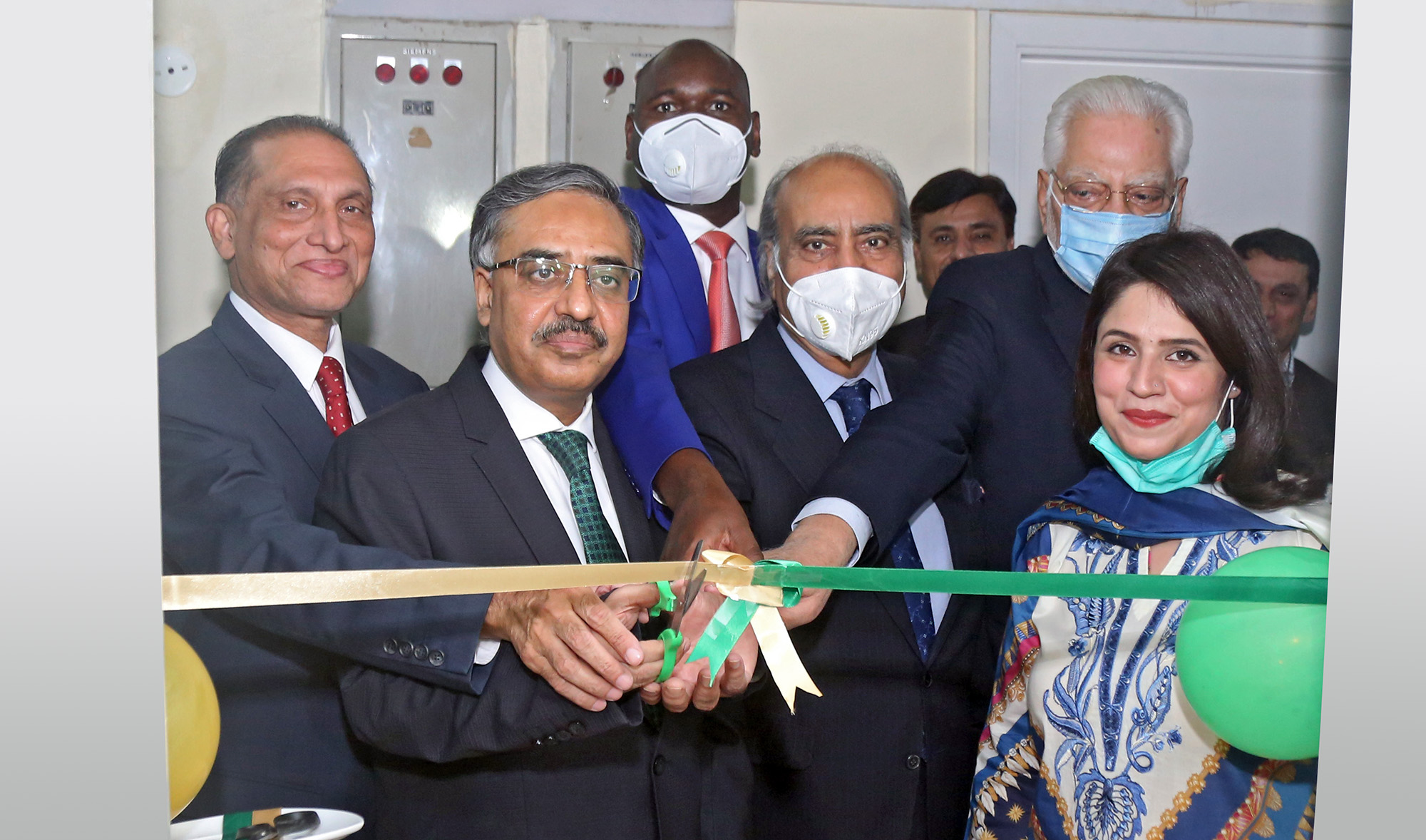


Pakistan's foreign secretary Sohail Mahmood inaugurates the Centre for Middle East and Africa at the Institute of Strategic Studies Islamabad on October 15, 2020. (Picture Courtesy: Institute of Strategic Studies Islamabad)

Khan said Pakistan had a huge diaspora community, especially in the Gulf countries, adding that this made it even more important for it to improve its understanding of the Middle East.
“The center will keep an eye on the latest developments, organize and promote dialogue and debate on political, security, economic, and social aspects of Middle Eastern and African countries, and keep its research relevant to Pakistan,” she continued.
“We want to expand our work and engage with likeminded organizations and individuals from around the globe through research, webinars and conferences,” she added.

Khan also informed that the new research department was set up without any extra allocations.
“This center consists of the same staff which was already working with the ISSI,” she explained, “so it is utilizing the same budget which was given to institute by the Ministry of Foreign Affairs and no extra budget was acquired for this purpose.”
“The Middle East is one of the most critical areas in the world today,” Pakistan’s foreign secretary Sohail Mahmood said on Thursday while addressing the center’s inauguration ceremony. “The people of Pakistan also share strong affinities with the people of the Middle East region.”
He noted that Pakistan’s future economic and strategic prospects were closely connected with the Middle East, stressing the need for in-depth research to fully harness its potential.
“The establishment of CMEA is both timely and beneficial,” he said.
His opinion was also echoed by the ISSI director general, Aizaz Ahmad Chaudhry, who maintained that Pakistan had “huge stakes” in the region.
The new unit is the fourth center of excellence that has been established at the ISSI. The other three are the Pak-China study center, India center and arms control and disarmament center.


US commits $1.25 billion EXIM financing for Pakistan’s Reko Diq mine — envoy

Updated 7 sec ago
Follow

US commits $1.25 billion EXIM financing for Pakistan’s Reko Diq mine — envoy

  • Financing could unlock up to $2 billion in US mining equipment exports, create 13,500 jobs across Pakistan and US
  • Move aligns with Pakistan’s push to close $3.5 billion debt package for world-class copper-gold mine in Balochistan

KARACHI: Washington has approved $1.25 billion in US Export-Import Bank financing for Pakistan’s Reko Diq copper-gold mine, Acting US ambassador Natalie Baker said in a video message on Wednesday, adding that the package could unlock up to $2 billion in US equipment and service exports for the project.

The facility, one of the largest US financing decisions in Pakistan’s minerals sector, is expected to help pave the way for US-sourced mining technology, drilling machinery and operations support, while creating jobs in both countries and accelerating development of one of the world’s largest untapped copper deposits.

The $7 billion Reko Diq project, located in the mineral-rich southwestern province of Balochistan, is being developed by Canadian mining giant Barrick Gold in partnership with Pakistan’s federal and provincial governments. The mine is central to Pakistan’s effort to expand exports, attract foreign investment and open the country’s largely untapped critical minerals reserves, a segment where copper plays a key role in electric vehicles, renewable energy, AI hardware and global supply chains. Saudi Arabia’s Manara Minerals, a Public Investment Fund and Ma’aden joint venture, has also expressed intent to acquire a 15 percent stake.

“I am pleased to highlight the US Export-Import Bank recently approved financing of $1.25 billion to support the mining of critical minerals at Riko Diq in Pakistan,” Baker said.

“In the coming years, EXIM’s project financing will bring in up to $2 billion in high-quality US mining equipment and services needed to build and operate the Riko Diq mine, along with creating an estimated 6,000 jobs in the US and 7,500 jobs in Balochistan, Pakistan.”

The envoy added that the deal reflects the strategic direction of US commercial diplomacy.

“The Riko Diq project serves as the model for mining projects that will benefit US exporters as well as local Pakistani communities and partners by bringing employment and prosperity to both our nations,” Baker added. “The Trump administration has made the forging of deals exactly like this one central to American diplomacy.”

SECURITY CHALLENGES

Speaking to Arab News last month, Pakistan’s Finance Minister Muhammad Aurangzeb said the broader debt package for Reko Diq was nearly complete, anchored by the International Finance Corporation (IFC) and expected to total about $3.5 billion.

“The financial close, from my perspective, is around the corner,” he said, adding that EXIM participation had been delayed only due to a temporary US government shutdown restrictions, now lifted.

If financing closes on schedule, Reko Diq is projected to generate $2.8 billion in export potential in its first year of shipment, nearly 10 percent of Pakistan’s existing export volume, and could embed the US as a long-term strategic investor alongside Canadian and Saudi partners. The project added 13 million ounces to Barrick’s gold reserves in 2024 and is expected to produce 200,000 metric tons of copper a year in its first phase, doubling after expansion, with projected free cash flow of more than $70 billion over 37 years.

Lenders including the International Finance Corporation and the Asian Development Bank among others are assembling a financing package exceeding $2.6 billion.

Balochistan suffers frequent attacks by separatists and other militants, making security a major concern for the mining scheme. The project also requires a railway line upgrade to transport copper concentrate to Karachi for processing abroad.

Barrick returned to Pakistan in 2022 after a years-long legal dispute was settled, and the mine has since become a flagship investment for the country as it seeks to draw more capital into its minerals sector.