

Pakistani opposition to launch anti-government protests from Friday

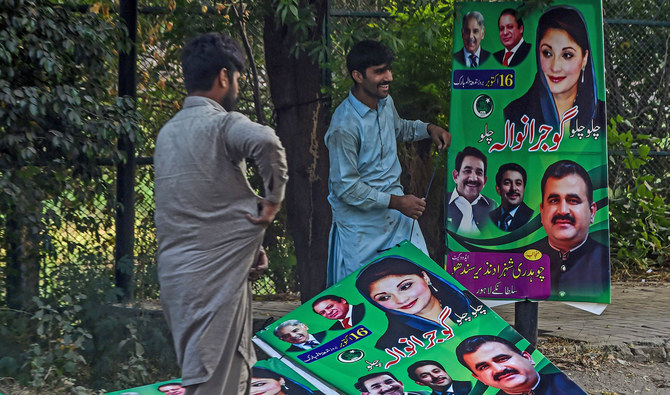
Workers hang posters of opposition party Pakistan Muslim League Nawaz (PML-N) on a street in Lahore on Oct. 15, 2020, as part of preparations ahead of an opposition rally. (AFP)
Short Url
Updated 15 October 2020
Follow

Pakistani opposition to launch anti-government protests from Friday

  • The opposition Pakistan Democratic Movement alliance will hold its first protest rally in Gujranwala
  • The federal information minister says the opposition parties have joined hands to protect their ill-gotten wealth

ISLAMABAD: Pakistan’s opposition parties on Thursday chalked out a strategy for anti-government protests that are scheduled to begin from tomorrow to oust the Pakistan Tehreek-e-Insaf (PTI) government through street agitation.

The opposition factions recently formed an alliance — the Pakistan Democratic Movement (PDM) — to address public gatherings across the country in a move to build pressure on the government for early general elections.

In a huddle at the residence of PDM chairman Maulana Fazlur Rehman in Islamabad, the opposition pledged to go ahead with its planned public rallies, with the first one scheduled to be held in Gujranwala tomorrow despite arrests of its workers.

“This government is the product of election rigging, and it has badly failed to deliver,” Mian Iftikhar Hussain, PDM information-secretary, told the media after the meeting.

Prime Minister Khan’s PTI party came to power in August 2018 after defeating all major opposition parties in general elections. The opposition alliance has, however, accused the ruling administration of election irregularities while demanding fresh polls in the country. The government vehemently denies the rigging charge.

“We are out on the streets for transparent elections, and our program is completely peaceful,” Hussain said, adding that all segments of the society, including health workers, teachers and even government employees, were protesting against the government’s flawed policies.

“Who voted for you when people from all walks of life are protesting against you,” he questioned the government, adding that the PTI administration was arresting political workers to limit their strength in the Gujranwala rally.

The government’s all policies, including foreign, interior and education, had failed, he said, adding that it had also failed to control inflation which was directly affecting the common man.

It was decided that all opposition leaders would travel to the site of public gathering in Gujranwala from their respective areas in Punjab and Khyber Pakhtunkhwa provinces along with their party workers. As per the plan, they would also hold a public rally in Karachi on October 18 and in Quetta on October 25.

The government has formally allowed the opposition alliance to hold the public gathering at a designated site in Gujranwala city.

Speaking on the occasion, Shahid Khaqan Abbasi, ex-premier and senior leader of the opposition Pakistan Muslim League-Nawaz party, said that former prime minister Nawaz Sharif would also address the gathering through a video link.

Sharif is currently in London for medical treatment, though local courts have issued his arrest warrants and directed the government to bring him back to face the corruption cases.

Responding to the opposition, Federal Minister for Information and Broadcasting Senator Shibli Faraz said the government had allowed the opposition to hold the public gathering as “protest is right of every political party.”

“The opposition parties have united to protect their looted money,” he added in a video message to the media.


Pakistan announces four-day work week among austerity measures to offset impact of Middle East crisis

Updated 5 sec ago
Follow

Pakistan announces four-day work week among austerity measures to offset impact of Middle East crisis

  • The development comes as ongoing US-Israeli strikes on Iran disrupt oil supplies in Strait of Hormuz, push prices past $119 a barrel
  • Islamabad bans government purchases, cuts fuel allocation for vehicles as well as workforce in public and private offices by 50 percent

ISLAMABAD: Prime Minister Shehbaz Sharif on Monday announced austerity measures, including a four-day work week and cuts in government expenditures, to offset the impact of rising global oil prices due to an ongoing conflict in the Middle East.

Global fuel supply lines have been disrupted in the Strait of Hormuz, which supplies nearly a fourth of world oil consumption, after Tehran blocked it following United States-Israeli strikes on Iran and counterattacks against US interests in the Gulf region.

Oil prices surged more than 25 percent globally on Monday to $119.50 a barrel, the highest levels since mid-2022, as some major producers cut supplies and fears of prolonged shipping disruptions gripped the market due to the expanding US-Israeli war with Iran.

In his televised address on Sunday night, Sharif said global oil prices were expected to rise again in the coming days but vowed not to let the people bear their brunt, announcing austerity measures to lessen the impact of fuel price hikes.

“Fifty percent staff in public and private entities will work from home,” he announced, adding this would not be applicable to essential services. “Offices will remain open for four days a week. One-day additional off is being given to conserve oil, but it would not be applicable to banks.”

Sharif didn’t specify working days of the week and the government was likely to issue a notification in this regard.

He said a decrease of 50 percent was being made in fuel allocation for government vehicles immediately for the next two months, but they would not include ambulances and public buses.

“Cabinet members, advisers and special assistants will not draw salaries for the next two months, 25 percent salaries of parliamentarians are being deducted, two-day salaries of Grade 20 and above officers, or those who are paid Rs300,000 ($1,067) a month, are being deducted for public relief,” he said.

Similarly, there will be 20 percent reduction in public department expenses and a complete ban on the purchase of cars, furniture, air conditioners and other goods, according to the prime minister.

Foreign trips of ministers and other government officials will also be banned along with government dinners and iftar buffets, while teleconferences and online meetings will be given priority.

Sharif’s comments were aired hours after Pakistani authorities said the country had “comfortable levels” of petroleum stocks and the supply chains were functioning smoothly, despite intensifying Middle East conflict.

Petroleum Minister Ali Pervaiz Malik said three oil shipments were due to reach Pakistan this week, state media reported.

Meanwhile, Pakistan Navy (PN) launched ‘Operation Muhafiz-ul-Bahr’ to safeguard national energy shipments, the Pakistani military said on Monday, amid disruptions to critical sea lanes due to the conflict.

The navy is conducting escort operations in close coordination with the Pakistan National Shipping Corporation (PNSC), according to the Inter-Services Public Relations (ISPR), the military’s media wing. It is fully cognizant of the prevailing maritime situation and is actively monitoring and controlling the movement of merchant vessels to ensure their safe and secure transit.

“With approximately 90 percent of Pakistan’s trade conducted via sea, the operation aims to ensure that vital sea routes remain safe, secure, and uninterrupted,” the ISPR said on Monday. “Currently, PN ships are escorting 2 x Merchant Vessels, one of which is scheduled to arrive Karachi today.”