

Twitter Poll: Shockingly, most Arab News readers in favor of Israeli actress Gal Gadot as Cleopatra

Israeli actress Gal Gadot previously played the role of Wonder Woman. (File/AFP)
Short Url
Updated 15 October 2020
Follow

Twitter Poll: Shockingly, most Arab News readers in favor of Israeli actress Gal Gadot as Cleopatra

  • More than 70% say yes she is appropriate for the role or will decide once the film is shown
  • British actress Elizabeth Taylor previously played the role of Cleopatra in the 1963 blockbuster

DUBAI: An overwhelming majority of respondents to an Arab News Twitter poll said they believed the Israeli actress, Gal Godot, was suitable for the role of Cleopatra in the upcoming new film of the same name by director Patty Jenkins.

Announced earlier this week, the decision was initially met with some level of disdain, with people saying the decision to cast the Wonder Woman actress as the legendary Egyptian queen was “just another stroke in the long history of white-washing.”
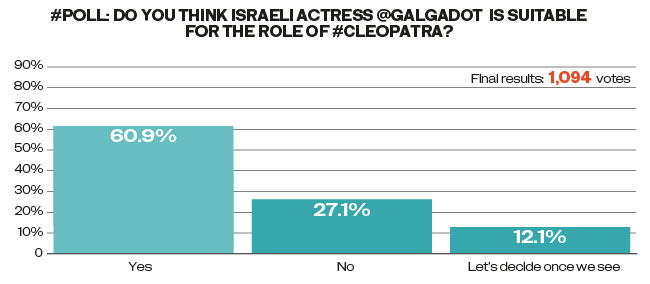
But 60.9 percent of respondents to the Arab News poll, asking readers if they felt her casting for the role was appropriate said it was – a further 12 percent said they would decide once the movie was finished, while 27.1 percent said she was not.


 “Yes. She is Mediterranean just like Cleopatra's Greek ancestors,” tweeted @Scripteladora.


And @EinatWilf added: “Seems to me @GalGadot  comes from the perfect geographical/ethnic background to play #Cleopatra...”


The Israeli actress is not the first to play a character from country different to their own – the British actress Elizabeth Taylor famously played the role of Cleopatra opposite her one-time husband Richard Burton in the 1963 movie of the same name.

“Elizabeth Taylor played Cleopatra in the 1963 movie She was JEWISH!!!!!!!!!!!” tweeted   @herbyg72


And @TeddysMom8 said: “If Omar Sharif could play Nicky Arnstein in Funny Girl beauty Gal Gadot can play Cleopatra.”


Meanwhile @Monahassan1111 questioned the timing of the announcement, which coincided with the signing of the Abraham Accords.

“It is not a coincidence that actor Gal Gadot  would represent Cleopatra and that coincided with the peace processes in the Middle East ..!Any way Art maybe success to achieve peace with ppl and create Dialogue language between ppl instead limited with Diplomatic room!”


6 planets will parade across the night sky at the end of February

Updated 24 February 2026
Follow

6 planets will parade across the night sky at the end of February

NEW YORK: Six planets are linking up in the sky at the end of February, and most will be visible to the naked eye.
It’s what’s known as a planetary parade, which happens when multiple planets appear to line up in the sky at once. The planets aren’t in a straight line, but are close together on one side of the sun.
Skygazers can usually spot two or three planets after sunset, according to NASA. Hangouts of four or five that can be glimpsed with the naked eye are less common and occur every few years. Last year featured lineups of six and all seven planets.

When will they be visible?
On Saturday, Mercury, Venus, Jupiter and Saturn will be visible to the naked eye if clear skies allow. Uranus and Neptune can only be spotted with binoculars and telescopes.

What time is optimal for viewing?
Go outside about an hour after sunset and venture away from tall buildings and trees that will block the view. Look to the western sky and spot Mercury, Venus and Saturn close to the horizon. Jupiter will be higher up, along with Uranus and Neptune.

How to know if you’ve spied a member of the parade?
“If it’s twinkling, it’s a star. If it is not twinkling, it’s a planet,” said planetary scientist Sara Mazrouei with Humber Polytechnic in Canada.
The parade should be visible over the weekend and in the days after. Eventually, Mercury will bow out and dip below the horizon.
At least one bright planet is visible on most nights, according to NASA.
Glimpsing many in the sky at once is a fun way to connect with astronomers of centuries’ past, said planetary scientist Emily Elizondo with Michigan State University.
Ancient astronomers used to make sense of the universe “just by looking up at the stars and the planets,” Elizondo said, “which is something that we can do today.”