



DUBAI: Young Saudi entrepreneurs have not let the coronavirus pandemic slow them down, judging by the countless fresh ideas that have continued to power ahead.
One of them is Ejaro, the first licensed peer-to-peer vehicle-sharing community in the Arab world.
Established by Mohammed Khashoggi, Ejaro aims to soup up the Saudi vehicle rental market and revolutionize the industry across the region.
“We’re similar to AirBnb, but for cars. It’s a great way for a person to generate an additional source of income,” Khashoggi, 31, told Arab News.
As a vehicle owner himself, who regularly hires cars while traveling in Europe for business, Jeddah-born Khashoggi came up with the idea when he saw a similar venture in the UK.
INNUMBERS
Entrepreneurial investment
* $67m Investment in KSA starts in 2019.
* 10 KSA startups in WEF’s 100 ‘most promising’ list.
* 42% Petroleum sector’s share of KSA GDP.
“I thought it was an amazing idea. I did my research and looked for similar ideas in the Middle East and North Africa (MENA). There were a couple that were meant to launch in the GCC (Gulf Cooperation Council) and didn’t,” he said.
“Licensing is the most important element, and we’re the first ones to be licensed by the Transport General Authority in the Kingdom.”
Growing up in Saudi Arabia, Khashoggi moved to the UK to pursue a bachelor’s degree in architecture. Three years later, he entered the world of business.
“I was in real estate with the family business. I was into that for a good five years,” he said. “My partner from university and I started a … company called the Continental Group in the UK, and from there we created a real estate company, which transacted over SR400 million ($100 million), bridging the gap between Saudi investors and the UK property market.”
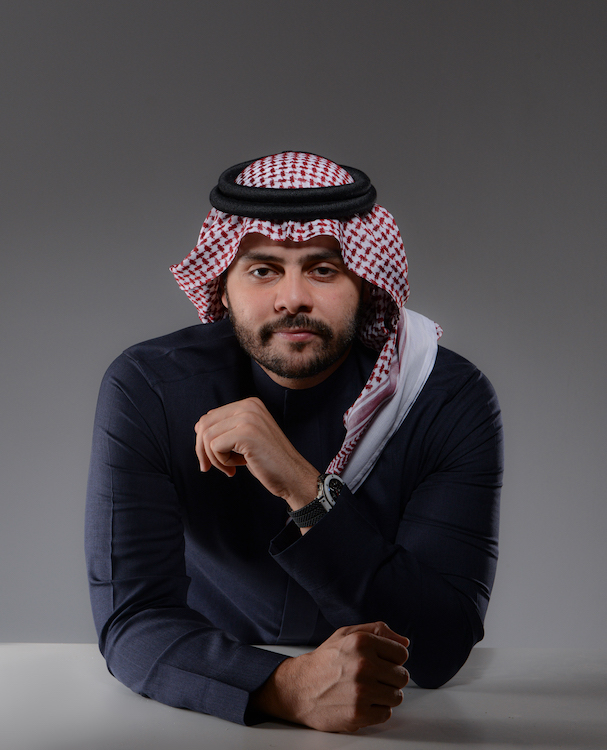
Jeddah-born Mohammed Khashoggi came up with the idea for Ejaro when he saw a similar venture in the UK. (Supplied)
During a weekend aboard a luxury yacht in Monaco to watch the Formula 1, Khashoggi struck upon the idea for another venture — C’s 500 Business Club — selling “weekend hospitality packages” to guest members to join a chartered yacht platform during the Abu Dhabi Formula 1.
His endeavors earned him valuable networking opportunities with influential people. “It gave us a great platform to gain more networking for our business,” Khashoggi said.
“From there we got into the tech world, and I started my first venture jointly with a German company, which did social trading. That’s where I got into the whole tech business.”
After living in the UK for 13 years, Khashoggi moved back to Saudi Arabia in April 2019. Shortly afterward, Ejaro featured as part of Riyadh Season, receiving special endorsements from Turki Al-Shaikh, a Saudi adviser at the Royal Court and current chairman of the General Authority for Entertainment.
“We’ve done almost zero marketing because being part of Riyadh Season gave us great brand positioning,” Khashoggi said. “Word of mouth also helped, and we’ve seen that people want this kind of service.”
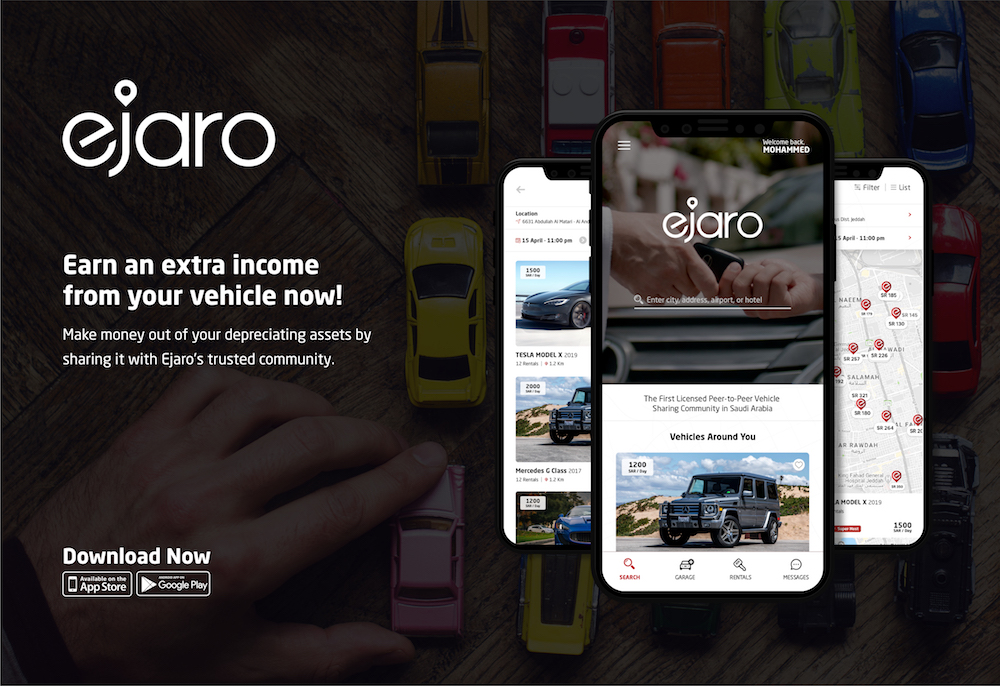
Once users download the app and register, they simply search for a vehicle and book. The owner then accepts or declines, allowing direct communication between both parties to coordinate vehicle pick-up or delivery.
A five-minute check-in process, followed by a vehicle inspection, a few photos and fuel and mileage readings, allows customers to drive off with no worries.
Rigorous background and criminal-record checks are also performed to ensure safety and peace of mind.
A VISION FOR INNOVATION
The Saudi economy is undergoing a massive economic development reformation, spearheaded by the transformation strategy Vision 2030. But for entrepreneurship to thrive, current and future generations in Saudi Arabia will need a stimulating environment. The Kingdom is boosting its startup ecosystem with supportive regulatory frameworks and local venture funds.
Various institutions and initiatives are working toward this end, including the Mohammed bin Salman College, the Saudi Aramco Entrepreneurship Center (Waed), the Public Investment Fund (PIF) Academy, the King Abdullah University of Science and Technology’s innovation and economic development department, and the MiSK Foundation. Various government agencies and companies are also supporting the Kingdom’s efforts in this regard, such as the Business Incubators and Accelerators Co., a unit of the Saudi Technology Development and Investment Co. (TAQNIA), in turn owned by the PIF. A number of programs are also working to promote future talent.
The Saudi Young Leaders Exchange Programs (SYLEP) is a three-week program in the US for undergraduate Saudi students or recently graduated university students aged 21-26. The aim of SYLEP 2020 is to “build leadership skills, civic responsibility, appreciation for cultural diversity, and community engagement and volunteerism among Saudi university students.”
The theme of this year’s program is STEAM — science, technology, engineering, art and mathematics. Beyond prioritizing technology and innovation, Saudi Arabia has made it easier for international entrepreneurs to obtain licenses to launch startups, as part of an initiative to drive the private sector to 65 percent of gross domestic product from its current 40 percent.
This will involve a blend of growth from foreign direct investment and Saudi-grown entrepreneurship and innovation. Despite the current challenges posed by the coronavirus pandemic, much of the foundation for future youth entrepreneurship has already been set. Throughout the Kingdom, the effects of this spirit of innovation will be felt for many years to come. — Richie Santosdiaz
So far Ejaro has proven popular among Saudis, with 2,500 registered users in the Kingdom and up to 130 vehicles in the beta phase alone.
Owners receive up to 80 percent in their wallet while Ejaro banks 20 percent for its connecting platform.
The team plans to initially focus on the Saudi market before expanding to the GCC and across the MENA region.
“Everyone wants an additional source of income. With Saudi Arabia’s Vision 2030, and tourism and travel opening up, there will be more demand for vehicle rental among tourists and locals,” Khashoggi said.
“We have a really fast and more efficient way to supply that demand through existing vehicles on the road, and in that sense we don’t add more congestion to the roads.”
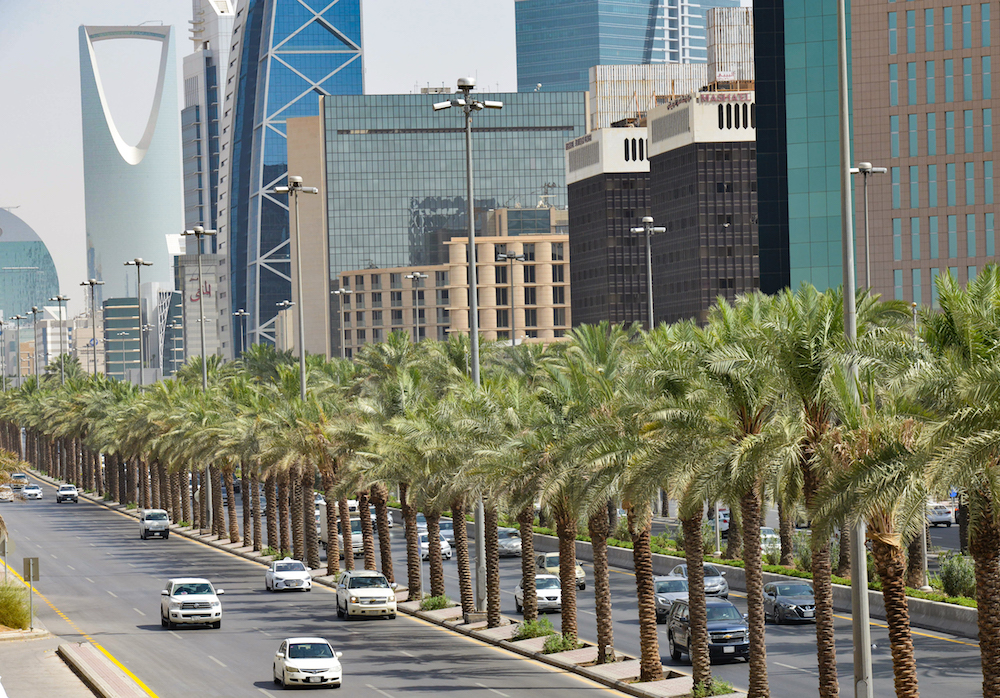
Khashoggi moved back to Saudi Arabia in April 2019. Shortly afterward, Ejaro featured as part of Riyadh Season, receiving special endorsements from Turki Al-Shaikh, a Saudi adviser at the Royal Court and current chairman of the General Authority for Entertainment. (AFP/File Photo)
Although the app is currently in its beta stage, a full launch is planned in the coming weeks. “The pandemic slightly affected us because we’re an early-stage company and because the travel, tourism and transportation industries came to a complete halt,” he said.
“But it gave us a chance to dig deep into our product, enhance it and completely change the user experience, making it much easier and seamless. The lockdown period had its blessings in disguise.”
It also allowed the team to integrate with several government systems to make it more secure and give users further peace of mind.
Khashoggi is optimistic about the road ahead for Saudi entrepreneurs. “I’m in this ecosystem, and there are definitely amazing things going on in the startup ecosystem in Saudi Arabia,” he said.
“We’ll be in the leading countries in the GCC, and hopefully in the world soon, thanks to the Vision 2030 of Crown Prince Mohammed bin Salman, and the agility and support from the government for SMEs (small and medium enterprises) and entrepreneurs. It will continue to grow and take its place very soon.”
----------------------
Twitter: @CalineMalek


