JERUSALEM: The Israeli government has extended an emergency provision that bars public gatherings, including widespread protests against Prime Minister Benjamin Netanyahu, for an additional week.
Government ministers approved the measure until Oct. 13 by a telephone vote, the Prime Minister’s Office said in a statement late on Wednesday.
Israel imposed a nationwide lockdown ahead of the Jewish High Holidays last month to rein in the country’s surging coronavirus outbreak. The Knesset, Israel’s parliament, passed a law last week allowing the government to declare a special week-long state of emergency to limit participation in assemblies because of the pandemic. The government then declared the state of emergency, limiting all public gatherings to within a km of a person’s home.
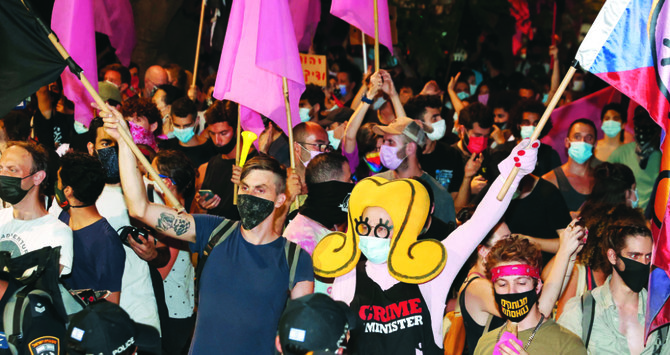
Netanyahu has said the restrictions are driven by safety concerns as the country battles a runaway pandemic, but critics and protesters accuse him of tightening the lockdown to muzzle their movement and expression of dissent.
Thousands of Israelis have participated in weekly demonstrations outside Netanyahu’s official residence in Jerusalem for months this summer, calling on the long-time prime minister to resign while on trial for corruption.
Since the restriction was approved last month, tens of thousands of Israelis have staged protests on street corners and public squares near their homes against the government’s perceived mishandling of the coronavirus crisis and its economic fallout.
On Thursday, an Israeli protester painted the Hebrew word “Go” — an increasingly popular slogan among anti-Netanyahu protesters — in large letters across Tel Aviv’s Rabin Square.
Israel was initially praised for its swift imposition of restrictions in February to curb the spread of the coronavirus. But after reopening the economy and schools in May, new cases increased quickly. It imposed a second lockdown on Sept. 18 as the infection rate skyrocketed to one of the highest per capita in the world.
The Health Ministry has recorded over 282,000 confirmed cases of the disease and over 1,800 deaths in the country of around 9 million people.
After nearly three weeks of lockdown, the number of new cases is gradually decreasing, but infections are still spreading, particularly among the country’s hard-hit ultra-Orthodox Jewish community.
Israel’s ultra-Orthodox community, which makes up around 10 percent of the country’s population, accounts for more than a third of Israel’s virus cases. Some members of the community have flouted the rules and held prayers in enclosed spaces, large festive gatherings and clashed with police over their enforcement of regulations.


![]()

Israeli government extends ban that limits public protests
Short Url
https://arab.news/g4muh
Israeli government extends ban that limits public protests


Latest updates


© 2026 SAUDI RESEARCH & PUBLISHING COMPANY, All Rights Reserved And subject to Terms of Use Agreement.