

OPEC doesn’t see peak oil demand

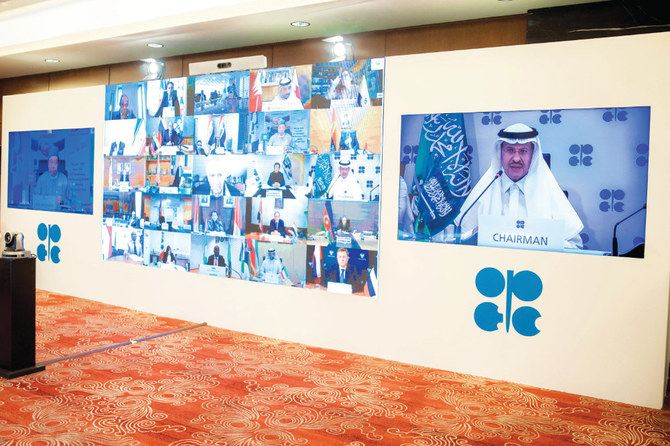
Saudi Energy Minister Prince Abdul Aziz bin Salman chairs the virtual extraordinary meeting of OPEC and non-OPEC countries earlier this year. (AFP)
Short Url
Updated 09 October 2020
Follow

OPEC doesn’t see peak oil demand

  • Group forecasts crude consumption growing, driven largely by greater use of cars in developing countries

PARIS: The coronavirus crisis has sparked talk that the world might have reached peak oil demand but the OPEC group sees crude consumption continuing to grow during the next quarter century, driven in large part by greater use of cars in developing countries.

In its latest forecasts, released on Thursday, OPEC sees surprisingly little long-term impact despite the pandemic plunging the global economy and oil demand into a tailspin.

While the pace of economic recovery will dictate how fast oil consumption rebounds, even OPEC’s scenario of a slow healing sees an eventual return to increased demand.

“At the global level, oil demand is expected to increase by almost 10 mbd (million barrels per day) over the long-term, rising from 99.7 mbd in 2019 to . . . 109.1 mbd in 2045,” it said in its latest World Oil Outlook.

This baseline scenario represents 9.4 percent growth from pre-coronavirus consumption levels.

Under its slow growth scenario, OPEC expects 5 percent growth in oil demand.

And even with fast adoption of green technologies and tougher climate change policies, the group still sees a 3.1 percent increase in consumption.

OPEC’s forecast contrasts with that of some industry players, including major oil firms such as BP, which in its latest long-term estimates predicted that oil demand had already peaked or would soon do so thanks to increased use of renewable energy and the impact of the coronavirus.

Yet even the cartel’s forecasts reveal the impact of the changes already underway in certain regions.

It sees oil demand as having already peaked in developed countries that are part of the OECD, while it will continue to grow in developing countries.

“Demand projections show a contrasting picture between the two major regions: Declining long-term OECD demand and growing demand in the non-OECD,” said the report.

“In this regard, India, China and other developing countries (DCs) with increasing populations and high economic growth play a key role in increasing energy demand while developed nations in the OECD are exerting more of their efforts on energy efficiency and low-carbon technologies,” it added.

China and India are expected to account for half of that energy demand growth.

OPEC expects oil demand in OECD countries to peak between 2022 and 2025 before beginning to decline, thanks in large part to a switch to electric vehicles.

But in China and India, OPEC sees road transportation as posting the biggest gains in oil demand.

In China, it expects road transport to account for almost half of the overall demand growth, as the number of cars on the road triples. In India, it expects the number of cars to multiply more than five times.


Saudi POS transactions see 20% surge to hit $4bn: SAMA

Updated 05 December 2025
Follow

Saudi POS transactions see 20% surge to hit $4bn: SAMA

RIYADH: Saudi Arabia’s total point-of-sale transactions surged by 20.4 percent in the week ending Nov. 29, to reach SR15.1 billion ($4 billion).

According to the latest data from the Saudi Central Bank, the number of POS transactions represented a 9.1 percent week-on-week increase to 240.25 million compared to 220.15 million the week before.

Most categories saw positive change across the period, with spending on laundry services registering the biggest uptick at 36 percent to SR65.1 million. Recreation followed, with a 35.3 percent increase to SR255.99 million. 

Expenditure on apparel and clothing saw an increase of 34.6 percent, followed by a 27.8 percent increase in spending on telecommunication. Jewelry outlays rose 5.6 percent to SR354.45 million.

Data revealed decreases across only three sectors, led by education, which saw the largest dip at 40.4 percent to reach SR62.26 million. 

Spending on airlines in Saudi Arabia fell by 25.2 percent, coinciding with major global flight disruptions. This followed an urgent Airbus recall of 6,000 A320-family aircraft after solar radiation was linked to potential flight-control data corruption. Saudi carriers moved swiftly to implement the mandatory fixes.

Flyadeal completed all updates and rebooked affected passengers, while flynas updated 20 aircraft with no schedule impact. Their rapid response contained the disruption, allowing operations to return to normal quickly.

Expenditure on food and beverages saw a 28.4 percent increase to SR2.31 billion, claiming the largest share of the POS. Spending on restaurants and cafes followed with an uptick of 22.3 percent to SR1.90 billion.

The Kingdom’s key urban centers mirrored the national decline. Riyadh, which accounted for the largest share of total POS spending, saw a 14.1 percent surge to SR5.08 billion, up from SR4.46 billion the previous week. The number of transactions in the capital reached 75.2 million, up 4.4 percent week-on-week.

In Jeddah, transaction values increased by 18.1 percent to SR2.03 billion, while Dammam reported a 14 percent surge to SR708.08 million.

POS data, tracked weekly by SAMA, provides an indicator of consumer spending trends and the ongoing growth of digital payments in Saudi Arabia. 

The data also highlights the expanding reach of POS infrastructure, extending beyond major retail hubs to smaller cities and service sectors, supporting broader digital inclusion initiatives. 

The growth of digital payment technologies aligns with the Kingdom’s Vision 2030 objectives, promoting electronic transactions and contributing to the nation’s broader digital economy.