

Pakistan's new textile policy to boost exports, create job opportunities

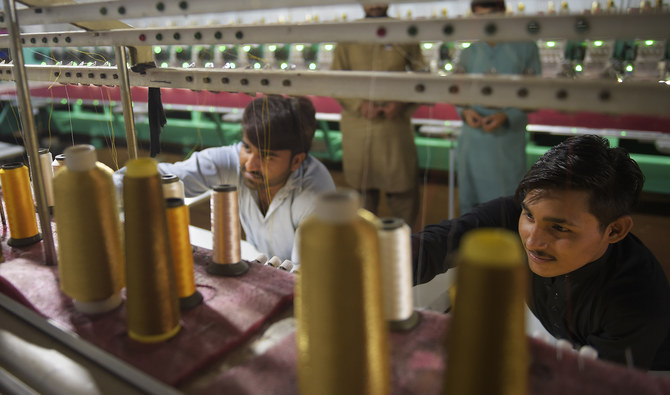
Workers supervise embroidery machines working on fabrics for wedding dresses at a small factory on the outskirts of Islamabad on Sept. 2, 2020. (AFP)
Short Url
Updated 09 October 2020
Follow

Pakistan's new textile policy to boost exports, create job opportunities

  • The policy is expected to be rolled out in next couple of months after consultation with stakeholder, says parliamentary secretary for textile
  • Pakistan is targeting $50 billion in exports by 2030 to bridge the current accounts deficit and boost foreign exchange reserves

ISLAMABAD: Pakistan plans to roll out a new textile policy in the next couple of months to boost exports, e-commerce, and create job opportunities for youth, a top government official said on Thursday, adding that the government was hoping to make the country part of the global value chain.
The textile industry is the single largest export earning sector of the country and eighth largest exporter of textile products in Asia. There are 423 textile industries working in the country, employing about 40 percent of the country’s total labor force.
The government has been struggling to boost the exports from the current $23 billion to $50 billion by 2030 to strengthen Pakistan’s economy, foreign exchange reserves and bridge the current account deficit by offering different tax incentives to the industry. Other than textiles, Pakistan exports food items, chemical and pharmaceutical products, leather and sports goods to different countries, including the Middle East and Europe.
“The consultation process [on the policy] is underway and its fine-tuning is being done with the help of public and private sectors,” Aliya Hamza Malik, parliamentary secretary for textile, commerce, industries and production, told Arab News in an interview.
She said the initial draft of the five-year policy was ready which would be presented to the Economic Coordination Committee of the Cabinet (ECC) for approval in the next couple of months.
“Our targets [for the industry] will be realistic and achievable,” she said. “We won’t make tall and fake claims.”
Malik said that Pakistan’s exports have registered a significant increase during the COVID-19 pandemic when exports of other countries in the region, including India and Bangladesh, were going down.
“We want to extend maximum benefit to our industry through this policy and are consulting all relevant stakeholders including economists and industrialists to make it more inclusive and comprehensive,” she said.
Pakistan’s textile industry is the fourth largest cotton producer and contributes 8.5 percent to the GDP.


Malik, however, said that her government was focusing beyond the raw material like cotton to boost value addition and export of end products. “We aren’t only focusing on market diversification but also making product and fiber diversification part of the policy.”
“Value addition is the future of textile … and textile is the backbone of our economy,” she said, adding that the government wanted to create more job opportunities for skilled and unskilled labor, boost e-commerce, small and medium enterprises and human resource development through its new policy.
The new policy would also help empower women entrepreneurs and skilled female workers as the government was laying focus on exports of the stitched materials.
“When I talk about value addition, it means we want to focus on stitching and when we will move to it we will need more training. This will help us encourage women participation,” she said.
The parliamentary secretary said that her government was also working on reducing the cost of doing business in Pakistan to make the industry competitive in the region. “Our textile industry is overbooked now … and our next goal is to make Pakistan part of the global value chain,” she said.


India look forward to Pakistan ‘challenge’ at T20 World Cup

Updated 7 sec ago
Follow

India look forward to Pakistan ‘challenge’ at T20 World Cup

  • Pakistan government late Monday ended a week-long stand-off by rescinding order for its team to boycott Feb. 15 match
  • Pakistan’s decision to go ahead with the match was hailed Tuesday as an outbreak of ‘good sense’ and ‘good for cricket’

NEW DELHI: India said Tuesday it would be “a challenge” to face a “quality” Pakistan team in Colombo after Islamabad U-turned and decided to play the blockbuster T20 World Cup clash.

The Pakistan government late Monday ended a week-long stand-off by rescinding its order for the cricket team to boycott the February 15 match.

“It’s great that the game is back on, we kind of never changed the preparation,” said India assistant coach Ryan ten Doeschate.

India will face a second Group A match against Namibia on Thursday in New Delhi before flying to Sri Lanka.

It means a quick turnaround for Sunday’s match, the biggest and most lucrative clash in world cricket.

“It’s going to be a challenge going to Colombo where Pakistan have been for the last two weeks,” added Ten Doeschate.

“We are delighted to have another chance to play against a quality side in the first phase of the tournament.

“We are fully focused on just bringing our best game to that fixture.”

Pakistan’s decision to go ahead with the match was hailed Tuesday as an outbreak of “good sense” and “good for cricket.”

A frantic weekend of negotiations saw International Cricket Council (ICC) and Bangladesh Cricket Board (BCB) chiefs fly to Lahore on Sunday for talks with the Pakistan Cricket Board (PCB).

The governments of Bangladesh and Sri Lanka both wrote to the Islamabad government on Monday urging it to change its stance and allow the game to go ahead.

After “multilateral discussions, as well as the request of friendly countries, the Government of Pakistan hereby directs the Pakistan National Cricket Team to take the field on February 15,” the Islamabad government said on its official X account late Monday night.

The decision had been taken with the aim of “protecting the spirit of cricket,” it added.

’GOOD FOR CRICKET’

Former India cricketer Madan Lal told AFP on Tuesday that it was “good for cricket.”

“We want strong teams to play so that the charm of the World Cup is not lost,” he added.

Sri Lanka, who will host the match which generates multi-millions of dollars in advertising, broadcast rights, sponsorship and tourism, also praised the decision.

Sri Lankan President Anura Kumara Dissanayake, in a social media post, thanked Pakistan’s Prime Minister Shehbaz Sharif for “ensuring the game we all love goes on.”

Veteran Indian journalist Pradeep Magazine told AFP “good sense has prevailed on all sides.”

Financial considerations would have been taken into account, he added.

“Everyone realized that losing the revenue from an India-Pakistan match would have been a loss-loss situation for all ICC member nations.”

The 20-team tournament has been overshadowed by an acrimonious political build-up.

Bangladesh, who refused to play in India citing security concerns, were replaced by Scotland.

As a protest, the Pakistan government ordered the team not to face co-hosts India in the Group A fixture.

Pakistan, who edged out Netherlands in the tournament opener on Saturday, would have conceded two points if they had forfeited the match.

Pakistan will play all their T20 World Cup matches in Sri Lanka as part of an International Cricket Council deal that ensures the two nations only meet on neutral territory.

India captain Suryakumar Yadav said on Friday before their opening win against the USA that his team would travel to Colombo for the clash, whether the game was on or not.

“We haven’t said no to playing them,” Suryakumar said. “Our flights are booked and we are going to Colombo.”