DUBAI: The digital era has transformed the way people work and live, and has become more evident as the coronavirus pandemic forced everybody into an online environment to learn, work, and communicate.
In a discussion, titled the ‘future of work,’ at the second day of the Civil Society 20 Summit (C20) a panel of experts and business leaders discussed leadership in the digital age.
The C20 is one of the eight official engagement groups of the G20, which allows civil society groups to put forward a non-government and non-business voice.
Panelists of the ‘Rethinking ‘Leadership’ for a Digital Age’ session said they agreed that leadership must work hand-in-hand with technology and that “there must be a greater understanding between leadership and authority in this digital age.”
“Leadership sometimes needs authority, sometimes it does not,” Salma El-Yassir, co-founder of Womaneze, said, stressing that it is important to understand the difference between the two.
Yassir further explained that the lack of understanding created underlying fears, leading to some resisting change, including a shift to technology-driven work.
Roberto Croci, managing director at Microsoft for Startups MEA, said leadership in the digital age was not about technology, but more on people.
“It is human centered. Leaders misunderstand their role, always thinking about themselves… but it is about others,” Croci told the panel.
“A leader should come out as vulnerable, it is okay to be human. A good leader should be asking the right questions [since leaders] do not have all the answers.”
Anastasia Dedyukhina, founder of Consciously Digital, said she believed that “leadership should work hand in hand with technology.”
“A great leader is not only listening to people but also listens to suggestions. The [coronavirus] pandemic is a perfect example, if a leader listens to employees it will invigorate leadership,” Dedyukhina said.
But Dedyukhina warned that technology tools were not necessarily neutral, as some digital tools end up putting workers on a digital leash.
“Small things [such as digital communication versus personal communication] make a big difference… technology adoption has an effect on employees,” she explained.
“Technology is taking a toll on people. That is not our natural state of being. We cannot be expected to be at a screen for hours on end. Companies have to be cognizant and aware and make allowances for it,” Yassir meanwhile commented.
For Croci, some leaders are not updating the way people are being measured for performance management.
“People must be rewarded on outcomes and impact. Who cares if you work nine hours in your laptop? The small mannerisms of leaders show how to respect your employees,” Croci explained.
“We are seeing signs of digital fatigue in this new normal. Long meetings are not natural, are not healthy.”
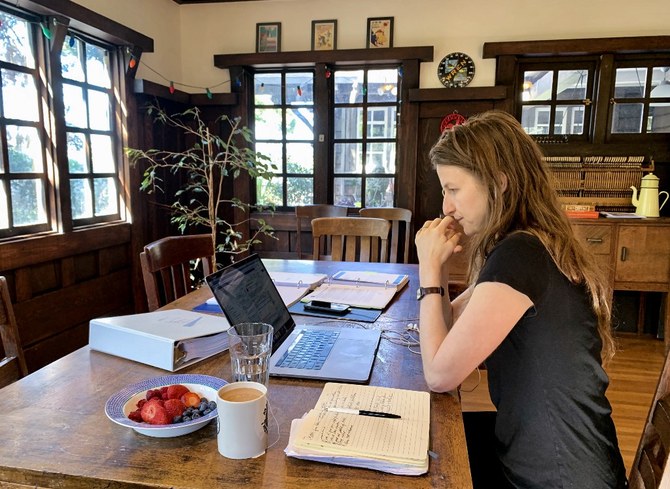
The panelists likewise had critical views about working from home, which has become common across workforces around the globe since the coronavirus pandemic broke out.
“On the short term [working from home] can be great, but the last six months has been just about surviving,” Dedyukhina said, and mentioned a study where home-based employees were eager to return to office work, fearing their chances of promotion were jeopardized by their physical absence.
“The idea of ownership of a day initially feels great but it stops, and then becomes tiring. It may be time for leaders to reconfigure, and give workers a choice of working from home or in the office,” Yassir said.
“It could be time to do a combination of things, trust people to do their work.”
“How you are measuring your employees… you do not necessarily have to be a Google or Microsoft. It is the way you care [for your employees]. Think of your employees as human, would you do this thing to yourself? We need a human-centered leader at these times,” Microsoft’s Croci meanwhile commented.


Work from home: is it time to return to the office, C20 panel asks
https://arab.news/gwv7p
Work from home: is it time to return to the office, C20 panel asks

- ‘Leadership sometimes needs authority, sometimes it does not’
- ‘Technology is taking a toll on humans, that is not our natural state of being’


Middle East war economic impact to depend on duration, damage, energy costs, IMF official says
- Katz: Prolonged increase in energy prices could unanchor inflation expectations
- IMF: 2026 global GDP outlook was solid, too early to judge war’s impact on growth
WASHINGTON: The Middle East war’s impact on the global economy will depend on its duration and damage to infrastructure and industries in the region, particularly whether energy price increases are short-lived or persistent, the International Monetary Fund’s number two official said on Tuesday.
IMF First Deputy Managing Director Dan Katz told the Milken Institute Future of Finance conference in Washington that if there is prolonged uncertainty from the conflict and a prolonged impact on energy prices, “I would expect central banks to be cautious and respond to the situation as it materializes.”
He said the conflict could be “very impactful on the global economy across a range of across a range of metrics, whether it’s inflation, growth and so on” but it was still early to have a firm conviction.
Prior to the US and Israeli air strikes on Iran and counterattacks across the region, the IMF had forecast solid global GDP growth of 3.3 percent in 2026, powering through tariff disruptions due in part to the continued AI investment boom and expectations of productivity gains.
Katz said that the economic impact from the Middle East conflict would be influenced by its duration and further geopolitical developments.
Earlier, the IMF said it was monitoring the conflict’s disruptions to trade and economic activity, surging energy prices and increased financial market volatility.
“The situation remains highly fluid and adds to an already uncertain global economic environment,” the Fund said in a statement issued from Washington. Katz said the IMF will look at the conflict’s direct impacts on the region, including damage to infrastructure, and disruptions to key sectors.
“Tourism is an important one. Air travel. Is there physical damage to infrastructure, production facilities, and the big industry in particular that everyone will be focused on is, of course, the energy industry,” he said.
Oil rose further on Tuesday as Iran vowed to attack ships passing through the Strait of Hormuz. Brent crude oil , the global benchmark, surged to $83 per barrel, up 15 percent from its level on Friday.
Katz said he expected central banks to “look through” a temporary rise in energy prices, given their focus on core inflation. But central banks could respond if a more persistent energy shock results in “a destabilizing of inflation expectations.”
He said the post-COVID inflation spike of 2022 was influenced by energy impacts from Russia’s invasion of Ukraine, with more pass-through from headline inflation to core inflation.
“And so I’m sure central banks, as they are thinking about how the geopolitical situation is translating into energy markets, will be looking at the lessons of the pandemic and seeing if they can apply any of those lessons in setting monetary policy,” Katz said.


