

Major banks in Singapore look to develop digital trade registry

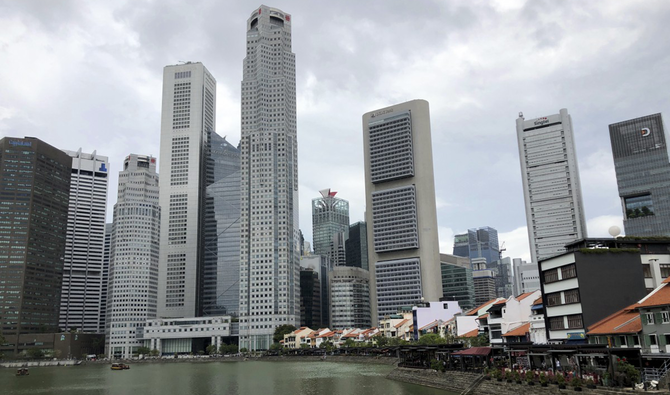
Banks have pared their commodities business this year following collapses, including that of Singapore oil trader Hin Leong Trading. (AP)
Short Url
Updated 07 October 2020
Follow

Major banks in Singapore look to develop digital trade registry

  • A digital trade registry helps trade financing banks to avoid duplicate financing

SINGAPORE: Some of the world’s biggest banks in commodity trade finance are creating a digital trade finance registry in Singapore to reduce risk of trade fraud and boost transparency after losing billions of dollars due to a spate of defaults.

Banks have pared their commodities business this year following collapses, including that of Singapore oil trader Hin Leong Trading, which shocked lenders after instances of financial wrongdoing were laid bare by the coronavirus crisis.

According to a joint statement issued on Tuesday, DBS Group and Standard Chartered are leading a group of 12 banks in Singapore to create and conduct a central database to access trade transactions financed across banks.

“A digital trade registry strengthens trade financing banks’ ability to avoid duplicate financing, and facilitates more sustained credit flow in trade financing,” said Ho Hern Shin, an assistant managing director at the Monetary Authority of Singapore.

The move comes after investigations into commodity trading firms revealed that multiple layers of financing from different lenders were obtained for the same inventory.

Eugene Tarzimanov, a senior credit officer at Moody’s Investors Service, said the latest move was “credit positive” for banks as it will reduce the risk of fraud seen in recent years.

“Moreover, the registry will make it easier for smaller commodity traders to access bank credit in Singapore, as their lenders will be more confident that the collateral is really there,” he told Reuters.

Reuters first reported in July that commodity trade financiers are teaming up in the city-state to strengthen lending practices and improve transparency.


Saudi IsDB approves $1.37bn in financing to support development projects in 12 countries 

Updated 5 sec ago
Follow

Saudi IsDB approves $1.37bn in financing to support development projects in 12 countries 

RIYADH: Saudi Arabia’s Islamic Development Bank has approved a new package of projects with a total value of approximately $1.37 billion, allocated to support 12 member countries. 

The approval was made by the board of executive directors of the bank, during its 363rd meeting chaired by its President Muhammad Al-Jasser. 

The session approved 14 financing operations to support development projects covering renewable energy, cross-border energy networks, major transport corridors, water and food security, alongside education and health services.  

This contributes to enhancing economic resilience, improving access to basic services, and supporting progress toward achieving the Sustainable Development Goals. 

The approvals included financing of €306.89 million ($360 million) for the expansion and development project of the Godomey–Ouedo–Hillacondji road in Benin, to enhance a strategic segment of the Abidjan–Lagos Corridor.  

Cote d’Ivoire received €200 million in financing to develop the Taferi–Ferkessedougou section of the A3 highway, boosting trade and mobility between central and northern regions and neighboring landlocked countries. 

Funding of $180.72 million was also approved for the King Faisal Road development project in Manama, Bahrain, aiming to alleviate traffic congestion and improve urban transport mobility.  

Lebanon benefited from $13.50 million in financing to establish the Bqarqacha bypass and develop the Bqarqacha–Bcharre road, to improve traffic safety and accessibility for local communities. 

In the energy sector, Uzbekistan will receive total financing of $110 million for utility-scale photovoltaic solar and battery storage projects in Samarkand-1 and Samarkand-2, enhancing national grid capacities.  

The bank also approved €55.19 million in financing for Mauritania to connect electricity grids with Mali and support related solar power stations, to provide cleaner and more reliable electricity to local communities. 

In the field of water and food security, the bank approved €188.82 million in financing for Morocco’s Water Stress Mitigation project, including the construction of dams and related works to ensure water supplies and transfer surplus from northern basins to the more stressed southern regions.  

Additionally, €18.23 million was approved for an inland aquaculture value chain development project. 

Sierra Leone was allocated €25.93 million for the Freetown Water Supply, Sanitation, and Aquatic Environment Revamping project, to improve water and sanitation services and restore key watersheds.  

Cameroon received €36.66 million for the Sustainable Irrigation and Agricultural Value Chain Development project, to support climate-resilient irrigation and improve rural infrastructure. 

In Jordan, the Hima Oasis for Prosperity and Employment program for rural employment and agricultural growth benefited from $11.25 million in financing to support rural jobs and agricultural productivity, focusing on women and youth by improving access to finance, skills, and market linkages. 

The Board also approved investments in the health and human capital development sector, including an allocation of €61.41 million for Mauritania to establish a 440-bed Maternal, Neonatal, and Child Health Referral Hospital in Nouakchott, enhancing access to specialized healthcare. 

In Tajikistan, $13.95 million in financing was approved for the Tourism Business Education Development project, aiming to elevate tourism and hospitality education and establish a national training center focusing on Halal tourism.  

Pakistan received $10 million in financing from the Islamic Solidarity Fund for Development to support the Out-of-School Children project in Azad Jammu and Kashmir. 

These approvals reflect the IsDB’s ongoing commitment to supporting member countries in bridging infrastructure gaps, expanding essential social services, accelerating the energy transition, and promoting comprehensive and sustainable development.