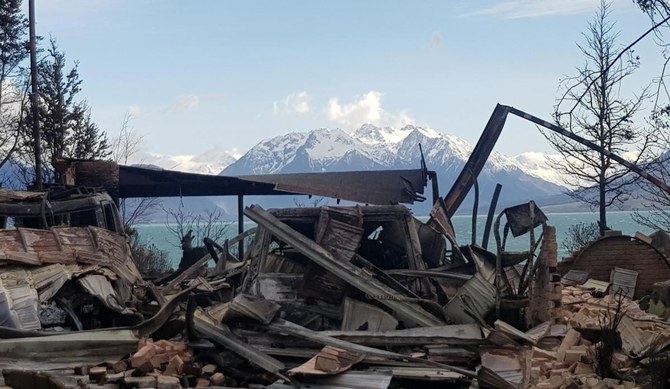
WELLINGTON: Wildfires have destroyed up to 50 homes in New Zealand, authorities announced Monday, saying it was a miracle no one was hurt as “a wall of orange” razed most of a remote South Island village.
The blaze began in a mountain forest early Sunday morning and, fanned by strong winds, swept through the village of Lake Ohau, forcing residents to flee for their lives.
Fire and Emergency New Zealand (FENZ) said the unpredictable winds made fighting the fire “challenging” and by Monday afternoon it had razed 4,600 hectares (18 square miles) of land.
Waitaki District mayor Gary Kircher said the tiny Lake Ohau community had been devastated.
“Of the 60 or 70 houses, we believe that the majority have gone,” he told Radio New Zealand.
“The reality is that it’s a minor miracle no one has been harmed. If it had been another 15-20 minutes it would have been a very different story.”
Kircher described how residents awoke to find an inferno bearing down on them.
“I talked to a gentleman who got up to his dog (barking) in the early hours, opened his door and there was this wall of orange,” he said.
“He was the one that set off the town fire alarm and helped to wake people... there’s certainly some scary tales about how close it came to being an absolute disaster with fatalities.”
Wildfires are relatively common on the South Island at this time of the year but the scale and intensity of the Ohau fire have been unusual.
By Monday afternoon the fire front had moved far enough from the village to allow evacuated residents a brief trip back to assess the damage.
Civil Defense Minister Peeni Henare, who accompanied them, described seeing burned out cars and gutted homes.
“The term I’ve heard used to describe it is a war zone,” he told reporters.
“It’s clear to me that there’s no rhyme or reason when it comes to fire, one house is affected, the neighbor isn’t... you can feel a sense of loss.”
FENZ said 11 helicopters and eight fire crews were attempting to contain the flames.
With light rain forecast for the next 24 hours, there were hopes it would be under control by Tuesday night.
New Zealand this year experienced its warmest winter on record, which government science body NIWA said was consistent with a long-term trend of rising temperatures linked to climate change.
University of Auckland environmental science expert, professor George Perry, said it was difficult to attribute a specific event such as the Lake Ohau fire to climate change.
But he said New Zealand had experienced more large wildfires that usual in recent years, pointing to changes in the three main factors affecting wildfires — fuel, climate and ignition sources.
“We would expect more such events under climate change especially as conditions become warmer and drier, and we see more droughts,” he told AFP.
ns/dm/mtp

Wildfires raze dozens of homes in New Zealand
https://arab.news/wqubm
Wildfires raze dozens of homes in New Zealand
- The blaze began in a mountain forest early Sunday morning
- Wildfires are relatively common on the South Island at this time of the year
UN chief launches first global, independent scientific panel on artificial intelligence
- Secretary-General Antonio Guterres nominates 40 experts to serve on body ‘dedicated to helping close the AI knowledge gap and assess the real impacts of AI’
- It will ‘help the world separate fact from fakes, and science from slop … at a moment when reliable, unbiased understanding of AI has never been more critical,’ he adds
NEW YORK CITY: UN Secretary-General Antonio Guterres on Wednesday formally launched what he described as the only global, independent scientific body focused on artificial intelligence, and submitted his recommendations for the experts to serve on it.
“It will be the first global, fully independent scientific body dedicated to helping close the AI knowledge gap and assess the real impacts of AI across economies and societies,” he told reporters in New York.
“And this could not be more urgent. AI is moving at the speed of light. No country can see the full picture alone.”
The Independent International Scientific Panel on Artificial Intelligence was established by the UN General Assembly through a resolution in August. Guterres said he has now submitted a list of 40 experts from all regions as his proposed candidates for the new body, which was mandated by world leaders under the UN’s Pact for the Future.
The panel is intended to provide authoritative, science-based analysis at a time when AI is developing rapidly and reshaping economies, governance and social life, but regulatory approaches remain fragmented.
Guterres underscored the need for shared understanding among countries to help develop effective safeguards, promote innovation for the common good, and strengthen international cooperation.
The UN said the panel would serve as a global reference point, helping policymakers and the public distinguish between reliable evidence and misinformation, and grounding debates on AI in independent scientific assessment.
The initiative comes amid growing concern over the societal, economic and security risks posed by unchecked technological competition.
“We need shared understandings to build effective guardrails, unlock innovation for the common good, and foster cooperation,” Guterres said.
“The panel will help the world separate fact from fakes, and science from slop. It will provide an authoritative reference point at a moment when reliable, unbiased understanding of AI has never been more critical.”
The proposed members of the panel were selected following an open global call that attracted more than 2,600 applicants, whose expertise spanned fields including machine learning, data governance, public health, cybersecurity, child development and human rights. The chosen candidates are expected to serve in a personal capacity, independent of governments, businesses or other institutions.
The panel will operate on an accelerated timeline, with its first report due in time to inform a Global Dialogue on AI Governance scheduled for July. UN officials said the findings were expected to support international efforts to build common ground on AI governance during a period of heightened geopolitical tensions and technological rivalry.
Guterres framed the initiative as part of a broader push to ensure that AI is shaped collectively, guided by scientific evidence and global solidarity, rather than allowing its development to outpace international cooperation.


