

Lebanon asks Interpol to issue arrest warrants for two Russians over Beirut blast

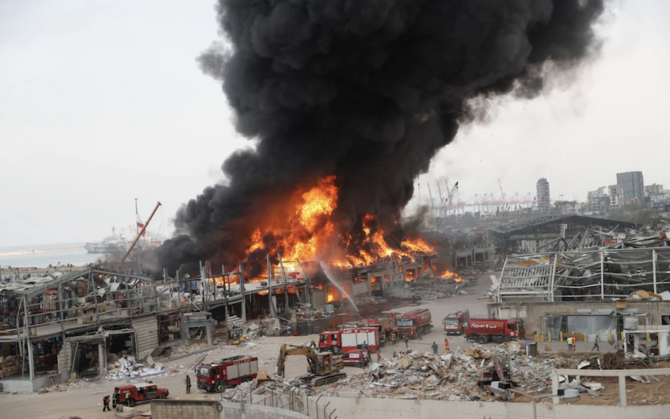
Almost 3,000 tons of ammonium nitrates were shipped into Beirut port in 2013 and stored there, which then subsequently exploded — killing 193 people, wounding more than 6,500 and causing billions of dollars of damage. (AP/File Photo)
Short Url
Updated 02 October 2020
Follow

Lebanon asks Interpol to issue arrest warrants for two Russians over Beirut blast

  • Almost 3,000 tons of ammonium nitrates were shipped into the port in 2013 and stored there

LONDON: Lebanon has asked Interpol to issue arrest warrants for two Russians who transported material into Beirut port which exploded on August 4.

Almost 3,000 tons of ammonium nitrates were shipped into the port in 2013 and stored there, which then subsequently exploded — killing 193 people, wounding more than 6,500 and causing billions of dollars of damage to the Lebanese capital.

Judge Fadi Sawwan referred the case to the state prosecution, which then asked Interpol to arrest two Russian citizens believed to be Boris Prokoshev, captain of the MV Rhosus which sailed from Turkey to Beirut, and businessman Igor Grechushkin living in Cyprus, who purchased the cargo ship in 2012, the National News Agency said.
Grechushkin had already been questioned by police on request of Interpol’s Lebanon office back in August.

More than 20 people, including port and customs officials, have been arrested and questioned since the devastating blast, which is now considered to be one of the biggest non-nuclear explosions ever recorded.

The Rhosus set sail from Batumi in Georgia carrying more than 2,700 tons of ammonium nitrate destined for Mozambique, but was forced to make a detour to Beirut in November 2013.

Almost a year later, in October 2014, the explosive material was moved into the port’s Warehouse 12, which holds impounded materials. 

The ammonium nitrate remained in the warehouse until it exploded while the Rhosus never left the port and sank there in February 2018, according to Lebanese official documents.


1,965 Israeli violations recorded against Palestinians in February

Updated 3 sec ago
Follow

1,965 Israeli violations recorded against Palestinians in February

  • Head of Wall and Settlement Resistance Commission condemns attacks as a continuation of ‘terror’ against Palestinians
  • Violations included assaults, uprooting trees, burning fields and preventing olive pickers from accessing their lands

LONDON: Israeli forces and settlers carried out 1,965 attacks across Palestinian towns in the occupied West Bank in February, according to a report by the Palestinian Authority.

Muayyad Shaaban, head of the Wall and Settlement Resistance Commission, condemned the attacks as a continuation of the “terror” against the Palestinian people, their land and property.

The commission documented 1,454 attacks by Israeli forces and 511 by settlers, most of which were concentrated in the governorates of Hebron with 421 attacks, followed by Nablus with 340, Ramallah and Al-Bireh with 320, and East Jerusalem with 210 attacks.

Violations have included direct beatings of Palestinians, uprooting trees, burning fields, and preventing olive pickers from accessing their lands.

Israeli forces have seized land and demolished homes and agricultural facilities under the pretext of “security,” which has enabled settlers to expand their settlements, according to Wafa news agency.

Shaaban said: “What is taking place represents an organized methodology aimed at emptying the land of its owners and imposing an integrated racist colonial system.”

Israeli settlers have poisoned and uprooted a total of 1,314 trees, including 1,054 olive trees, in the areas of Ramallah, Bethlehem, Hebron, Nablus and Tulkarm. The olive groves have been a lifeline for Palestinians in the West Bank, with an estimated 80,000 to 100,000 families relying on the olive harvest for their livelihoods, according to the UN Human Rights Council.

In February, Israeli forces demolished 122 structures belonging to Palestinians, including 56 inhabited homes, nine uninhabited homes, 34 agricultural facilities and 18 sources of livelihood. More than one-third of these demolitions took place in Jerusalem, totaling 46 structures.