

‘Worst debate ever’ — US expats lament lack of substance in Trump-Biden bust-up

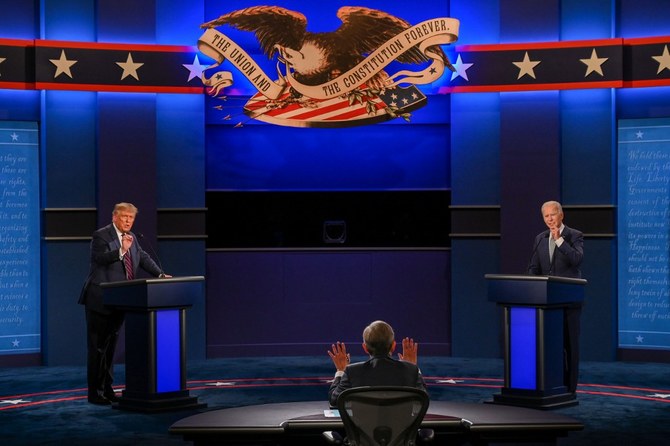
US President Donald Trump and Democratic Presidential candidate and former US Vice President Joe Biden exchange arguments as moderator and Fox News anchor Chris Wallace (C) raises his hands to stop them during the first presidential debate. (AFP)
Short Url
Updated 07 October 2020
Follow

‘Worst debate ever’ — US expats lament lack of substance in Trump-Biden bust-up

  • Americans in the Gulf shocked by crosstalk, insults, mockery and lack of focus on policies during candidates’ first televised showdown
  • Any attempt at substantive exchanges on the main issues — the Supreme Court, COVID-19, race and violence, the economy, and the integrity of the election — were drowned out by acrimony

DUBAI: Americans living in the Gulf looked on, aghast, as personal insults flew back and forth between the two men who aspire to lead the US.

A chaotic 90 minutes of insults, temper tantrums, endless interruptions and attacks on an opponent’s family turned the first televised debate between Donald Trump and Democratic challenger Joe Biden into the most acrimonious televised presidential head-to-head in US history.

Expatriates in the Middle East set their alarms for the early hours to watch what turned out to be a “dumpster fire” of a debate, as some commentators described it, unfold in Cleveland, Ohio.

“This debate completely lacked in substance, so how could an expat understand anything about Biden (or Trump’s) positions,” said Liberty Jones, who is from Washington D.C. and has lived in Dubai for eight years. “Aside from a quick discussion on how Trump is handling COVID, it was devoid of any depth on their approaches.”

Opinion

This section contains relevant reference points, placed in (Opinion field)

The debate was the first of three between the two candidates in the run up to election day on Nov. 3. Any attempt at substantive exchanges about the six main issues — the Supreme Court, COVID-19, race and violence in US cities, the economy, and the integrity of the election — were drowned out by acrimony.

“You’re the worst president that America ever had,” Biden told Trump. “In 47 months I’ve done more than you have done in 47 years,” Trump responded.

The moderator, Chris Wallace of Fox News, had to raise his voice on several occasions to demand that Trump respect the two-minute time allocated for uninterrupted answers to questions and let Biden speak. Biden also provided fuel for the fire with a series of personal attacks, calling Trump a liar and a racist.

Then there was Biden’s “inshallah” moment, which lit up Twitter across the Arab world. It came after Trump promised to release his still-hidden tax returns, some details of which were published by the New York Times last week. Biden sarcastically asked, “When?” followed by a word that many viewers thought sounded like “Inshallah,” meaning “God willing.”

Whether or not he actually uttered the familiar Arabic expression remains a mystery but it certainly caught the attention of American expats in the Gulf, some of whom feel distanced from the core issues of the election.

“As expats, we are naturally not as close to the candidates and their platforms,” said Jones, who is a public relations director for luxury retailer Tiffany & Co. “While we can consume news, we don’t have the benefit of our community and families sharing their perspectives on the candidates. This places greater weight on the debates to help expats understand the platforms and policies of the respective candidates.”

James Erazo Ruiz, a healthcare company director who lives in Abu Dhabi and describes himself as a Republican, said: “The American people are the losers of this debate.

“History tells us that presidential debates are not decision-making events. I hoped this one would be different but all we saw was name-calling and an insulting debacle that served no purpose.

“The debate was light on policy, issues and solutions. Quite frankly, it was the worse debate I have ever seen. It was a joke.”

Brian Raggott, who has worked in Dubai for nine years for an American IT company, said the debate reinforced the negative image of America outside of the US.

“America needs someone who can bring the country back together again and last night we didn’t see it,” he said. “As an American outside of the US, you want to bring American ideals wherever you go — and right now it’s a tough time.”

Ali Khalaf, who has lived in Dubai since 2007, sounded a slightly more optimistic note for the future of American politics. He said that he hopes the “disturbing” nature of the debate will shock more people into greater engagement with the political process.

“The hope that can be drawn from these debates is that we emerge from these elections with the desire to invest more in our nation’s choices,” he added.

The last topic of the debate, the integrity of the election, in particular struck a chord with Americans in the Gulf, many of whom said that despite submitting a request weeks ago they are still waiting to receive their absentee ballots.

Approximately 9 million Americans live overseas, according to 2016 figures from the US State Department. If they were considered to be a US state, it would rank as the 12th largest in population size, so they represent a powerful block of votes.

An anonymous US citizen living in Dubai, who declined to be named, said: “Americans abroad deserve to feel confident that our votes are accurately counted and protected from fraud. It’s strange to wait this long for a ballot — and then when it comes and we mail it in, can we trust that it will be counted appropriately?”

“Our votes absolutely count,” said Jean Candiotte, a creative director, writer and producer who has lived in Dubai for almost seven years. “This has the potential to be a close election, which means that every single vote is important.

“As Americans, we get to take our home country with us when we live overseas; we file and pay our home country’s taxes and we maintain the right to vote, and it’s important to exercise that right — it’s who we are as a nation.”


Syrian army pushes into Aleppo district after Kurdish groups reject withdrawal

Updated 10 January 2026
Follow

Syrian army pushes into Aleppo district after Kurdish groups reject withdrawal

  • Two Syrian security officials told Reuters the ceasefire efforts had failed and that the army would seize the neighborhood by force

ALEPPO, Syria: The Syrian army said it would push into the last Kurdish-held district of Aleppo ​city on Friday after Kurdish groups there rejected a government demand for their fighters to withdraw under a ceasefire deal.
The violence in Aleppo has brought into focus one of the main faultlines in Syria as the country tries to rebuild after a devastating war, with Kurdish forces resisting efforts by President Ahmed Al-Sharaa’s Islamist-led government to bring their fighters under centralized authority.
At least nine civilians have been killed and more than 140,000 have fled their homes in Aleppo, where Kurdish forces are trying to cling on to several neighborhoods they have run since the early days of the war, which began in 2011.

HIGHLIGHTS

• Standoff pits government against Kurdish forces

• Sharaa says Kurds are ‘fundamental’ part of Syria

• More than 140,000 have fled homes due to unrest

• Turkish, Syrian foreign ministers discuss Aleppo by phone

ِA ceasefire was announced by the defense ministry overnight, demanding the withdrawal of Kurdish forces to the Kurdish-held northeast. That would effectively end Kurdish control over the pockets of Aleppo that Kurdish forces have held.

CEASEFIRE ‘FAILED,’ SECURITY OFFICIALS SAY
But in a statement, Kurdish councils that run Aleppo’s Sheikh Maksoud and Ashrafiyah districts ‌said calls to leave ‌were “a call to surrender” and that Kurdish forces would instead “defend their neighborhoods,” accusing government forces ‌of intensive ⁠shelling.
Hours ​later, the ‌Syrian army said that the deadline for Kurdish fighters to withdraw had expired, and that it would begin a military operation to clear the last Kurdish-held neighborhood of Sheikh Maksoud.
Two Syrian security officials told Reuters the ceasefire efforts had failed and that the army would seize the neighborhood by force.
The Syrian defense ministry had earlier carried out strikes on parts of Sheikh Maksoud that it said were being used by the Kurdish-led Syrian Democratic Forces (SDF) to launch attacks on the “people of Aleppo.” It said on Friday that SDF strikes had killed three army soldiers.
Kurdish security forces in Aleppo said some of the strikes hit a hospital, calling it a war crime. The defense ministry disputed that, saying the structure was a large arms depot and that it had been destroyed in the resumption of strikes on Friday.
It ⁠posted an aerial video that it said showed the location after the strikes, and said secondary explosions were visible, proving it was a weapons cache.
Reuters could not immediately verify the claim.
The SDF is ‌a powerful Kurdish-led security force that controls northeastern Syria. It says it withdrew its fighters from ‍Aleppo last year, leaving Kurdish neighborhoods in the hands of the Kurdish ‍Asayish police.
Under an agreement with Damascus last March the SDF was due to integrate with the defense ministry by the end of 2025, ‍but there has been little progress.

FRANCE, US SEEK DE-ESCALATION
France’s foreign ministry said it was working with the United States to de-escalate.
A ministry statement said President Emmanuel Macron had urged Sharaa on Thursday “to exercise restraint and reiterated France’s commitment to a united Syria where all segments of Syrian society are represented and protected.”
A Western diplomat told Reuters that mediation efforts were focused on calming the situation and producing a deal that would see Kurdish forces leave Aleppo and provide security guarantees for Kurds who remained.
The diplomat ​said US envoy Tom Barrack was en route to Damascus. A spokesperson for Barrack declined to comment. Washington has been closely involved in efforts to promote integration between the SDF — which has long enjoyed US military support — and Damascus, with which the ⁠United States has developed close ties under President Donald Trump.
The ceasefire declared by the government overnight said Kurdish forces should withdraw by 9 a.m. (0600 GMT) on Friday, but no one withdrew overnight, Syrian security sources said.
Barrack had welcomed what he called a “temporary ceasefire” and said Washington was working intensively to extend it beyond the 9 a.m. deadline. “We are hopeful this weekend will bring a more enduring calm and deeper dialogue,” he wrote on X.

TURKISH WARNING
Turkiye views the SDF as a terrorist organization linked to the outlawed Kurdistan Workers’ Party and has warned of military action if it does not honor the integration agreement.
Turkish Foreign Minister Hakan Fidan, speaking on Thursday, expressed hope that the situation in Aleppo would be normalized “through the withdrawal of SDF elements.”
Though Sharaa, a former Al-Qaeda commander who belongs to the Sunni Muslim majority, has repeatedly vowed to protect minorities, bouts of violence in which government-aligned fighters have killed hundreds of Alawites and Druze have spread alarm in minority communities over the last year.
The Kurdish councils in Aleppo said Damascus could not be trusted “with our security and our neighborhoods,” and that attacks on the areas aimed to bring about displacement.
Sharaa, in a phone call with Iraqi Kurdish leader Masoud Barzani on Friday, affirmed that the Kurds were “a fundamental part ‌of the Syrian national fabric,” the Syrian presidency said.
Neither the government nor the Kurdish forces have announced a toll of casualties among their fighters from the recent clashes.