

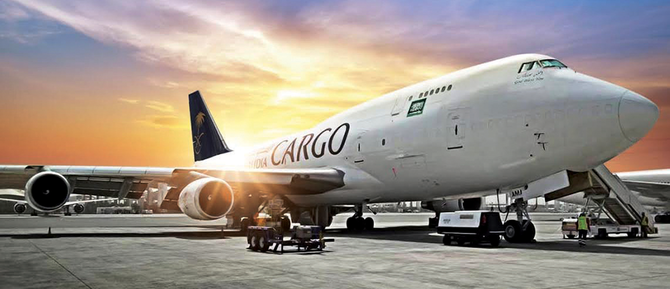
New Boeing 747-400F freighter joins Saudia Cargo fleet

The Boeing 747-400F freighter will enhance the logistic capacity of Saudia Cargo’s fleet.
Short Url
Updated 26 September 2020
Follow

New Boeing 747-400F freighter joins Saudia Cargo fleet

Saudia Cargo has added a Boeing 747-400F freighter to enhance the logistic capacity of its fleet, bringing the total number of its Boeing aircraft to seven. The company said the new aircraft will boost its cargo and supply operations and help meet the significant surge in demand for medicines, medical and preventive equipment and other goods.

Omar Hariri, CEO of Saudia Cargo, said: “We have taken practical steps to guarantee the smooth continuity of cargo and supply opera- tions to and from the Kingdom ever since the flights, excluding cargo and evacuation, were suspended due to COVID-19. Today, flights have been resumed but to a certain degree. Once the new freighter is put into operation, it will increase the operation and cargo capacity and help the company meet its targets and provide logistic support to deliver urgent medical goods to the Kingdom in order to mitigate the impact of COVID-19 as part of its continued efforts.”

The aircraft started the freighter services in September after all licenses had been obtained, flight schedules prepared and proper enhancements were put in place.

Since the emergence of CO- VID-19, Saudia Cargo has taken numerous measures to ensure cargo operations continue to run efficiently and provide high-quality logistic services. The company increased air freight services to many global destinations and markets covering the Middle East, Europe, Africa, Asia, and the US. It announced on March 25 the operation of pas- senger planes that were converted into cargo aircraft to increase capacity after complying with preventive and safety measures for crews on board.

Saudia Cargo fleet consists of seven Boeing aircraft, which include four Boeing 777 and three Boeing 747-400F.


RLC Global Forum places Kingdom at center of future of retail

Updated 16 January 2026
Follow

RLC Global Forum places Kingdom at center of future of retail

The RLC Global Forum will return to the Saudi capital on Feb. 3–4 to shape the future of retail and consumer-facing industries at a defining moment for growth against a backdrop of shifting cross-border commerce, evolving consumption patterns, and the global AI imperative.
As the world’s economic and cultural gravity continues to shift, Riyadh stands at the intersection of transformation by connecting East and West, tradition and innovation, and providing the ideal stage for this global dialogue.
The forum’s launch coincides with the announcement of two strategic partnerships with Cenomi Centers and Panda Retail Company, highlighting Saudi Arabia’s emergence as a driving force in the global growth narrative.
Speaking to Arab News ahead of the annual forum, Panos Linardos, chairman of RLC Global Forum, said the event enables decision-makers to create a sustainable growth and innovation strategy in retail by monitoring major transformative forces affecting worldwide leaders. 
“At the 2026 RLC Global Forum, the priority is not identifying trends — in fact most leaders already see the signals — but understanding how those forces collide and reshape decision-making. This year’s agenda reflects a world at a growth crossroads: capital is more disciplined, consumers are more selective, and traditional operating models are under strain,” said Linardos.
“This year we are focused on three interconnected questions. First, where does enduring growth come from when scale alone no longer guarantees resilience? Second, how are power and value shifting across the retail ecosystem? And third, how do markets like Saudi Arabia move from rapid expansion to sustainable, system-level value creation?” said the chairman.
“We believe that retail does not operate in isolation. That is why the forum is structured to examine these dynamics across retail, real estate, technology, and investment as a single interdependent system. This integrated view, rather than siloed thinking, is where meaningful strategy now takes shape,” he added.
The forum will convene more than 2,000 senior decision-makers in Riyadh, with participants spanning global retail groups, sovereign-linked investors, developers, technology platforms, policymakers, and academic institutions from more than 40 countries.
“What matters most, however, is not scale but composition. You must understand that this is an invitation-only audience shaped deliberately around decision-making authority. CEOs sit alongside ministers, investors alongside operators, and academics alongside practitioners, not to offer commentary, but to interrogate assumptions and test strategies against real-world constraints,” said Linardos.
What distinguishes the forum is its ability to bring global perspectives into direct conversation with regional realities.
“As Saudi Arabia’s role in global trade, tourism, and consumer markets accelerates, that intersection has become increasingly relevant for leaders reassessing how and where growth is built,” he said.
Reports indicate that retail sales in the Kingdom are forecast to reach $161.4 billion by 2028. “The scale of the opportunity is clear, but the more interesting question is how that growth is shaped,” Linardos told Arab News. “Demographics, digital adoption, tourism growth, and large-scale urban development are converging at once. That creates opportunity, but also raises the bar. The next phase of retail growth in the Kingdom will favor models that integrate physical space, digital infrastructure, cultural relevance, and operational discipline.”
At the 2026 RLC Global Forum, many of the discussions center on this transition, he said.
The Kingdom’s advantage lies in its ability to design ecosystems where retail, hospitality, culture, and experience reinforce one another. Creating this long-term, integrated value is a core focus of the discussions at the forum, he added.
Commenting on the forum’s role in the future of the Saudi retail landscape, Linardos said: “Saudi Arabia does not need another conference to showcase ambition. What it benefits from — and increasingly demands — is a platform for informed, global dialogue grounded in execution. The RLC Global Forum plays that role by positioning Saudi Arabia not as a case study, but as a strategic participant in shaping the future of retail and consumer economies.”
“By bringing global leaders into Riyadh, the forum allows for an exchange that is both outward-looking and locally anchored. As the Kingdom moves from rapid transformation to long-term institution building, these conversations become more consequential. The forum is thus a critical catalyst in translating Vision 2030’s ambitions into a resilient, global-market reality,” he added.
The RLC Global Forum is a leading platform that brings together the world’s most influential retail leaders, innovators, and policymakers to drive positive industry change. It marks the next phase of the Retail Leaders Circle’s 12-year mission to connect and empower decision-makers across the retail and consumer-facing sectors.
Through high-level dialogue and strategic cross-industry initiatives, the forum addresses the long-term forces defining the trajectory of retail and its interconnected ecosystems.
Alongside the annual retail forum in Riyadh, the RLC Global Forum curates a calendar of high-profile events around the world, including the CEO Summit in New York and the RLC Fashion Summit in Milan.