

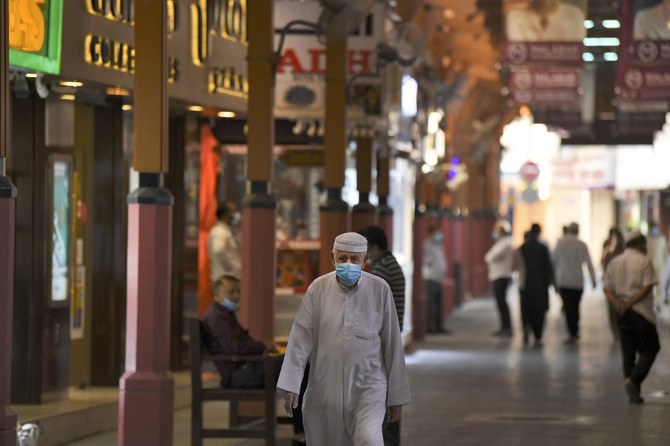
Dubai businesses slapped with fines over non-compliance with coronavirus measures

The establishments were fined over non-compliance with coronavirus measures. (File/AFP)
Short Url
Updated 26 September 2020
Follow

Dubai businesses slapped with fines over non-compliance with coronavirus measures

  • The authority has urged customers to report non-compliance
  • The UAE has been reporting increasing daily cases

DUBAI: Dubai Economy fined 14 commercial establishments and issued warnings to five more due to non-compliance with coronavirus measures, state news agency WAM reported.

The establishments activities were varied, between retail, medical supplies, money exchange, shipping and marketing management.

The authority has urged customers to report non-compliance with safety measures through the Dubai Consumer app, calling 600545555 or visiting consumerrights.ae website.

The UAE has been reporting increasing daily cases, with 1,008 new infections on Sept. 25.


From gunshots to the Africa Cup, Sudanese players endure brutal war to bring hope

Updated 2 sec ago
Follow

From gunshots to the Africa Cup, Sudanese players endure brutal war to bring hope

CASABLANCA: When Sudan player Ammar Taifour first heard gunfire outside his hotel room, he shrugged it off and went back to sleep. He had a soccer match to play.
But hours later, gunfire erupted again and gunmen surrounded the hotel in Omdurman, central Sudan, trying to seize control of the area. Taifour, a 28-year-old American-Sudanese midfielder, didn’t realize the shots marked the beginning a brutal war that would claim tens of thousands of lives and displace millions.
“We saw them from the windows all around the hotel holding guns,” Taifour told The Associated Press at the Africa Cup of Nations this week. “They were shooting at army aircraft. It was completely unexpected.”
Taifour and his teammates, coaches and medical staff were trapped inside the hotel for more than two days, as food and water supplies ran low. They left only after the gunmen withdrew, and Taifour flew back to the United States, leaving his career in Sudan behind as he searched for a new team.
His experience mirrors that of other Sudanese players forced to flee the country, leaving family members behind in the war-torn African nation while attempting to pursue soccer careers at the highest level.
A brutal war
The war in Sudan was labeled by the UN as the world’s worst humanitarian crisis. It erupted in April 2023 when a power struggle between the military and the powerful paramilitary Rapid Support Forces exploded into open fighting, with widespread mass killings and rapes, and ethnically motivated violence.
The conflict has killed more than 40,000 people according to UN figures, but aid groups say the true number could be many times higher. More than 14 million people have been displaced, as disease outbreaks and famine spread in parts of the country.
But the Sudanese national team, known as the Falcons of Jediane, is persevering, and it qualified for the Africa Cup despite training and playing every qualifying game abroad. Sudan even defeated Ghana, denying the African powerhouse qualification for the four-week tournament.
Symbol of hope
For many Sudanese, the team has become a symbol of hope and unity and a rare source of joy to escape wartime hardship. Ahead of their team’s opening match against Algeria in the Moroccan capital Rabat, Sudanese supporters erupted in celebration, waving national flags and honking car horns. Hundreds chanted “Sudan!” and danced as they made their way to stadiums and fan zones.
“The war has destroyed many parts of the country and killed far too many innocent people,” national team player Mohamed Abuaagla told the AP. “Playing and winning games brings happiness to our people back home. We are trying to plant a small seed of a smile in them, despite the hardships they are enduring.”
The players themselves have faced many challenges. With the league suspended due to the war, players were forced to play abroad, often in neighboring Libya.
Sudan’s two largest clubs, Al Merrikh and Al Hilal, compete in Rwanda’s league. Previously, they played in Mauritania’s championship, with Al Hilal going on to win it. Last year, the Sudan Football Association organized what it called an “elite league,” an eight-team competition that lasted less than a month.
Abuaagla lost his uncle during the war.
“He was sick, but we couldn’t take him to a hospital because they were all deteriorated from the fighting,” Abuaagla said, fighting tears.
Both players said the war is a driving force for Sudanese players on the field. They carry the weight of their compatriots’ struggle, whether at home or abroad, and feel a greater responsibility to represent Sudan now than ever before.
Something to celebrate
Sudanese rally behind their team because it serves as an apolitical symbol of the country, political and security risk analyst Thomas O’Donoghue told the AP. It can unify people and remind them or something worth celebrating, he said.
“But I don’t think the soccer team alone can push the warring parties toward a ceasefire or mediation,” O’Donoghue said. “The conflict has been ongoing for nearly three years and involves numerous domestic and international stakeholders, many with economic interests in Sudan.”
Sudan lost its opening Africa Cup match against Algeria and will hope to progress from its group with good results against Burkina Faso and Equatorial Guinea. But the team has also been plagued by injuries, with three forward, the team captain and a full back all ruled out.
“It’s a difficult situation. Sometimes I don’t feel comfortable talking about it, but I just have to deal with those who are available and how best you can use them,” Sudan coach James Kwesi Appiah said after the loss to Algeria.
The players competing in Morocco are determined to go as far as possible, and the dream of lifting the trophy.
“Before each game, I pray for the people back in Sudan,” Taifour said. “They deserve happiness, and I try to do my best to bring that to them.”