Turkey’s behavior in region is ‘explosive and dangerous’ to its neighbors, says Cypriot envoy

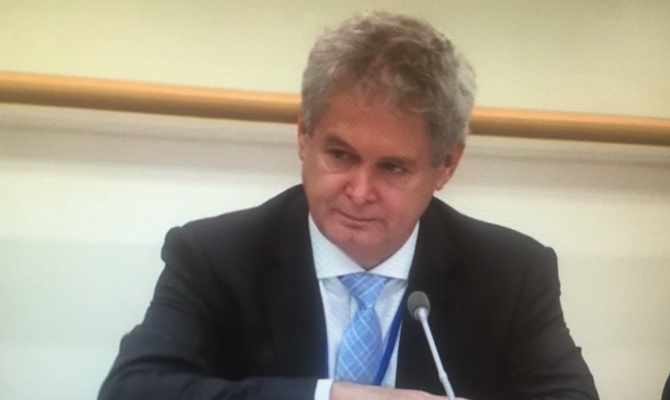
Andreas Mavroyiannis, the permanent representative of Cyprus to the UN, (Photo credit: Cyprus Mission in the UN)
Short Url
Updated 26 September 2020
Follow

Turkey’s behavior in region is ‘explosive and dangerous’ to its neighbors, says Cypriot envoy

  • Cypriot ambassador to UN condemns expansionist policies and urges Ankara to refrain from activities that violate international law

NEW YORK: Turkey is engaged in an “expansionist and imperialistic policy” that is creating “very, very explosive and dangerous” problems for neighboring countries, according to Andreas Mavroyiannis, the permanent representative of Cyprus to the UN.

Turkey and Greece have been fighting over Cyprus for decades. In 1974, the ruling Greek military junta staged a coup in an attempt to incorporate the island into Greece. In response, Turkey invaded and, after gaining control of the north, unilaterally declared the establishment of the Turkish Republic of Northern Cyprus.

Almost 50 years later, tensions between Greece and Turkey continue to run high and recent developments, including a dispute over rights to energy resources in the eastern Mediterranean, have raised concerns that they could escalate into open conflict.


Last year, Ankara signed a maritime accord with the Libyan Government of National Accord and began gas exploration operations in areas of the Mediterranean Greece considers part of its economic zone. More recently, Turkey sent survey vessels close to areas the Cypriot government have licensed to multinational companies to explore for oil and gas.

“Recently, we have this more hegemonic Turkish policy in the area,” said Mavroyiannis in an exclusive interview with Arab News. “(It is an) expansionist and imperialistic policy that creates problems for all neighbors.

“The (Turks) are trying to create a fait accompli and the situation is very, very explosive and dangerous.”

He conceded that his country’s small size and lack of military power means that its options for responding to Ankara’s actions are limited to diplomatic and political channels.
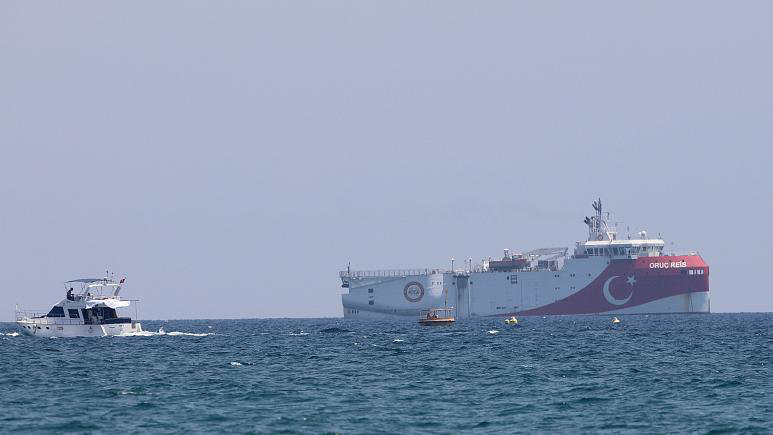


Exploratory drilling by Turkey's research vessel Oruc Reis on waters claimed by Greece has raised tensions in the eastern Mediterranean. (AP file photo)

“But this is (only the situation) for us,” said Mavroyiannis. “I understand and appreciate that for other neighbors — and in particular Greece, which is now the focus of the Turkish expansionist policies — it is very different.

“Greece not only has the means to react (but) it is compelled to use those means if Turkey continues with its current violations of international law and of maritime zones.”

The dispute between Greece and Turkey escalated in August when Ankara sent survey vessels, accompanied by Navy warships, to explore gas reserves in the eastern Mediterranean. During the standoff that followed, Greek and Turkish warships were involved in a minor collision.

Athens subsequently announced significant weapons purchases, along with plans to expand its armed forces.


However, Turkey’s activities in the region have repercussions not only for Cyprus and Greece, said Mavroyiannis. One way or another, all neighboring nations — including Egypt, Israel and Syria — are affected, he added, and Ankara’s policies should be of concern to the entire Arab world.

France sides with Greece and has urged Turkish President Recep Tayyip Erdogan to “refrain from any new unilateral action likely to provoke tensions, and to engage without ambiguity in the construction of an area of peace and cooperation in the Mediterranean.”

While France has adopted an aggressive stance, as evidenced by heated exchanges between Erdogan and his French counterpart, Emmanuel Macron, Germany has struck a more conciliatory tone, proposing incentives for Ankara in return for deescalation.

“Those (two European) schools of thought are two sides of the same coin,” said Mavroyiannis. “On the one hand the stick, and on the other hand the carrot.

“(If) Turkey accepts the approach of Germany and we have deescalation, (then) of course, the relationship will improve. If (the Turks) don’t (it must be made) clear that there are consequences. (Turkey) has to understand that there is no free ride.”


Despite intensive diplomatic efforts, in Cyprus the dispute between Turkish and Greek Cypriots remains as tense as it was four decades ago. The most recent round of talks between the two sides collapsed in 2017.

During his speech to the 75th General Assembly of the UN this week, Cypriot President Nicos Anastasiades, who leads his country’s internationally recognized government, reaffirmed his commitment to resuming reunification talks with Turkish Cypriots, “but not at gunpoint.”

Following a meeting with UN Secretary-General Antonio Guterres in Berlin last November, both sides in Cyprus agreed to wait until after the presidential election in Northern Cyprus that was scheduled for April this year before resuming negotiations. However, the election was delayed until October 11 as a result of the COVID-19 pandemic.

During his opening remarks at the General Assembly, Guterres stressed the importance of confidence-building measures from all parties, and warned against any further “unilateral actions” that might further stoke the fear of war in the eastern Mediterranean.

“To resume actual, substantive negotiations, we need to have the right atmosphere — we cannot negotiate under duress,” Mavroyiannis said.


“The message from the secretary-general is this: there is a need for those who don’t abide by the rules to stop their activities and to allow the negotiations to move forward.

“So, for us, (this is) a clear message to Turkey to stop all those violations of international law (and) of Cyprus’s maritime zones, to create a climate conducive to negotiation.”

Mavroyiannis also expressed regret over what he described as the suffering that has been inflicted on the region by the decision of the US to reduce its presence and withdraw troops. This, he said, has emboldened Erdogan.

“The US is the number one world power,” he said. “Turkey and the US are also partners in NATO. I believe that the US has a lot of leverage and we would like them to exercise it.

“At the end of the day, for us the most important thing is to have our place under the sun, and to continue having seamless cooperation with all our neighbors to promote peace and security and prosperity in the eastern Mediterranean.”


New US military-led group aided Mexico’s hunt for ‘El Mencho’ cartel boss

Updated 3 sec ago
Follow

New US military-led group aided Mexico’s hunt for ‘El Mencho’ cartel boss

  • Ex-official ‌says US gave Mexico detailed target package
  • Mexico planned, executed raid, Mexican official says
WASHINGTON: A new US-military-led task force specializing in intelligence collection on drug cartels played a role in the Mexican military raid on Sunday that killed the Mexican drug lord known as ‘El Mencho,’ ​a US defense official told Reuters. The Joint Interagency Task Force-Counter Cartel, which involves multiple US government agencies, was formally launched last month with the goal of mapping out networks of drug cartel members on both sides of the US-Mexico border, US officials said.
The US official, who spoke to Reuters on condition of anonymity, did not offer further details on any information that the US-military-led task force may have offered Mexican authorities. The official stressed the raid itself was a Mexican military operation.
A former US official, speaking on condition of anonymity without referring specifically to the task force, said the US compiled a detailed target package for El Mencho and provided it to the Mexican government for its operation.
This detailed dossier included information provided by US law enforcement, US intelligence, the former ‌official said.
The former official ‌added El Mencho was very high, if not at the top, of a ​list ‌of US ⁠targets in ​Mexico.
Mexican ⁠authorities killed drug lord Nemesio Oseguera, commonly known as ‘El Mencho,’ during an operation designed to capture him in the western state of Jalisco. The operation set off a wave of violence, with torched cars and gunmen blocking highways in more than half a dozen states.
Mexico’s defense ministry said US authorities had provided “complementary information,” but offered no details. A Mexican government source familiar with the operation said the Mexican government designed and executed it, and that no US military personnel were physically involved.
An ex-police officer, Oseguera, 60, was the shadowy leader of the powerful Jalisco New Generation Cartel (CJNG), an international criminal enterprise widely viewed as one of Mexico’s most powerful. He managed to evade arrest for ⁠years despite a $15 million bounty from the US for information leading to his arrest or capture.
The kingpin’s ‌killing notches a major victory for Mexico’s war on drug cartels that are ‌responsible for smuggling billions of dollars in cocaine and fentanyl into the US
President ​Donald Trump’s administration has waged a pressure campaign on Mexican President ‌Claudia Sheinbaum’s government to ramp up its crackdown on drug trafficking, including US threats to intervene directly in Mexico.

US MAPPING OUT ‌CARTELS
There is little information publicly available about the US Joint Interagency Task Force-Counter Cartel, or JITF-CC. Its website says its goal is to “identify, disrupt, and dismantle cartel operations posing a threat to the United States along the US-Mexico border.”
US Brig. Gen. Maurizio Calabrese, who leads the task force, spoke to Reuters this month about how the US military is channeling its experience battling groups like Al-Qaeda and Islamic State to map out cartel ‌networks.
“The cartels operate differently than Al-Qaeda or Daesh, different motivations, which makes it even more important for us to identify entire networks so that we can disrupt and dismantle (them),” ⁠Calabrese told Reuters, using an ⁠acronym for Islamic State.
Calabrese noted that estimates vary widely but said there were possibly a few hundred core cartel members “at the top.”
“But then you have anywhere from 200,000 to 250,000 independent contractors that will help you move these drugs,” Calabrese said.
Jack Riley, a former senior official at the Drug Enforcement Administration, said Trump’s designation of Mexican cartels as terrorist organizations last year
unlocked new kinds of US military assistance.
He said that could be helpful when it comes to US military intelligence, surveillance and reconnaissance resources.
“Our surveillance capabilities are going to be probably unlimited, and that will really help with real-time stuff,” Riley told Reuters.
“But these guys are extremely astute at being able to cover their tracks, cover who’s in charge and where those people are.”
A second US defense official, speaking to Reuters ahead of the Mexican operation, said the new task force fit into a broader US strategy to combat drug trafficking that has seen the US military take increasing operational control of the border with Mexico.
It also includes now-regular US strikes on suspected drug boats in ​Caribbean and Pacific waters, the legality of which has been ​challenged by Democratic lawmakers and legal experts.
“The whole idea of creating an interagency effort is to not have stray voltage, is to bring it all together, synchronize it,” the second official said of the task force.