Supreme Court orders government to make Peshawar school massacre report public

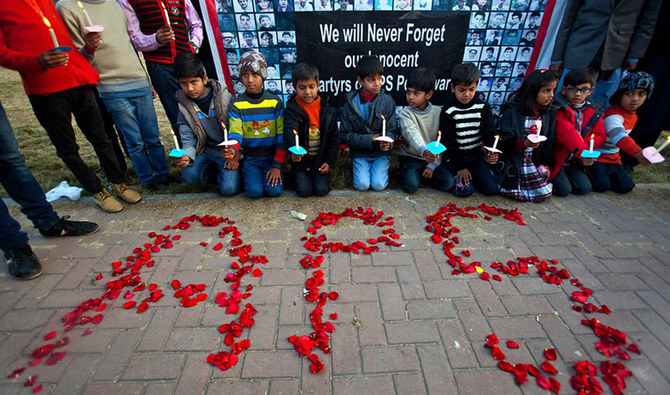
Pakistani youth hold candles next to a banner showing pictures of victims of an attack on a Peshawar school in 2014 during a demonstration in connection with the first anniversary of the attack on Dec. 15, 2015. (AP/File)
Short Url
Updated 26 September 2020
Follow

Supreme Court orders government to make Peshawar school massacre report public

  • The country’s top judiciary wants the government to take strict action against those whose negligence made the carnage possible
  • Chief Justice Gulzar Ahmed says it is important to prevent such future tragedies

ISLAMABAD: The Supreme Court of Pakistan instructed the government on Friday to make public the judicial commission report on the Army Public School massacre that took place in Peshawar on December 16, 2014.
The attack happened when six Tehreek-e-Taliban Pakistan militants conducted a terrorist attack on a military-run education institute in the provincial capital of Khyber Pakhtunkhwa, killing 149 people including 132 schoolchildren.
Pakistan’s former chief justice, Saqib Nisar, formed the commission in 2018 since the parents of the martyred children wanted an investigation into the tragedy.
During the hearing, the court asked the attorney general to name those whose negligence made it easy for terrorists to take so many lives of innocent children and members of the school management.
Chief Justice Gulzar Ahmed asked him to begin with those individuals were in power, adding that strict action should be taken against them to prevent such tragedies from taking place in the future.
According to Dawn, a local newspaper, the commission report maintained that the TTP militants had crossed Pakistan’s border with Afghanistan and reached their destination after “befooling the security apparatus.”
The report also said they were assisted by the residents of the neighborhood where the school was located, adding: “When one’s own blood and flesh commit treachery and betrayal, the result would always be devastating.”
The hearing of the case has now been adjourned for a month. 


Pakistan Navy launches fourth Hangor-class submarine ‘Ghazi’ in China 

Updated 6 sec ago
Follow

Pakistan Navy launches fourth Hangor-class submarine ‘Ghazi’ in China 

  • As per Islamabad’s agreement with Beijing, four of eight submarines will be built in China and the rest in Pakistan
  • Navy says all four submarines under construction in China undergoing sea trials, in final stages of being handed over

ISLAMABAD: The Pakistan Navy announced on Wednesday it has launched the fourth Hangor-class submarine named “Ghazi” at a Chinese shipyard in Wuhan, saying the development will help maintain peace in the region.

Pakistan’s government signed an agreement with China for the acquisition of eight Hangor-class submarines, the navy said in its press release. Under the contract, four submarines are being built in China while the remaining four will be constructed in Pakistan by the Karachi Shipyard and Engineering Works Ltd. company.

“With the launching of GHAZI, Pakistan Navy has achieved another significant milestone where all four submarines under construction in China are now undergoing rigorous sea trials and are in the final stages of being handed over to Pakistan,” the navy said. 

It further said that these submarines will be fitted with advanced weapons and sensors capable of engaging targets at standoff ranges. 

“Hangor-class submarines will be pivotal in maintaining peace and stability in the region,” the navy added. 

Pakistan’s agreement with China is set to strengthen its naval defenses, especially as ties with arch-rival India remain tense. 

India and Pakistan were involved in a four-day military confrontation in May this year before Washington intervened and brokered a ceasefire. Four days of confrontation saw the two countries pound each other with fighter jets, exchange artillery fire, missiles and drone strikes before peace prevailed. 

Pakistan’s air force used Chinese-made J-10 fighter jets in May to shoot down an Indian Air Force Rafale aircraft, made by France.

The altercation between the nuclear-armed neighbors surprised many in the military community and raised questions over the superiority of Western hardware over Chinese alternatives.

Islamabad has long been Beijing’s top arms customer, and over the 2020-2024 period bought over 60 percent of China’s weapons exports, according to data from the Stockholm International Peace Research Institute.