DUBAI: The UAE has started issuing entry permits to the country again, starting Sep. 24 but work permits are still on hold, state news agency WAM reported.
The Federal Authority for Identity and Citizenship said the decision followed the preventive measures implemented by the travel industry to curb the coronavirus spread.
Dubai, the region's tourism and business hub and one of the seven emirates that make up the UAE, had already lifted its own visa ban in July.
All six Gulf Arab countries have lifted internal curfews and lockdowns, but restrictions on gatherings and foreign travel remain in the region, where the total number of COVID cases stands at over 800,000, with more than 6,800 deaths.
Neighboring Oman said on Thursday it would resume scheduled international flights on Oct. 1 with strict measures to protect the country and aviation staff from the virus.


UAE resumes issuing visas to foreign visitors

https://arab.news/2hk2t
UAE resumes issuing visas to foreign visitors

- Dubai had already lifted its own visa ban in July


‘Where can we go?’ say Rafah residents as Israel demands evacuation
- Areas designated for evacuation currently shelter some 250,000 people
- Israel’s retaliatory offensive, aimed at destroying Hamas, has killed at least 34,683 people in Gaza, mostly women and children
Rafah: Palestinian civilians in the southern Gazan city of Rafah voiced despair on Monday as Israel dropped fliers urging them to evacuate for their own “safety” ahead of a “limited” military operation.
Israel’s army said it was instructing Palestinian families in eastern Rafah to flee in preparation for an expected ground assault on the city which abuts Gaza’s border with Egypt.
Residents of Rafah described emerging outside after a terrifying night in which around a dozen air strikes were carried out on Rafah, to find fliers falling from the sky telling them to “evacuate immediately.”
“The army is working with intensive power against the terrorist forces near you,” read a flier circulated in eastern Rafah.
“For your safety, the IDF (Israeli military) tells you to evacuate immediately toward the expanded humanitarian zone of Al-Mawasi,” it said, with a map indicating the location to the north of Rafah.
Osama Al-Kahlout, of the Palestinian Red Crescent Society in Gaza, told AFP that the areas designated for evacuation currently shelter some 250,000 people, many of whom have already been displaced from other areas in the Gaza Strip.
“The evacuation process has begun on the ground, but in a limited manner,” he said.
An Israeli militark spokesman, when asked how many people should move, said: “The estimate is around 100,000 people.”
About 1.2 million people are currently sheltering in Rafah, according to the World Health Organization, most having fled there during the seven-month war between Israel and Hamas Palestinian militants.
Amid pouring rain, some of those sheltering in Rafah said they had begun packing up their things from the densely packed tents and preparing to leave even before Israel’s directive arrived.
“Whatever happens, my tent is ready,” a resident told AFP.
But others said the area they were being told to flee to was already overcrowded, and they did not trust that it would be safe.
Abdul Rahman Abu Jazar, 36, said he and 12 family members were in the designated evacuation area.
Jazar and his family did not know what to do, he said, because the “humanitarian zone” they were told to head for “does not have enough room for us to make tents because they are (already) full of displaced people.”
“Where can we go? We do not know,” he told AFP.
“There are also no hospitals and it is far from any services many need,” he said, adding that one of his family members relied on dialysis at the Al-Najar hospital, in the area of Rafah instructed to evacuate.
“How will we deal with her after that? Should we watch her die without being able to do anything?“
An Israeli military spokesman told reporters that the evacuation “is part of our plans to dismantle Hamas ... we had a violent reminder of their presence and their operational abilities in Rafah yesterday.”
On Sunday, four Israeli soldiers were killed and others wounded, the army said, when a barrage of rockets was fired toward the Kerem Shalom border crossing between Israel and Gaza.
The army said the rockets were fired from an area adjacent to Rafah.
International aid organizations have voiced alarm at the expected invasion of Rafah.
“From the humanitarian perspective, no credible humanitarian plan for an attack on Rafah exists,” said Bushra Khalidi, advocacy director for Oxfam in the Palestinian territories.
She said she could “not fathom that Rafah will happen,” asking where displaced Palestinians will go “when most of their surroundings have been reduced to death and rubble?“
Gaza’s bloodiest-ever war broke out following Hamas’s unprecedented October 7 attack on Israel which resulted in the deaths of more than 1,170 people, mostly civilians, according to an AFP tally of Israeli official figures.
Militants also seized some 250 hostages, with Israel estimating that 128 of them remain in Gaza, including 35 whom the military says are dead.
Israel’s retaliatory offensive, aimed at destroying Hamas, has killed at least 34,683 people in Gaza, mostly women and children, according to the Hamas-run territory’s health ministry.
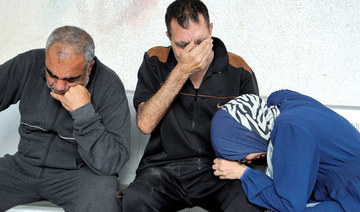


US weapon system identified in Israeli-Lebanon strike may breach international law
- Guardian investigation with Human Rights Watch identifies Boeing-made Joint Direction Attack Munition fragments at site where aid workers were killed
- US bans export of such systems to foreign militaries where ‘credible information’ of human rights breaches exists
LONDON: An Israeli airstrike in Lebanon that killed seven aid workers in March may have been conducted with a US-supplied weapon system, according to an investigation by The Guardian.
The incident claimed the lives of seven paramedics aged 18-25, all volunteers, at an ambulance center in Al-Habariyeh in southern Lebanon on March 27.
It came five days before an Israeli strike in Gaza killed seven aid workers working for World Central Kitchen.
Debris found at the scene in Al-Habariyeh was identified by The Guardian, an independent expert and Human Rights Watch as having belonged to a 500-pound Israeli MPR bomb and a Boeing-made Joint Direction Attack Munition, a system attached to explosives to turn them from “dumb bombs” into GPS-guided weapons.
HRW’s Lebanon researcher Ramzi Kaiss told The Guardian: “Israel’s assurances that it is using US weapons lawfully are not credible. As Israel’s conduct in Gaza and Lebanon continues to violate international law, the Biden administration should immediately suspend arms sales to Israel.”
The US government is legally unable to help or arm foreign militaries where “credible information” of human rights abuses exists, under the terms of the 1997 Leahy law.
A spokesperson for the US National Security Council told The Guardian: “The US is constantly working to ensure defense articles provided by the US are being used consistent with applicable domestic and international law. If findings show violations, we take action.”
But Josh Paul, a non-resident fellow with Democracy for the Arab World Now and a former State Department employee, said: “The State Department has approved several of these (weapons) transfers on a 48-hour turnaround. There is no policy concern on any munitions to Israel other than white phosphorus and cluster bombs.”
He added that JDAMs have been “key items” regularly requested by Israel since the start of the Gaza war.
Secretary of State Antony Blinken will deliver a report on Wednesday to Congress on Israel’s use of American weapons and whether they may have been involved in violations of this or other laws.
Maryland Sen. Chris Van Hollen told The Guardian that the findings from Al-Habariyeh are “deeply concerning and must be fully investigated by the Biden administration, and their findings should certainly be included in the NSM-20 report that is due to be submitted to the Congress on May 8.”
The airstrike on the ambulance center in Al-Habariyeh came without warning before 1 a.m. on March 27. No fighting had been reported in the area.
The victims had been at the center for the night shift, and were named as twin brothers Hussein and Ahmad Al-Shaar, aged 18; Abdulrahman Al-Shaar, 19; Mohammad Hamoud, 21; Mohammad Al-Farouk Aatwi, 23; Abdullah Aatwi, 24; and Baraa Abu Kaiss, 24.
The Israeli military claimed that the strike, which leveled the two-storey building, killed a “prominent terrorist belonging to Jamaa Islamiya,” an armed Lebanese political group with ties to Hezbollah. It did not identify the person by name.
A Jamaa Islamiya spokesman acknowledged that some of the ambulance volunteers were members of the group, but denied that they were part of its armed wing.
Samer Hardan, head of the local Civil Defense center who was among the first responders, told The Guardian: “We examined every centimetre looking for parts of bodies and their possessions. We saw nothing military-related. We knew (the victims) personally, so we could identify their remains.”
Since Oct. 7, 16 medical workers have been killed by Israeli airstrikes in Lebanon, and a further 380 people have died including 72 civilians. Eleven Israeli soldiers and eight civilians have also been killed.
Kassem Al-Shaar, father of Ahmad and Hussein, said he had warned his sons not to volunteer.
“I told them that it was dangerous to do this type of work, but they said that they accepted the risk. I don’t know what Israel was thinking — these were young people excited to help others,” he said.
“My sons wanted to do humanitarian work, and look what happened to them. Israel wouldn’t dare to do what they did if it wasn’t for the US standing behind them.”


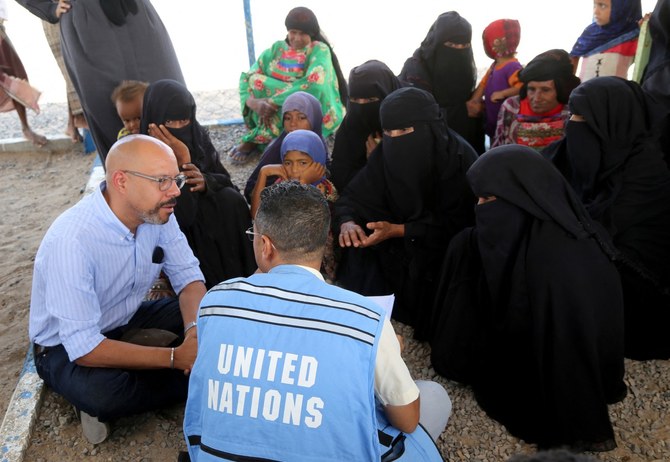
Aid groups issue urgent appeal for Yemen funds
- UN agencies warned that 18.2 million people in need of help after nine years of war
Dubai: Nearly 200 aid groups appealed on Monday for funds to bridge a $2.3 billion shortfall in assistance for war-torn Yemen, warning of potentially “catastrophic consequences” for the Arabian Peninsula’s poorest country.
A joint statement from 188 humanitarian organizations, including several UN agencies, warned that 18.2 million people — more than half the population — were in need of help after nine years of war.
Their appeal came a day before a meeting of high-ranking EU officials in Brussels to discuss the aid program for Yemen, which is suffering one of the world’s worst humanitarian crises.
“Inaction would have catastrophic consequences for the lives of Yemeni women, children and men,” the statement said, calling Tuesday’s meeting a “critical moment.”
“The humanitarian community appeals to donors to urgently address existing funding gaps, and provide sustainable support to enhance resilience and reduce aid dependency.”
Yemen has been gripped by conflict since the Iran-backed Houthis overran the capital Sanaa in 2014, triggering the Saudi-led military intervention in support of the government the following year.
Hundreds of thousands have died in the fighting or from indirect causes such as a lack of food, the United Nations says.
Hostilities slowed considerably in April 2022, when a six-month, UN-brokered ceasefire came into effect, and they have remained at a low level since.
But only $435 million of the $2.7 billion called for in Yemen’s 2024 Humanitarian Response Plan requirement has been raised, the aid groups said, warning of threats including food insecurity, cholera and unexploded ordnance.
“Underfunding poses a challenge to the continuity of humanitarian programming, causing delays, reductions and suspensions of lifesaving assistance programs,” it said.
“These challenges directly affect the lives of millions who depend on humanitarian assistance and protection services for survival.”


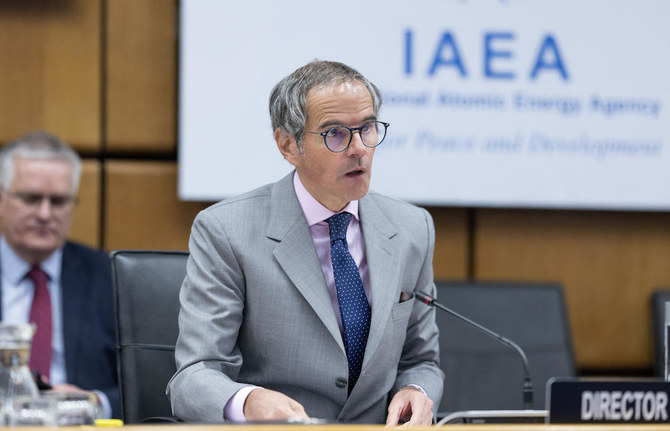
UN atomic watchdog chief Rafael Grossi arrives in Iran: media
- Visit comes at a time of heightened regional tensions and with IAEA criticizing Iran for lack of cooperation on inspections and other outstanding issues
TEHRAN: UN atomic watchdog chief Rafael Grossi arrived Monday in Iran, where he is expected to speak at a conference and meet officials for talks on Tehran’s nuclear program.
“The Director General of the International Atomic Energy Agency arrived in Tehran on Monday at noon at the head of a delegation to participate in the nuclear conference and negotiate with top nuclear and political officials of the country,” Tasnim news agency said, with other agencies reporting the same details.
The visit comes at a time of heightened regional tensions and with the IAEA criticizing Iran for lack of cooperation on inspections and other outstanding issues.
Grossi, head of the IAEA, is expected to deliver a speech at Iran’s first International Conference on Nuclear Science and Technology.
The three-day event, which starts on Monday, is being held in Isfahan province, home to the Natanz uranium enrichment plant and where strikes attributed to Israel hit last month.
The IAEA and Iranian officials reported “no damage” to nuclear facilities after the reported attack on Isfahan, widely seen as Israel’s response to Iran’s first-ever direct attack on its arch foe days earlier, which itself was a retaliation for a deadly strike on Tehran’s Damascus consulate.
During his visit, Grossi is expected to meet with Iranian officials including the Islamic republic’s nuclear chief Mohammad Eslami.
On Wednesday Eslami, head of the Atomic Energy Organization of Iran, said he was “sure that these negotiations will further help clear ambiguities, and we will be able to strengthen our relations with the agency.”
Iran in recent years has deactivated IAEA monitoring devices at nuclear facilities and barred inspectors, according to the UN agency.
Grossi last visited Iran in March 2023 and met with top officials including President Ebrahim Raisi.
Iran has suspended its compliance with caps on nuclear activities set by a landmark 2015 deal with major powers after the United States in 2018 unilaterally withdrew from the agreement and reimposed sweeping sanctions.
Tensions between Iran and the IAEA have repeatedly flared since the deal fell apart, while EU-mediated efforts have so far failed both to bring Washington back on board and to get Tehran to again comply with the terms of the accord.
Last year, Iran slowed down the pace of its uranium enrichment, which was seen as a goodwill gesture while informal talks began with the United States.
But the Vienna-based UN nuclear agency said Iran accelerated the production of 60-percent enriched uranium in late 2023.
Enrichment levels of around 90 percent are required for military use.
Tehran has consistently denied any ambition to develop nuclear weapons, insisting that its atomic activities were entirely peaceful.
In February, the IAEA said in a confidential report seen by AFP that Iran’s estimated stockpile of enriched uranium had reached 27 times the limit set out in the 2015 accord.
On Sunday, the Iranian official news agency IRNA said Grossi’s visit provides “an opportunity for the two sides to share their concerns,” especially with regard to the IAEA’s inspectors.
Iran in September withdrew the accreditation of several inspectors, a move described at the time by the UN agency as “extreme and unjustified.”
Tehran, however, said its decision was a consequence of “political abuses” by the United States, France, Germany and Britain.
Eslami said the IAEA has “more than 130 inspectors” working in Iran, insisting Tehran remains committed to cooperating with the nuclear watchdog.


Lebanon’s Hezbollah says fired dozens of rockets at Israeli base
- The Israeli army said its warplanes “struck a Hezbollah military structure... deep inside Lebanon,”
The Iran-backed Hezbollah group said it fired “dozens of Katyusha rockets” at an Israeli base in the occupied Golan Heights on Monday in retaliation for a strike in Lebanon’s east.
Earlier, Lebanese official media said three people had been wounded in an Israeli strike early Monday in the country’s east, with the Israeli army saying it had struck a Hezbollah “military compound.”
Hezbollah fighters launched “dozens of Katyusha rockets” targeting “the headquarters of the Golan Division... at Nafah base,” the group said in a statement, saying it was “in response to the enemy’s attack targeting the Bekaa region.”
Israel and Lebanon’s Hezbollah have exchanged regular cross-border fire since Palestinian militant group Hamas’s unprecedented October 7 attack on southern Israel sparked war in the Gaza Strip.
In recent weeks Hamas-ally Hezbollah has stepped up its attacks on northern Israel, and the Israeli military has struck deeper into Lebanese territory.
“Enemy warplanes launched a strike at around 1:30 am this morning on a factory in Sifri, wounding three civilians and destroying the building,” Lebanon’s official National News Agency said.
Sifri is located in Lebanon’s Bekaa Valley, near the city of Baalbek, around 80 kilometers from the Israel-Lebanon frontier.
The Israeli army said its warplanes “struck a Hezbollah military structure... deep inside Lebanon,” referring to the location as “Safri.”
Last month, a building in Sifri was targeted in an Israeli raid, according to a source close to Hezbollah, while the Israeli army said it had targeted Hezbollah sites in Lebanon’s east.
East Lebanon’s Baalbek area is a Hezbollah stronghold and has been repeatedly struck by Israel in recent weeks.
On Sunday official media in Lebanon said an Israeli strike on a southern village killed four family members, with Hezbollah announcing retaliatory fire by dozens of rockets toward Kiryat Shmona in northern Israel.
The intensifying exchanges have stoked fears of all-out conflict between Israel and Hezbollah, which went to war in 2006.
In Lebanon, at least 390 people have been killed in nearly seven months of cross-border violence, mostly militants but also more than 70 civilians, according to an AFP tally.
Israel says 11 soldiers and nine civilians have been killed on its side of the border.
Tens of thousands of people have been displaced on both sides.