

YouGov reveals top brands in Saudi Arabia, UAE and Egypt

1 / 4
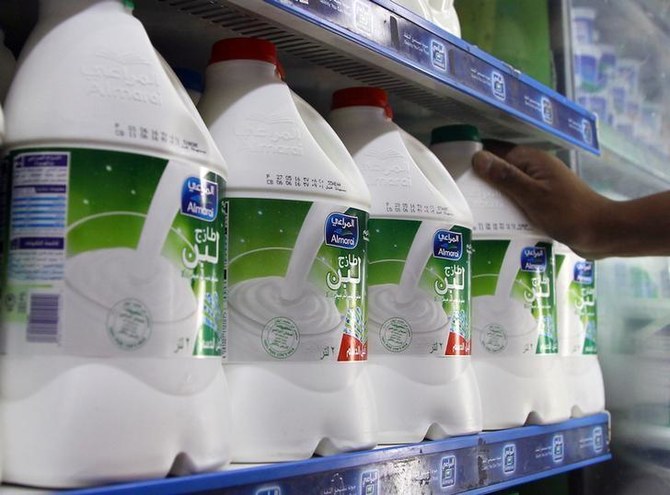
Dairy products produced by Almarai at a grocery store in Riyadh, Saudi Arabia, June 2, 2016. (Reuters)
2 / 4
3 / 4
4 / 4
Short Url
Updated 22 September 2020
Follow

YouGov reveals top brands in Saudi Arabia, UAE and Egypt

  • The report finds that Emirates, Almarai and Carrefour are the brands with the most loyal customers in the UAE, Saudi Arabia and Egypt, respectively
  • In Saudi Arabia, Emirates has emerged as the biggest mover within the top 10 brands, at seventh place, up from 15th last year

DUBAI: YouGov BrandIndex, which measures the public’s perception of brands on a daily basis across a range of metrics, has released its 2020 Customer Loyalty rankings.

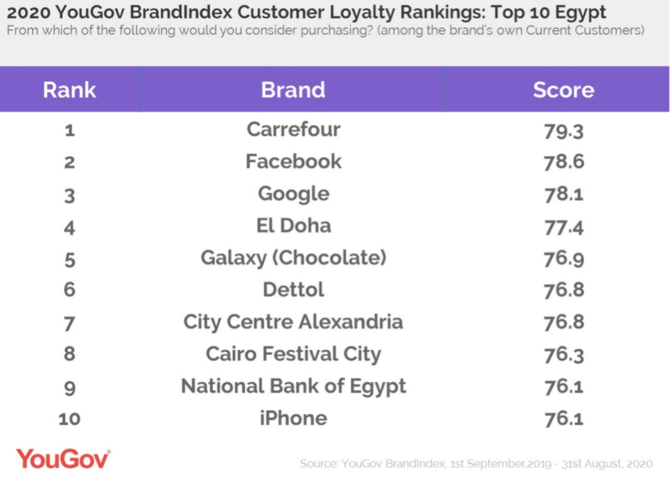
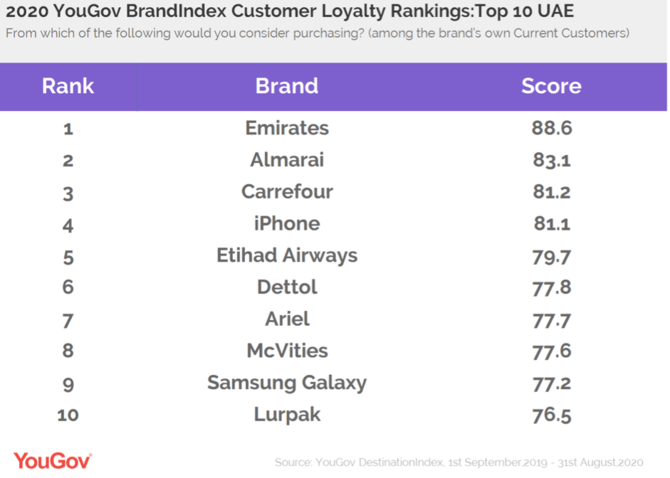
The report finds that Emirates, Almarai and Carrefour are the brands with the most loyal customers in the UAE, Saudi Arabia and Egypt, respectively. 

In the UAE’s top 10, the biggest movers were Lurpak — at 10th, up from 15th last year — and Dettol, which rose from 10th to sixth this year.

Despite the flight restrictions in place, loyalty toward leading carrier brands has remained strong in the UAE and Saudi Arabia. After Emirates at first position, Etihad appeared in the UAE rankings at fifth.

In Saudi Arabia, Emirates has emerged as the biggest mover within the top 10 brands, at seventh place, up from 15th last year. Saudia’s strong loyalty among Saudi customers landed it second place in the 2020 rankings.

Popular handset brand iPhone makes an appearance in the rankings of all three countries. In the UAE, Saudi Arabia and Egypt, customer loyalty toward the brand remains strong, not showing change in reconsideration rates despite its status as a luxury item amid a tough economic climate.

YouGov BrandIndex has also released the 10 “most improved” brands of the past year — those that have registered the largest rise in their loyalty score.

Majid Al-Futtaim is the “most improved” brand of the past year in the UAE, with a rise of 9.6 points.

It also makes an appearance in the improvers’ lists of Egypt and Saudi Arabia, as the third and sixth most improved brand, respectively. 

In Saudi Arabia, Al-Raya is the “most improved” brand of the past year, with a rise of 7.7 points. In Egypt, Jumia.com reigns as the most improved brand, up 12.5 points.

Consumer brands dominate the list of improvers this year, highlighting the role of familiar fast-moving consumer goods (FMCG) power brands in maintaining comfort through periods of prolonged lockdown and social distancing.

Mirinda, Fanta and Cheetos make an appearance in the UAE list. Egypt sees the presence of Tiger (up 6.6 points), KFC (up 5.7), Mountain Dew (up 5.7), Maggi (up 5.6), Heinz (up 5.5) and Juhayna (up 5.2) within the top 10 improvers.


Saudi gaming industry has promising future, says Qiddiya executive

Updated 04 February 2026
Follow

Saudi gaming industry has promising future, says Qiddiya executive

  • Mike Milanov said that the industry had surpassed the combined industries of film, television, music and sports worldwide
  • Milanov added that Saudi Arabia had talented teams with strong skills in esports and game development

RIYADH: Saudi Arabia is uniquely positioned for a highly promising future in the gaming sector, which is valued at $323 billion globally, according to the head of gaming at Saudi entertainment megaproject Qiddiya.

Mike Milanov, the company’s head of gaming and esports, spoke during the session “The Global Era of Gaming: How It Became the New Frontier for Media and Entertainment” at the Saudi Media Forum 2026 in Riyadh.

The industry, he said, had surpassed the combined industries of film, television, music and sports worldwide and was growing globally at an annual rate of 3 percent to 9 percent, expected to reach about $623 billion by 2035

He added that future generations held different perspectives and levels of engagement, as gaming represented a form of digital advancement and a powerful tool for connection.

Milanov also highlighted how Saudi Arabia had talented teams with strong skills in esports and game development, along with significant creative and innovative energy that supported building relationships both locally and globally.

He further noted that Qiddiya City spanned nearly 330 sq. km, and that more than 86 percent of Saudis identified themselves as gamers, reinforcing the Kingdom’s position as one of the world’s largest gaming and esports markets.

Karen Starr, vice president of marketing, branding and creative at Activision Publishing, also spoke during the panel and emphasized the major role gaming played across social media platforms.

She described this influence as positive for brand building, especially given the young audiences that followed gaming brands.

Starr added that the sustainability of major gaming brands depended on continuous engagement, community-building, and adapting content locally to maintain cultural relevance.

She explained that gaming had evolved into an ongoing media experience based on constant interaction and long-term audience connection.

She also said that gaming today had become a global media force that had surpassed traditional channels, shaping culture, content and audience engagement over time.

Meanwhile, Shelley Williams, executive vice president of sales at F1 Arcade Simulation, spoke about how gaming experiences were built on a sense of belonging and participation, which helped to create stronger infrastructure and extended media experiences.

She said that shared audience experiences opened the door to new ecosystems and further game development, supporting long-term content sustainability.