
WASHINGTON: The United States slapped additional sanctions on Iran on Monday after the Trump administration’s unilateral weekend declaration that all United Nations penalties that were eased under the 2015 nuclear deal had been restored.
The announcement comes in defiance of the world community, which has rejected U..S. legal standing to impose the international sanctions and sets the stage for an ugly showdown at the annual UN General Assembly this week.
Today, @SecPompeo delivered remarks to the media on Iran Snapback Sanctions. pic.twitter.com/L1XCmTJvtb
— Department of State (@StateDept) September 21, 2020
“The United States has now restored UN sanctions on Iran,” President Donald Trump said in a statement issued shortly after he signed an executive order spelling out how the US will enforce the “snapback” of the sanctions. “My actions today send a clear message to the Iranian regime and those in the international community who refuse to stand up to Iran.”
Rather than waiting for Iran to threaten the world, the U.S. is taking sweeping actions to prevent the world’s top state sponsor of terror from obtaining a nuclear weapon. This includes sanctions on 25 entities and individuals. We are keeping Americans and world citizens safe!
— Secretary Pompeo (@SecPompeo) September 21, 2020
Trump’s administration named 27 people or entities that it said would be subject to UN sanctions, but the world body itself says that the decision is not up to Washington.
Speaking to reporters with fellow Cabinet secretaries at the State Department, Secretary of State Mike Pompeo then announced the administration was hitting more than two dozen Iranian individuals and institutions with penalties. Nearly all of them, however, including the Iranian defense ministry and its atomic energy agency, were already subject to US sanctions that the administration had re-imposed after Trump withdrew from the nuclear deal in 2018.
.@DeptOfDefense Secretary @EsperDoD delivers remarks to the media on Iran Snapback Sanctions at the State Department. pic.twitter.com/TIUaVcYhEO
— Department of State (@StateDept) September 21, 2020
Trump’s executive order mainly affects Iranian and foreign entities involved in conventional weapons and ballistic missile activity. A UN arms embargo on Iran is to expire in October under the terms of the nuclear deal, but Pompeo and others insist the snapback has rescinded its termination.
The Trump administration argues that it is enforcing the UN arms embargo that Iran has violated, including through an attack on Saudi oil facilities.
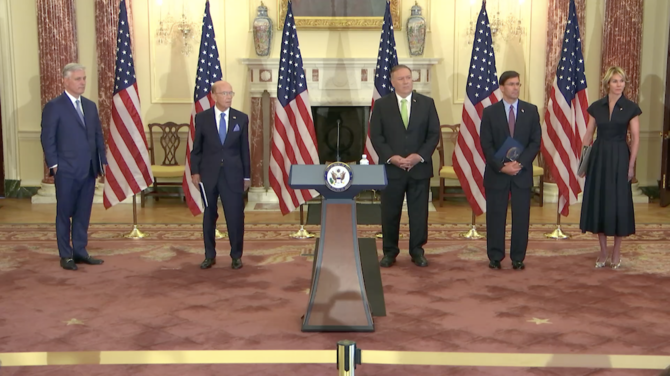
Accompanied by Treasury Secretary Stephen Mnuchin, Defense Secretary Mark Esper, Commerce Secretary Wilbur Ross, Ambassador to the United Nations Kelly Craft and national security adviser Robert O’Brien, Pompeo said the US was acting because the rest of the world is refusing to confront the Iranian threat.
Honored to join @SecPompeo in support of @POTUS Executive Order restoring & expanding sanctions on Iran. We refuse to allow Iran to build its capacity to arm terrorists & upend advances toward Middle East peace. As the world sits idly by, US leadership will hold Iran accountable. https://t.co/XFwYU4zjle
— Ambassador Kelly Craft (@USAmbUN) September 21, 2020
“We have made it very clear that every member state in the United Nations has a responsibility to enforce the sanctions,” US Secretary of State Mike Pompeo told reporters when asked about European opposition.
“That certainly includes the United Kingdom, France and Germany. We will have every expectation that those nations enforce these sanctions,” he said.
“No matter where you are in the world, you will risk sanctions,” he said, warning foreign companies and officials not to do business with targeted Iranian entities.
U.S. and @UN sanctions on Iran promote the safety & security of Americans and the entire world. There is no justification for allowing Iran, the world's leading state sponsor of terrorism, access to new & better weaponry, and we will not allow it. https://t.co/76v20mVrgE
— Ambassador Kelly Craft (@USAmbUN) September 21, 2020
Craft said, “As we have in the past, we will stand alone to protect peace and security.”
The administration declared on Saturday that all UN sanctions against Iran had been restored because Tehran is violating parts of the nuclear deal in which it agreed to curb its nuclear program in exchange for billions of dollars in sanctions relief.
But few UN member states believe the US has the legal standing to restore the sanctions because Trump withdrew from the nuclear deal in 2018. The US argues it retains the right to do so as an original participant in the deal and a member of the council.
The remaining world powers in the deal — France, Germany, Britain, China and Russia — have been struggling to offset the sanctions that the US re-imposed on Iran after the Trump administration left the pact, which the president said was one-sided in favor of Tehran.
NSA O'Brien delivers remarks to the media on Iran Snapback Sanctions at the State Department. @WHNSC pic.twitter.com/a2kJewg4aA
— Department of State (@StateDept) September 21, 2020
Ali Akbar Salehi, the head of Iran’s nuclear agency, said Monday that there is still a broad agreement among the international community that the nuclear pact should be preserved.
At a conference of the International Atomic Energy Agency in Vienna, Salehi said the Joint Comprehensive Plan of Action, or JCPOA, has been “caught in a quasi-stalemate situation” since Trump pulled out in 2015.
Today, Secretary @stevenmnuchin1 delivers remarks to the media on Iran Snapback Sanctions. pic.twitter.com/J9aw6M9dmw
— Department of State (@StateDept) September 21, 2020
While insisting it is not pursuing a nuclear weapon, Iran has been steadily breaking restrictions outlined in the deal on the amount of uranium it can enrich, the purity it can enrich it to, and other limitations. At the same time, Iran has far less enriched uranium and lower-purity uranium than it had before signing the deal, and it has continued to allow international inspectors into its nuclear facilities.
We will continue to aggressively investigate and designate individuals and parties to the Entity List who act contrary to the national security of the United States and international law.
— Sec. Wilbur Ross (@SecretaryRoss) September 21, 2020
The United States has separately been seeking to oust Venezuelan President Nicolas Maduro, who has increasingly sought cooperation with Iran on the oil sector.
The State Department said it was again imposing sanctions on Maduro under the executive order from Trump that is based on the UN resolution, pointing to defense transactions between Iran and the leftist Venezuelan leader.
The U.S. will not allow the Iranian regime to obtain a nuclear weapon as its malign and destabilizing behavior is a threat to the region and the world. Today, we continue our maximum pressure campaign against the regime: https://t.co/EaKqTFD3nP
— Steven Mnuchin (@stevenmnuchin1) September 21, 2020
“For nearly two years, corrupt officials in Tehran have worked with the illegitimate regime in Venezuela to flout the UN arms embargo,” Pompeo said.
“Our actions today are a warning that should be heard worldwide.”
.@CommerceGov Secretary @SecretaryRoss delivers remarks to the media on Iran Snapback Sanctions at the State Department. pic.twitter.com/xCC9YacPqb
— Department of State (@StateDept) September 21, 2020
Furthermore, Elliott Abrams, Washington’s envoy on Iran, said on Monday that the US is concerned about Iran’s cooperation with North Korea and will do whatever it can to prevent it, .
Abrams was responding to a reporter’s question on whether the United States had seen evidence that Tehran and Pyongyang had resumed cooperation on long-range missile development.
He spoke shortly after the Trump administration slapped the new sanctions on Iran.
(With Reuters, AFP and AP)