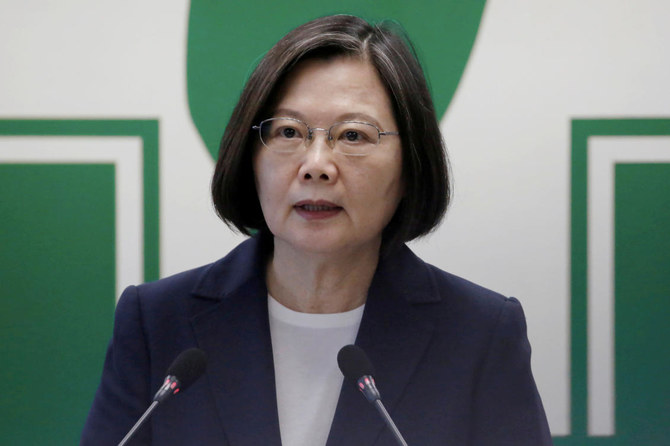
TAIPEI: The last two days of Chinese aircraft approaching Taiwan demonstrate that Beijing is a threat to the entire region and have shown Taiwanese even more clearly the true nature of China’s government, President Tsai Ing-wen said on Sunday.
Multiple Chinese aircraft flew across the mid line of the Taiwan Strait and into Taiwan’s air defense identification zone on Friday and Saturday, causing Taiwan to scramble jets to intercept. China claims Taiwan as its own territory.
At a news conference in Beijing on Friday about China’s UN peacekeeping efforts, China announced combat drills near the Taiwan Strait and denounced what it called collusion between the island and the United States.
The exercises took place as US Undersecretary for Economic Affairs Keith Krach was in Taipei, the most senior State Department office to come in four decades.
Speaking to reporters, Tsai denounced China’s drills.
“I believe these activities are no help to China’s international image, and what’s more have put Taiwan’s people even more on their guard, understanding even better the true nature of the Chinese Communist regime,” she said.
“Additionally, other countries in the region also have a better understanding of the threat posed by China,” Tsai added. “The Chinese Communists must restrain themselves, and not provoke.”
China’s air force on Saturday put out a video showing its nuclear capable H-6 bombers, which have been involved in many Chinese fly-bys of Taiwan, exercising.
One montage shows a simulation of an H-6 attack against an air base which appears by its runway layout to be the main US air force base on Guam.
Asked about that footage, and China’s decision to release it while Krach was in Taiwan, Tsai said China’s recent activities where a threat broader than just to Taiwan.
“China’s existence is indeed aggressive and will bring a definite threat.”
In comments carried by Chinese state media from a forum on relations with Taiwan in the southeastern Chinese city of Xiamen, the head of China’s Taiwan Affairs Office on Sunday made no direct mention of the current tensions.
Meeting young Taiwanese, Liu Jieyi said it was inevitable that the two sides would grow closer.
“Only when cross-strait relations are good can the interests and well-being of Taiwan compatriots be fundamentally guaranteed,” Liu said.
But further friction seems likely as Taiwan and the United States further deepen relations, with Taiwan angling for a free trade agreement.
Taiwan Economy Minister Wang Mei-hua said on Sunday they were planning to hold a formal economic dialogue with the United States, after having what she called informal talks with Krach and his team on issues like supply chain restructuring.


![]()

Taiwan president says drills show China is threat to whole region
Short Url
https://arab.news/w6adh
Taiwan president says drills show China is threat to whole region
- Exercises took place as US Undersecretary for Economic Affairs Keith Krach was in Taipei
- ‘China’s existence is indeed aggressive and will bring a definite threat’


Latest updates


© 2026 SAUDI RESEARCH & PUBLISHING COMPANY, All Rights Reserved And subject to Terms of Use Agreement.