

Education minister opposes closures as Pakistani schools shut again for flouting coronavirus rules

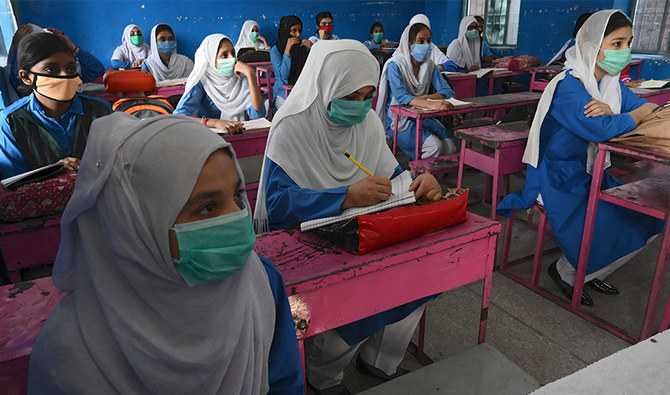
Students wearing facemasks attend a class at a government school in Lahore on September 15, 2020 after the educational institutes were reopened nearly six months after the spread of the Covid-19 coronavirus. (AFP)
Short Url
Updated 20 September 2020
Follow

Education minister opposes closures as Pakistani schools shut again for flouting coronavirus rules

  • Dozens of schools were closed in the past few days due to noncompliance with health protocols
  • Pakistan’s infection figures are increasing again after a steady decline between June and late August

ISLAMABAD: Federal Education Minister Shafqat Mahmood said on Saturday that any hasty decision to close down schools will "destroy education," after dozens of institutes across Pakistan shut down again for failing to follow coronavirus precautions.
The minister's words came a day after authorities in Sindh province decided to delay the reopening of secondary schools over fears of the spread of COVID-19. Educational institutions across the country started to reopen on Sept. 15. All schools were closed in March when the government enforced a nationwide lockdown to contain the pandemic.
The six-month closure "deeply affected the students," Mahmood said in a Twitter post. "Decision to open was taken with great care. Any hasty decision to close will destroy education."


The National Command and Operation Centre (NCOC) announced on Friday that another 13 educational institutions — 10 in Khyber Pakhtunkhwa and three in Sindh — were closed due to “non-compliance with health protocols and disease prevalence.” Also on Friday, Balochistan education department closed two high schools after several students tested positive for COVID-19. On Thursday, 22 schools were sealed in Khyber Pakhtunkhwa, Islamabad and Azad Kashmir.
Pakistan Medical Association (PMA) has warned last week that the government was "taking a huge risk" by reopening schools.
“The government should make antibody tests for school staff compulsory to check the infection before the reopening,” PMA secretary general Dr. Qaiser Sajjad told Arab News on Sept. 12, as he warned that school staff and students could become virus carriers.
Pakistan’s infection figures are increasing again after a steady decline between June and late August.
At least 645 people have tested positive for the coronavirus during the past 24 hours. Over 305,000 people have contracted the virus in Pakistan since the beginning of the outbreak and 6,415 have succumbed to the disease.


Pakistan demands ‘equitable’ climate finance for vulnerable states at UN forum

Updated 4 sec ago
Follow

Pakistan demands ‘equitable’ climate finance for vulnerable states at UN forum

  • Pakistan repeatedly suffers from deadly climate disasters, including floods this year that killed over 1,000 people during monsoon
  • Pakistan minister stresses role of international cooperation, private sector engagement for environmental sustainability

ISLAMABAD: Pakistan’s Minister for Climate Change Dr. Musadik Malik on Saturday called for an “equitable, accessible” climate finance for vulnerable nations, saying that climate action must be treated as a shared global responsibility.

Malik was speaking at a high-level conference titled: “The Bottom Line: Why Tackling Environmental Degradation Is Critical to the Future of the Global Financial System” held on the sidelines of the United Nations Environment Assembly (UNEA) in Nairobi. 

Pakistan has suffered repeated climate-inducted disasters frequently over the years. Devastating floods this year claimed over 1,000 lives in the country during the monsoon season. Super floods in 2022 cost the country an estimated $30 billion in damages. 

“Federal Minister for Climate Change and Environmental Coordination Dr. Musadik Malik has stressed that environmental degradation poses systemic risks to the global financial system and called for more accessible and equitable climate finance for vulnerable countries,” state-run Associated Press of Pakistan (APP) reported. 

Participants highlighted the importance of policy coherence, effective regulatory frameworks and whole-of-government approaches to create enabling conditions for sustainable finance.

Pakistan has been pushing for easy access and terms of financing for developing countries that suffer from climate change effects over the past few years at global events such as the Conference of the Parties (COP) and World Economic Forum. 

Dr. Malik noted that countries contributing least to global emissions were among those facing the “most severe” impacts of climate change. 

Pakistan contributes less than 1 percent to the total greenhouse gas emissions.

“The minister underscored the role of international cooperation and responsible private sector engagement in ensuring that financial stability and environmental sustainability reinforce each other,” the APP report said. 

The summit brought together global leaders, policymakers, financial regulators and experts to discuss how governments are steering private finance toward pathways that strengthen economic and financial stability. 

Discussions also focused on mobilizing private capital for high-impact sectors and integrating environmental risks into financial decision-making processes.