


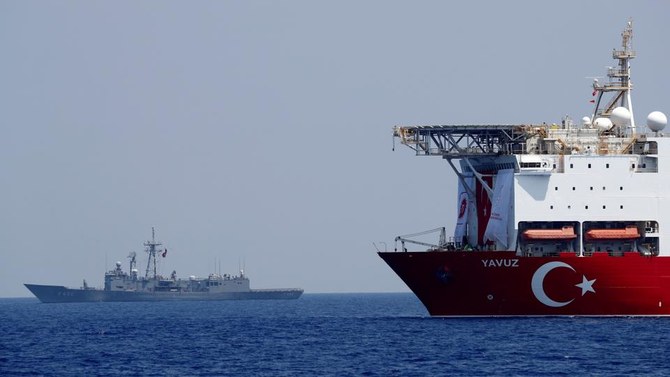

ANKARA: European pressure is piling up on Turkey ahead of a meeting next week about the country’s activities in the eastern Mediterranean, with the European Parliament urging the immediate end to “illegal exploration and drilling” in the region.
European Union leaders will meet in Brussels on Sept. 24 and 25 to discuss the single market, industrial policy and digital transformation, as well as external relations, particularly with Turkey and China.
The situation in the eastern Mediterranean and relations with Turkey were raised by some member states during an EU leaders’ video conference of Aug. 19. Leaders expressed their concern about the growing tensions and stressed the urgent need to de-escalate.
A European Parliament resolution on Thursday called for sanctions against Turkey unless it showed “sincere cooperation and concrete progress” in defusing tensions with EU members Greece and Cyprus.
Parliamentarians also want it to “immediately end any further illegal exploration and drilling activities in the Eastern Mediterranean, by refraining from violating Greek airspace and Greek and Cypriot territorial waters and by distancing itself from nationalistic warmongering rhetoric.”
Opinion
This section contains relevant reference points, placed in (Opinion field)
But Turkey criticized the resolution, saying it was biased, and insisted on the need for completely demilitarizing Greek islands in the zone.
Marc Pierini, a former EU ambassador to Turkey and now analyst at Carnegie Europe, said the resolution reflected the views of a democratically elected parliament from across the bloc.
“This is not ‘country X against country Y,’ it is the aggregated view of the European Parliament,” he told Arab News.
Germany is pushing for mediation efforts, while France is campaigning for punitive measures to stay united with Cyprus and Greece.
Following talks with Cypriot Foreign Minister Nikos Christodoulides in Nicosia, French Minister for European Affairs Clement Beaune said the EU should consider employing sanctions, among other available tools, if Turkey continued to “endanger the security and sovereignty of a member state.”
European Commission President Ursula von der Leyen said on Wednesday that nothing could justify Turkey’s coercion in the eastern Mediterranean in a dispute over energy resources.
“Turkey is and will always be an important neighbor,” she said, a day after Turkey said the operations of its drilling vessel Oruc Reis were extended until Oct. 12. “But while we are close together on the map, the distance between us appears to be growing.”
Fiona Mullen, director of the Nicosia-based research consultancy Sapienta Economics, said that the European Parliament was less important for the east Mediterranean issue than the European Council heads of government.
“But in the European Council it looks as though momentum is building for serious sanctions,” she told Arab News. “I think this is why we saw the removal of the Oruc Reis vessel for maintenance. Turkey cannot afford big sanctions when the lira in such a vulnerable state.”
If backstage diplomacy was successful, she said, the removal of vessels around Cyprus would likely be a carrot for Turkey in terms of the customs union. “It is in everyone’s interests to find a win-win result out of this,” she added.
Pierini anticipated that three elements would stand out in the upcoming European Council debate: EU solidarity with Cyprus and Greece; availability for dialogue but not under threat; and ongoing work on possible graduated sanctions should the need arise.
The parliamentary resolution included the possibility of further restrictive measures to be “sectoral and targeted.”
Turkish President Recep Tayyip Erdogan had a phone call with European Council head Charles Michel on Thursday and urged Brussels to adopt an “impartial stance” toward Turkey.
The US is “deeply concerned” about Turkey’s moves in the region, according to Secretary of State Mike Pompeo.
Ankara told Washington to stay neutral on the row.


