Greek police move homeless migrants to new Lesbos camp

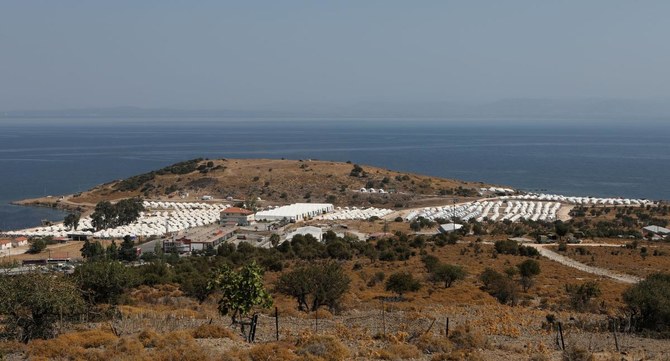
A view of a new temporary camp for refugees and migrants, on the island of Lesbos, Greece, September 17, 2020. (Reuters)
Short Url
Updated 17 September 2020
Follow

Greek police move homeless migrants to new Lesbos camp

  • Officers woke the migrants in their tents and sleeping bags on the roadsides to take them to the temporary center that was hastily set up
  • Over 12,000 people were left homeless when fire broke out on the night of September 8 in the overcrowded and unsanitary Moria camp

LESBOS ISLAND, Greece: Police on the Greek island of Lesbos on Thursday launched an operation to rehouse thousands of asylum seekers sleeping rough for over a week after Europe’s largest migrant camp was destroyed by fire.
Officers woke the migrants in their tents and sleeping bags on the roadsides to take them to the temporary center that was hastily set up after Europe’s largest camp for asylum seekers at Moria burned down last week.
Quietly, with only the sounds of children crying, and under a hot sun the migrants folded their blankets, picked up bags containing whatever belongings they had saved from the fire and dismantled their tents.
Women and children with bundles on their backs were seen gathering by a barricade police had set up on the road.
“It’s awful, there’s nothing in it, not enough food, toilets, no shower, there’s not even a bed,” Mustafa, a Sudanese asylum seeker, told AFP, after arriving at the temporary camp a few kilometers from the burnt out Moria camp.
A migration ministry source said some 2,800 people were inside the new camp.
“The aim is to safeguard public health,” police spokesman Theodoros Chronopoulos told AFP in Athens, confirming that “an operation is underway” which “responds to humanitarian aims.”
He said around 70 women police officers took part in the operation. Videos posted by police showed women officers in white uniforms talking to migrant families.
Eight organizations providing legal assistance to migrants on Thursday noted that although asylum processes had begun anew, lawyers had not been given access to the new camp.
“Neither asylum seekers nor legal support organizations have until now received any information from Greek authorities about this facility,” the organizations said in a statement, noting that claimants were being called to interviews via teleconference without legal representation.
Doctors Without Borders (MSF), which opened an emergency clinic in the area, said they were initially barred from accessing the facility during the night. They were later allowed to reopen.
Over 12,000 people including entire families with elderly and newborns were left homeless when fire broke out on the night of September 8 in the overcrowded and unsanitary Moria camp — which came to prominence five years ago at the height of Europe’s migrant crisis.
Six young Afghans have been arrested in connection with the incident, with four of them brought before a Lesbos magistrate on Wednesday.
Thousands of the migrants have been sleeping under tarpaulins or tents at roadsides and in the car parks of closed supermarkets since the blaze.
Late Wednesday, around 1,000 tents, each able to accomodate between eight and 10 people, had been erected at the new site near Moria.
Medical tents were to be set up, and two quarantine zones were planned for the several dozen people who have tested positive for coronavirus.
But many migrants have refused to enter the new camp, fearing they would be left waiting for months to have their requests for asylum processed so that they can be transferred to the Greek mainland or to another European country.
The UN refugee agency on Wednesday urged Greece to speed up asylum processes on Lesbos.
“The idea is not that people remain for ever on the island of Lesbos, but that processes are accelerated so that people can leave gradually and in an orderly way” to the capital Athens or elsewhere on the mainland, the UN agency’s chief in Greece Philippe Leclerc told reporters.
Greece’s police minister Michalis Chrysochoidis this week said that “half” the migrants on Lesbos should be able to leave “by Christmas” and “the rest by Easter.”
Local communities on Thursday filed a legal complaint against the new camp, arguing that it was likely built without the proper environmental and archaeological permits.


Trump warns Maduro against playing ‘tough’ as US escalates pressure campaign on Venezuela

Updated 23 December 2025
Follow

Trump warns Maduro against playing ‘tough’ as US escalates pressure campaign on Venezuela

  • Venezuelan President Nicolas Maduro on Monday fired back at Donald Trump, who has ordered US naval forces to blockade the South American country's oil wealth, saying the US president would be "better off" focusing on domestic issues rather than threatenin
  • The Defense Department, under Trump’s orders, continues its campaign of attacks on smaller vessels in the Caribbean and eastern Pacific Ocean that it alleges are carrying drugs to the United States and beyond

WEST PALM BEACH, Florida: President Donald Trump on Monday delivered a new warning to Venezuelan President Nicolás Maduro as the US Coast Guard steps up efforts to interdict oil tankers in the Caribbean Sea as part of the Republican administration’s escalating pressure campaign on the government in Caracas.
Trump was surrounded by his top national security aides, Secretary of State Marco Rubio and Defense Secretary Pete Hegseth, as he suggested that he remains ready to further escalate his four-month pressure campaign on the Maduro government, which began with the stated purpose of stemming the flow of illegal drugs from the South American nation but has developed into something more amorphous.
“If he wants to do something, if he plays tough, it’ll be the last time he’ll ever be able to play tough,” Trump said of Maduro as he took a break from his Florida holiday vacation to announce plans for the Navy to build a new, large warship.
Trump levied his latest threat as the US Coast Guard on Monday continued for a second day to chase a sanctioned oil tanker that the Trump administration describes as part of a “dark fleet” Venezuela is using to evade US sanctions. The tanker, according to the White House, is flying under a false flag and is under a US judicial seizure order.
“It’s moving along and we’ll end up getting it,” Trump said.
It is the third tanker pursued by the Coast Guard, which on Saturday seized a Panama-flagged vessel called Centuries that US officials said was part of the Venezuelan shadow fleet.
The Coast Guard, with assistance from the Navy, seized a sanctioned tanker called Skipper on Dec. 10, also part of the shadow fleet of tankers that the US says operates on the fringes of the law to move sanctioned cargo. That ship was registered in Panama.
Trump, after that first seizure, said the US would carry out a “blockade” of Venezuela. Trump has repeatedly said that Maduro’s days in power are numbered.
Last week, Trump demanded that Venezuela return assets that it seized from US oil companies years ago, justifying anew his announcement of a blockade against sanctioned oil tankers traveling to or from the South American country.
Homeland Security Secretary Kristi Noem, whose agency oversees the Coast Guard, said in a Monday appearance on “Fox & Friends” that the targeting of tankers is intended to send “a message around the world that the illegal activity that Maduro is participating in cannot stand, he needs to be gone, and that we will stand up for our people.”
Russian diplomats evacuate families from Caracas
Meanwhile, Russia’s Foreign Ministry started evacuating the families of diplomats from Venezuela, according to a European intelligence official speaking on condition of anonymity to discuss sensitive information.
The official told The Associated Press the evacuations include women and children and began on Friday, adding that Russian Foreign Ministry officials are assessing the situation in Venezuela in “very grim tones.” The ministry said in an X posting that it was not evacuating the embassy but did not address queries about whether it was evacuating the families of diplomats.
Venezuela’s Foreign Minister Yván Gil on Monday said he spoke by phone with his Russian counterpart, Sergey Lavrov, who he said expressed Russia’s support for Venezuela against Trump’s declared blockade of sanctioned oil tankers.
“We reviewed the aggressions and flagrant violations of international law that have been committed in the Caribbean: attacks against vessels and extrajudicial executions, and the unlawful acts of piracy carried out by the United States government,” Gil said in a statement.
The scene on a Venezuelan beach near a refinery
While US forces targeted the vessels in international waters over the weekend, a tanker that’s considered part of the shadow fleet was spotted moving between Venezuelan refineries, including one about three hours west of the capital, Caracas.
The tanker remained at the refinery in El Palito through Sunday, when families went to the town’s beach to relax with children now on break from school.
Music played on loudspeakers as people swam and surfed with the tanker in the background. Families and groups of teenagers enjoyed themselves, but Manuel Salazar, who has parked cars at the beach for more than three decades, noticed differences from years past, when the country’s oil-dependent economy was in better shape and the energy industry produced at least double the current 1 million barrels per day.
“Up to nine or 10 tankers would wait out there in the bay. One would leave, another would come in,” Salazar, 68, said. “Now, look, one.”
The tanker in El Palito has been identified by Transparencia Venezuela, an independent watchdog promoting government accountability, to be part of the shadow fleet.
Area residents on Sunday recalled when tankers would sound their horns at midnight New Year’s Eve, while some would even send up fireworks to celebrate the holiday.
“Before, during vacations, they’d have barbecues; now all you see is bread with bologna,” Salazar said of Venezuelan families spending the holiday at the beach next to the refinery. “Things are expensive. Food prices keep going up and up every day.”
Venezuela’s ruling party-controlled National Assembly on Monday gave initial approval to a measure that would criminalize a broad range of activities that could be linked to the seizure of oil tankers.
Lawmaker Giuseppe Alessandrello, who introduced the bill, said people could be fined and imprisoned for up to 20 years for promoting, requesting, supporting, financing or participating in “acts of piracy, blockades or other international illegal acts against” commercial entities operating with the South American country.
The Defense Department, under Trump’s orders, continues its campaign of attacks on smaller vessels in the Caribbean and eastern Pacific Ocean that it alleges are carrying drugs to the United States and beyond.
At least 104 people have been killed in 28 known strikes since early September. The strikes have faced scrutiny from US lawmakers and human rights activists, who say the administration has offered scant evidence that its targets are indeed drug smugglers and that the fatal strikes amount to extrajudicial killings.