Archaeology team in KSA unearths earliest-known traces of humans on Arabian Peninsula

1 / 5
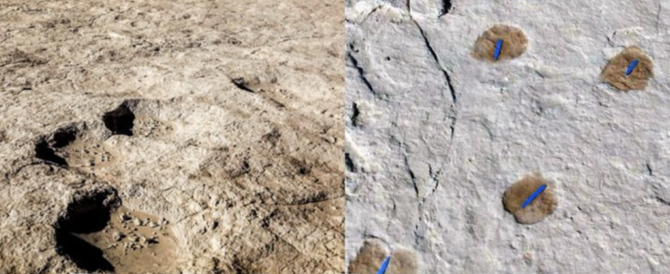
ootprints of humans, elephants and other animals dating back more than 120,000 years were discovered on the edge of an ancient dry lake on the outskirts of Tabuk in Saudi Arabia. (Twitter: Saudi Ministry of Culture)
2 / 5
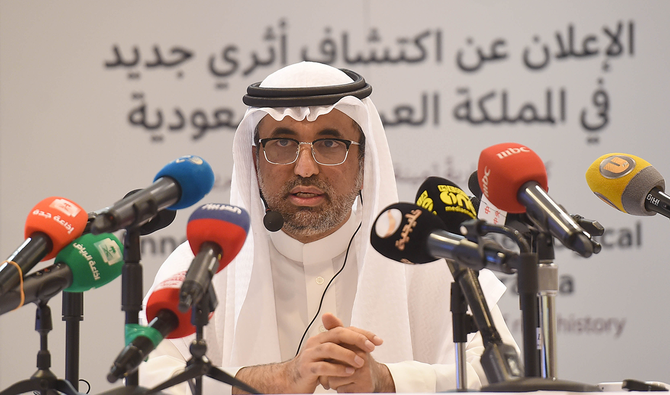
Dr. Jasser bin Sulaiman Al-Herbish, CEO of the authority. (Photo by Basheer Saleh)
3 / 5
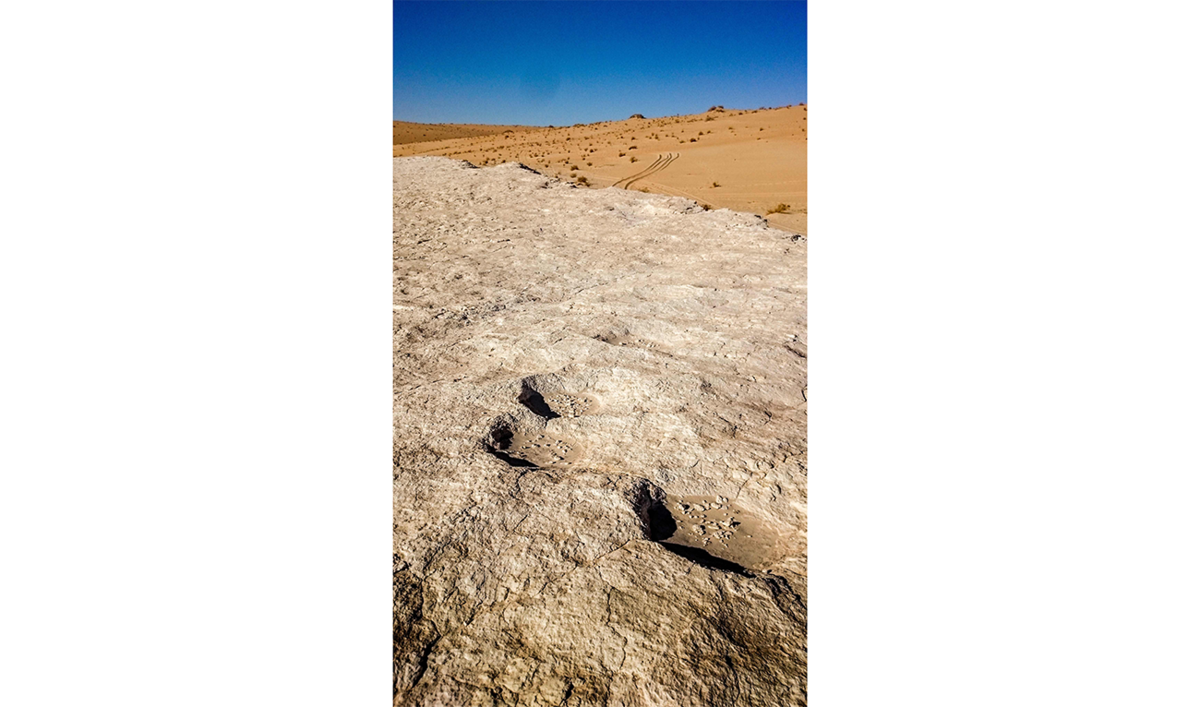
A view of the edge of the an ancient lake deposit on the outskirts of Tabuk. The humans may have hunted the big mammals but they did not stay long, using the watering hole as a waypoint on a longer journey. (AFP)
4 / 5
Animal fossils eroding out of the surface of the ancient lake deposit. (AFP)
5 / 5
A 120,000-year-old human footprint discovered on the outskirts of Tabuk. (AFP)
Short Url
Updated 16 September 2020
Follow

Archaeology team in KSA unearths earliest-known traces of humans on Arabian Peninsula

  • The survey team identified the prints of seven humans, 107 camels, 43 elephants, and other animals including ibex and bovine species

RIYADH: An archaeology team in Saudi Arabia on Wednesday announced the discovery of 120,000-year-old footprints representing the earliest-known evidence of human habitation on the Arabian Peninsula.

The Saudi and international group of experts unearthed footprints of humans, elephants, and predators around an ancient, dry lake on the outskirts of Tabuk, in the north west of the Kingdom, revealed Dr. Jasser bin Sulaiman Al-Herbish, CEO of the Heritage Authority.

The survey team identified the prints of seven humans, 107 camels, 43 elephants, and other animals including ibex and bovine species. Around 233 fossils of elephant and oryx bones were also found, along with signs of the presence of predators.

Al-Herbish said the location of the discoveries confirmed the historical and geographical importance of the Arabian Peninsula to human civilization.

“Just as excavation and exploration reveal oil, gold, and treasures on the earth, it connects us with the legacy of ancient civilizations that inhabited our homeland and provided us with evidence that this part of the world was and still is a source of inexhaustible civilizations,” he added.

“This event is considered an important national reflection related to the history of this land and its fundamental place in the course of life throughout history. When we search and discover, we are simultaneously creating tomorrow’s legacy and presenting our message for the future.”

The chief executive said that the finds were the results of the “Green Arabian Peninsula” scientific project supervised by the Heritage Authority in collaboration with the Max Planck Institute in Germany, the University of Oxford, the University of Queensland in Australia, King Saud University, the Geological Survey Authority, and Aramco.
For more than 10 years, a research team has been working on multidisciplinary field studies covering desert areas, volcanic zones, and parts of the coast in Tabuk, Najran, Riyadh, Hail, and Madinah.

He pointed out that the project’s findings had shown that there had been significant environmental changes ranging from extremely arid to wet.

Current evidence strongly supports assertions of the existence of a green Arabian Peninsula in the past with environmental records and archaeological sites dating back at least 500,000 years.

Al-Herbish said that during wet periods of time there had been rivers and lakes throughout the Arabian Peninsula, which led to population expansions.

“This confirms that Arabia has been a major crossroads between Africa and the rest of Eurasia throughout prehistoric times,” he added.

Saudi Arabia is home to many archaeological treasures spread throughout its regions. Five sites in the Kingdom are on UNESCO’s World Heritage List, namely Al-Ahsa Oasis, Mada’in Salih in AlUla, Al-Turaif district in Diriyah, historic Jeddah, and rock art in the Hail region.

Authorities in the Kingdom are making great efforts to preserve and highlight mankind’s shared history and in 2019 Saudi Arabia was elected to UNESCO’s World Heritage Committee.


Why Saudi Arabia’s desert night skies are becoming a magnet for stargazers

Updated 4 sec ago
Follow

Why Saudi Arabia’s desert night skies are becoming a magnet for stargazers

  • AlUla’s remote desert landscape offers some of the Middle East’s darkest skies, creating ideal conditions for celestial tourism
  • The growth of desert stargazing reflects a wider push to revive the region’s ancient astronomy traditions and heritage

LONDON: Within living memory, knowledge of the famously vivid night skies over Arabia was essential for the safe passage of sailors on the high seas, and travelers crossing the region’s great, trackless deserts.

Now, fascination with, and knowledge of, the heavenly bodies over the deserts of Saudi Arabia is flourishing once again as astronomy and simple stargazing are poised to play a starring role in the development of the Kingdom as an attractive destination for cultural tourism.

The science of astronomy flourished during the Golden Age of Islam, from the 9th to the 13th centuries, to the extent that many stars still have their original Arabic names, including Altair in the constellation Aquila, and Aldebaran in Taurus.

The astronomical terms azimuth and nadir, still in universal use, are also Arabic in origin, and Arab scientists are credited with the invention of navigational tools such as the astrolabe, an ingenious mechanical computer that could be used to fix a ship’s position by the stars, or to indicate the direction of Makkah.

In addition to creating the famous House of Wisdom academy, the Abbasid Caliph Abu Al-Mamun (who ruled from 813 to 833 A.D.) also built the region’s first observatory in Baghdad.

As the journal Astronomy has noted: “While the pinnacle of the science is most commonly thought to have been during the Renaissance, it actually began a thousand years earlier and 8,000 kilometers to the east.” While in the Dark Ages “Europe was in an intellectual coma, the Islamic empire, which stretched from Moorish Spain to Egypt and even China, was entering its Golden Age (and) astronomy was of particular interest.”

Now, in the dramatic landscapes of northwestern Saudi Arabia, astronomy is becoming a subject of particular interest once again.

Near the ancient Nabataean city of Hegra, work is underway on a unique visitor attraction, AlUla Manara, described by the Royal Commission for AlUla as “a place unlike anywhere else on Earth, an inspiring destination within a destination where the universe unveils its secrets, a space dedicated to advancing research and education in astronomy and space science.”

The full details are not expected to be revealed until next year but, says the RCU, AlUla Manara will be “an architectural marvel and state-of-the-art facility that invites visitors to explore the wonders of the cosmos.”

Interactive exhibits, high-tech telescopes and immersive workshops “will bridge the gap between ancient celestial wisdom and modern scientific discovery.” As a hub for astrotourism, the attraction will offer “unique stargazing experiences, drawing visitors from around the world to connect with the cosmos in an unforgettable way.”

AlUla is already recognized as a unique destination for stargazing. In October 2024, AlUla Manara and Gharameel Nature Reserve, two key protected areas covering a total of 2,334 sq. km, were formally designated as an International Dark Sky Park.

This certification, awarded by the organization DarkSky International, was a first for the Gulf region. As a spokesperson for AlUla said at the time, it recognizes “a vast stretch of desert where the stars can still be seen as they were by ancient travelers: clearly, vividly and without interference.”

AlUla joins the ranks of 249 other dark-sky locations around the world certified by DarkSky International since 2001. To earn its certification, AlUla had to demonstrate “strict environmental and lighting controls, a long-term conservation strategy, and a clear commitment to education and public access.”

Naif Al-Malik, executive program director at AlUla Manara, welcomed the accreditation as “a major boost … particularly to the development of a new astrotourism ecosystem.”

He added: “Preserving and celebrating access to the night sky is an important part of what makes AlUla a unique destination where visitors can explore the natural, scientific and cultural world, while also raising awareness of the impact of light pollution and the need to protect dark skies globally.”

In its accreditation, DarkSky noted that amid stunning rocky landscapes, the reserves at AlUla “offer captivating and surreal desert vistas paired with stunning views of the night sky. Thanks to their isolation from urban lights, and optimal atmospheric conditions, AlUla is the perfect destination for travelers seeking an unparalleled dark-sky experience.”

There is also much to see nearby at ground level, including towering rock formations sculpted by the desert winds, and the ancient ruins and rock art of the Nabatean civilization.

But as the sun sets and dusk gives way to true darkness, unspoiled by man-made lighting, “another spectacle unfolds, as travelers are greeted by thousands of stars and the Milky Way arching across the night sky,” creating “one of the best stargazing spots in the world.”

Even before AlUla Manara is fully up and running, curious tourists are already traveling to the area to sample the new “astrotourism” on offer, camping under clear night skies for organized experiences in which “Bedouin storytelling meets astrophysics.”

Astronomer Nawal Al-Anazi, who in 2017 became the first woman to graduate with a master’s degree in astronomy from King Saud University in Riyadh, said she is “thrilled and very happy that astronomy is being linked with tourism” in the Kingdom.

“Our relationship with the stars goes way back in history,” she added. “As an Arab civilization, we were looking to the sky to identify the time of the rains for farming, and of course for navigation, and today we still have Arabic names for stars.”

In the deserts of Saudi Arabia, she said, “there is no light pollution and we have the clearest skies, which makes it perfect for seeing the stars with a telescope or even the naked eye.”

Her interest in astronomy grew from trips into the desert as a child, when “we used to go camping to see the stars at night and learn their names.” The conditions for this were perfect in Al-Dahna desert, about 100 kilometers east of Riyadh and far from the lights of civilization.

“In this location you can see the stars very clearly, especially if it is a new moon, when there is no moonlight,” Al-Anazi said.

Her favorite constellation is Orion, “the hunter.” It features several bright stars, including Rigel and Betelgeuse, and is clearly visible in the vicinity of Riyadh.

Always visible in the Arabian night sky is the constellation Ursa Minor, also known as the “Little Bear or Little Dipper,” which has been used by travelers for navigation for millennia because it includes Polaris, the bright, always visible North Star.

Through a quirk of astrophysics, Polaris always appears to be stationary in the sky, thanks to the fact that the Earth’s axis points directly towards it.

There is no shortage of clubs and societies devoted to encouraging an interest in astronomy among young people in Saudi Arabia, including Noor Astronomy in Al-Qassim, Falak for Space Science and Research in Riyadh, and Hajr Astronomy Association in Al-Ahsa.

Falak, which is supported by Misk, the Mohammed bin Salman Foundation, is “dedicated to building a passionate astronomical community that contributes to enriching scientific content in space and its applications to enhance human quality of life.”

As astronomy continues to grow in popularity in Saudi Arabia, Al-Anazi has some tips for first-time stargazers. Travel at least 100 kilometers from any towns or cities, she said, to avoid light pollution.

Stargazing in Arabia is better during the winter months, between October and March, she added, not only because of the cooler temperatures but because the sky will be clearer.

“If you have a small telescope, with a tripod, so much the better, but you will see plenty of stars and the Milky Way with the naked eye,” Al-Anazi said.

To help identify stars and constellations one can use an app; she recommends Stellarium Mobile, which is used by students at the University of Glasgow in Scotland, where she teaches and is studying for her doctorate in astronomy.

Another good app option is Skyview. Both will identify stars and constellations, and can also be used to track satellites, the International Space Station, and even rocket debris orbiting the earth.

Al-Anazi said she is excited by the developments at AlUla Manara and plans to visit as soon as she completes her studies.

“We have the clear skies and the wide-open spaces, and I think it is going to focus attention on the importance of astronomy in Saudi Arabia and how tourism can transform it into a cultural experience,” she added. “I can’t wait to see it.”