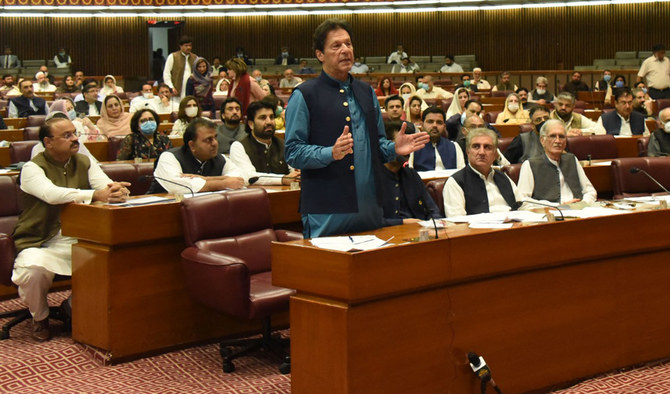
ISLAMABAD: Prime Minister Imran Khan on Wednesday criticized the opposition for not supporting new legislation that could help the country be removed from a grey list of the Financial Action Task Force (FATF), saying that political rivals were only interested in protecting their “ill-gotten wealth.”
The government convened a joint sitting of parliament on Wednesday to get three bills passed after 104 members of the country’s Senate, which is dominated by opposition factions, rejected the laws over reservations they would be used to trample civil liberties.
The bills were passed amid protest and uproar by the opposition, as 200 parliamentarians voted in favor of them while 190 voted against them. The assembly also rejected all the amendments introduced by opposition lawmakers with a majority vote.
“It is my conviction that the interests of Pakistan are not the same as the interests of opposition leaders,” the prime minister said while speaking on the floor of the house.
He said the country would face severe economic sanctions if it was blacklisted by the global financial watchdog over money laundering and terror financing.
“I was expecting the opposition to support the legislation because this is in Pakistan’s interest,” he added.
The FATF placed Pakistan, a nation of 220 million, on its grey list due to inadequate controls over terror financing in June 2018, giving it a 27-point action plan that also included strengthening its legal framework by passing new laws.
Islamabad is now required to submit a compliance report with the FATF until September 30, or its status will be downgraded to a blacklist that includes countries like North Korea and Iran. Being blacklisted would mean Pakistan would be shunned by international financial institutions, causing severe economic hardships.
Pakistan has long been accused of supporting militant groups and using them as proxies to advance its interests in the region, though Islamabad categorically denies such accusations.
A minimum of three votes by FATF members are needed to avoid the organization’s blacklist, and Pakistan has so far managed to avoid it due to the support of China and other friendly nations, including Malaysia and Turkey.
Officials in Islamabad claim Pakistan has done much to comply with the FATF conditions, including an unprecedented conviction of Hafiz Saeed, the founder of Lashkar-e-Taiba (LeT) group, on charges of terror financing.
Analysts believe that the most crucial aspect of compliance with the FATF in Pakistan’s case would be to effectively prevent militant groups from openly operating and raising funds.
The global watchdog has pushed Pakistan to adequately identify, assess and understand risks associated with the presence of militant groups in the country.
Addressing the media, the opposition Pakistan Muslim League-Nawaz party’s lawmaker, Shahid Khaqan Abbasi, said the government had enacted “black laws” on the pretext of FATF, adding that these laws were against civil liberties and interests of Pakistan.
“We moved the amendments [in the draft laws],” he said, “but the government unfortunately rejected them.”


![]()

Pakistan passes new laws in push to be removed from FATF grey list
Short Url
https://arab.news/racfr
Pakistan passes new laws in push to be removed from FATF grey list
- Prime Minister Imran Khan criticizes the opposition for not supporting the legislation
- Opposition parties accuse the government of enacting ‘black laws’ on the pretext of satisfying FATF's conditions
Latest updates


© 2026 SAUDI RESEARCH & PUBLISHING COMPANY, All Rights Reserved And subject to Terms of Use Agreement.