

BEIRUT: The Lebanese army on Monday killed what it described as the “ringleader of a terrorist cell” during a raid on a house in a town near Tripoli which also left four soldiers dead.
Khaled Al-Talawi died after a force from the Military Intelligence Directorate closed in on an apartment where he had been hiding in Beddawi, northern Lebanon.
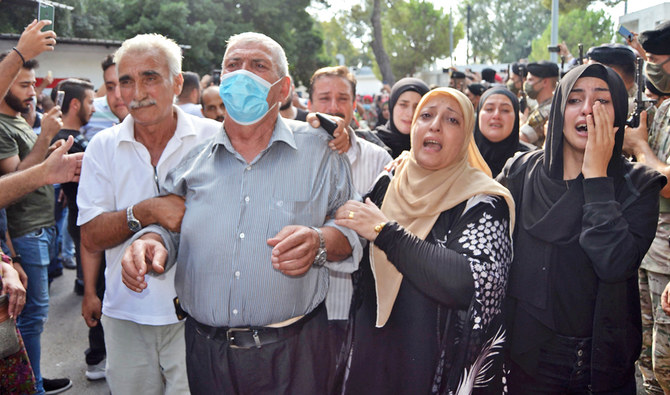
Sgt. Louay Melhem, and soldiers Charbel Jebili, Anthony Takla, and Nihad Mustafa were killed when the militant threw a hand grenade and fired at their patrol before fleeing the scene with three other people. Al-Talawi was later killed in the Zgharta district after he shot at soldiers. Units stopped another fugitive and chased two others.
Al-Talawi had been on the run from authorities after his car was used by armed men during the killing of three young guards in the town of Kaftoun on Aug. 21. The militants were part of a terrorist cell, led by Al-Talawi, linked to Daesh.
Since the attack, security services have carried out a series of raids, including one on the Beddawi Palestinian refugee camp, and Syrian refugee camps in the north.
Lebanese Army Command revealed that the cell’s members “had received military training, collected weapons and ammunition, which were seized, and carried out several thefts to finance their activities.”
Commander of the Lebanese Armed Forces, Joseph Aoun, briefed President Michel Aoun on the military operation in a phone call.
Meanwhile, French President Emmanuel Macron’s deadline for Lebanese parties to form a new government of specialists and nonpolitical ministers has expired with as yet, no solution.
Lebanon’s Prime Minister-designate Mustapha Adib was unable to prepare a list of names following claims from the Amal Movement, Hezbollah, and the Free Patriotic Movement that he had not consulted with them.
After meeting President Aoun on Monday, Adib said he had visited the Presidential Palace “for further consultations,” and that over the next two days “we hope for the best.”
FASTFACTS
• Khaled Al-Talawi had been on the run from authorities after his car was used by armed men during the killing of three young guards in the town of Kaftoun on Aug. 21.
• The militants were part of a terrorist cell, led by Al-Talawi, linked to Daesh.
The French initiative, launched by Macron in Beirut two weeks ago, provided for the speedy formation of a government of specialists to implement the necessary reforms required to lift the country out of its severe economic crisis.
Macron intervened on Sunday night in an attempt to resolve a dispute over the finance portfolio that Parliament Speaker Nabih Berri had insisted be allocated to a Shiite proposed by him.
“The (French) president is pressuring Lebanese politicians to fulfill their promises to form a new government this week and to pull the country out of its worst crisis since the civil war that took place between 1975 and 1990,” the French president’s office said on Sunday. “President Macron continues his contacts with various political actors in Lebanon.”
When Macron visited Beirut on Sept. 1, the Lebanese leadership promised to form a government of specialists without party loyalties within two weeks to tackle an economic meltdown made worse by the devastating explosion at Beirut port on Aug. 4.
On Monday, it was announced that Aoun had started meetings with “heads or representatives of the parliamentary blocs to promote a convergence of views on government developments.”
Mohanad Hage Ali, resident researcher at the Carnegie Middle East Center in Beirut, told Arab News: “It’s a new French 48-hour deadline that was given to the Lebanese parties after the expiration of the two-week deadline to come up with a formula agreed upon by all.”
Ali said: “The Amal Movement, Hezbollah, and the Free Patriotic Movement feel that the government rug has been pulled from under their feet. They are trying to position themselves in the middle. They refuse to participate in the government, but they cooperate with it.
“This is because they know that stopping state subsidies on fuel will soon come in light of the sharp drop in hard currency reserves, and therefore they do not want the street to explode in their face,” he added.
Leader of the Free Patriotic Movement, MP Gebran Bassil, received a phone call from Macron and another from Adib. He said on Sunday that the movement’s participation in the government was “not a condition for its support,” adding that “the constitution is clear that a ministry is not devoted to a sect.”
After receiving a similar call from Macron, Berri’s office said: “The problem is not with the French, the problem is internal. We informed the prime minister-designate of our unwillingness to participate in the government on the basis that he had laid, and we informed him of our readiness to cooperate to the fullest extent in all that is necessary to stabilize Lebanon and its finances, undertake reforms, and save its economy.”
Ali said: “The three opposing parties know that the age of this new government will not be later than the coming new year, awaiting the results of the American presidential elections, and that this government will not be able to propose solutions to the big problems despite the competencies of those who will be chosen for ministerial portfolios.
“On the other hand, these parties fear that this government will obtain external support to implement reforms that they will not play a role in formulating if they remain outside it.
“What the three parties will do within 48 hours is to negotiate half the nomination, meaning that the parties express their opinion on the names proposed by Adib only without undermining the formation,” Ali added.