

Lebanon’s overcrowded prison may be courting COVID-19 health disaster

1 / 2
Inmates produce protective face masks, to be used by security members and inmates themselves as part of the preventive measures against the spread of the coronavirus disease (COVID-19), inside Roumieh prison, Lebanon, in this handout picture received by Reuters on April 6, 2020. (REUTERS)
2 / 2
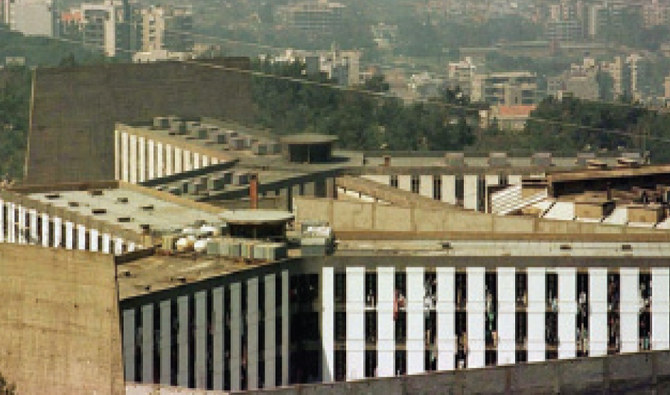
The Roumieh Prison, located east of Beirut, houses more than 5,500 prisoners and has a separate juvenile section. (Reuters/File)
Short Url
Updated 14 September 2020
Follow

Lebanon’s overcrowded prison may be courting COVID-19 health disaster

  • Inmates’ families panic over reports about spread of coronavirus in Roumieh Prison, organize protests

BEIRUT: Reports about the spread of the coronavirus disease (COVID-19) in Roumieh Prison, the largest in Lebanon, have caused panic among the families of inmates who fear disaster if quick measures are not taken.

Several guards and inmates are reported to have contracted the virus. Lebanon’s prisons already suffer from severe overcrowding, running at 160 percent of capacity at the end of 2019.

Roumieh, located east of Beirut, houses more than 5,500 prisoners and has a separate juvenile section.

The prison was opened in 1970 with a capacity of about 1,500 prisoners, but the number has grown over the years, making social distancing impossible. The possibility of granting a general amnesty to all inmates is currently under discussion.

Lawyer Ghida Franjieh said: “The judiciary ordered the release of many detainees since the announcement of the general mobilization to avoid crowding in detention facilities.”

She added that parliamentary intervention would be required to ensure the release of those convicted of minor crimes.

“There are many questions that need answers: Were the infections discovered in the early stages?” she added. “Were the infected people isolated immediately?”

“The increase of overcrowding could lead to a health disaster in Roumieh Prison that may cross prison boundaries if the internal security forces and the judiciary do not take all necessary measures to protect infected prisoners and those in contact with them, especially since many prisoners suffer from weak immunity due to poor living conditions and health.”

Many prisoners have complained of fatigue, high temperatures, coughing, shortness of breath, sore throats, loss of smell, and other symptoms. The prison pharmacy has run out of painkillers and fever remedies, according to reports.

Health Minister Hamad Hassan confirmed that there had been COVID-19 cases in Roumieh, but said infections were chiefly “among the security forces in the prison” and that “a very limited number of infections were reported among the prisoners.

“We are working to secure a hospital in Bekaa and another in Beirut to treat the detainees,” he added.

The General Directorate of the Internal Security Forces stated: “Thirteen prisoners and nine security personnel tested positive for the virus on Sept. 11, and a place for quarantine has been prepared in the central prison, in cooperation with the International Red Cross and the World Health Organization (WHO), and sections have been allocated in government hospitals for necessary treatment.”

Families of many detainees in Roumieh organized a protest in Tripoli, calling for necessary measures for the protection of prisoners and to prevent the spread of the virus among them.

The total number of people infected with COVID-19 in Lebanon has reached 24,000, as the daily number of infections has exceeded 500 since mid-August. The total number of deaths as of Sunday was 239.

Lebanese Foreign Minister Charbel Wehbe has also been infected with the virus. His ministry’s employees were subjected to PCR tests last week, and it was found that three people who had contact with the minister were also infected.

Tripoli MP Faisal Karami expressed his concern over the spread of the virus, with only 26 beds to treat COVID-19 patients in his home city, with people having to wait for six days to take tests.

Karami revealed that the residents of Tripoli and its municipality “do not yet believe in the existence of the virus, and people do not adhere to the preventive measures.”

Meanwhile, a spokesman for the UN Interim Force in Lebanon (UNIFIL), Andrea Tenente, said 90 peacekeepers had contracted the virus.

“Eighty-eight of them belong to the same unit. They have been kept in quarantine and all precautions are being taken to prevent the spread of the virus among the peacekeepers,” he said.

“UNIFIL is taking very strict precautionary measures with all its military and civilian elements inside and outside their centers, by following all approved protocols, including quarantine and isolation, in line with the guidelines of the WHO and the Lebanese government. With regard to our employees, we have reviewed the roles of all.”

He said all UNIFIL activities related to implementing its mandate in accordance with UN Security Council Resolution 1701 remain unaffected.


Gaza health officials say strikes kill 21 after Israel says shots wounded officer

Updated 4 sec ago
Follow

Gaza health officials say strikes kill 21 after Israel says shots wounded officer

GAZA CITY: Gazan health officials said Israeli air strikes on Wednesday killed 21 people in the Palestinian territory, with Israel’s military saying it struck after gunfire targeting its troops wounded an officer.
Despite a US-brokered truce entering its second phase last month, violence has continued in the Gaza Strip, with Israel and Hamas accusing each other of breaching the agreement.
The latest bloodshed came days after Israel partly reopened the Rafah crossing between Gaza and Egypt, the only exit for Gazans that does not pass through Israel.
The health ministry, which operates under Hamas authority, said that 21 people were killed in a series of strikes, with at least 38 others wounded, updating an earlier figure given by the territory’s civil defense agency.
Among the dead were three children, said the agency, which operates as a rescue force under the Hamas authority.
“We were sleeping when suddenly shells and gunfire rained down on us,” said Abu Mohammed Haboush, whose son was killed.
“Young children were martyred, my son and my nephew were among the dead. We lost many young men,” he said, adding that he and his family were living far away from the so-called “Yellow Line,” where Israeli forces are stationed.
AFP images showed mourners offering prayers in the compound of Al-Shifa hospital in Gaza City, where several bodies wrapped in white shrouds were laid out.
An AFP photograph showed a relative holding a body of a child wrapped in a shroud at the hospital as relatives gathered around him.
Shortage of medical aid
Three bodies were brought to Nasser Hospital after Israeli strikes hit homes and tents housing displaced Palestinians in the southern Khan Yunis area, the civil defense agency said.
Fourteen more bodies were taken to Al-Shifa Hospital, its director Mohamed Abu Salmiya said in a statement.
“We also received dozens of wounded. The situation is extremely difficult in the hospitals of the Gaza Strip due to the severe shortage of medicines and medical supplies,” Abu Salmiya said.
Israel scrutinizes all aid into besieged Gaza, a tiny coastal territory surrounded by fences, walls and the Mediterranean Sea.
The Israeli military said it had launched strikes after “terrorists opened fire on troops” Wednesday, seriously wounding an officer, adding that it considers the incident a violation of the ceasefire.
It said the troops came under attack near the “Yellow Line,” without specifying which side of the line the troops were on.
The ceasefire took effect after two years of war in Gaza, sparked by Hamas’s October 2023 attack on Israel.
Following what was reportedly US pressure, Israel allowed the opening of the Rafah crossing, but limited passage to patients and their travel companions.
Sick and wounded Gazans have begun crossing into Egypt to seek medical treatment since Monday.
On Tuesday, 45 people crossed into Egypt and 42 entered the territory, a source at the Palestinian Red Crescent Society told AFP.
Shortly after midnight Wednesday, those meant to enter during the day on Tuesday arrived in Gaza through Rafah in a large bus, an AFP journalist reported.
‘My homeland’
Relatives of those returning from Egypt screamed in joy, hugging and crying.
“I am so happy to be back with my husband, my children, my family, my loved ones, and of course, my homeland,” Fariza Barabakh, who returned that day, told AFP.
“It’s an indescribable feeling, thank God. What can I say? My two young children didn’t recognize me, but thank God. I hope it will be alright,” Yusef Abu Fahma, another returnee, told AFP.
Gaza’s health ministry says at least 556 people have been killed in Israeli strikes since the ceasefire took effect on October 10, while the Israeli military says four of its soldiers have been killed over the same period.
Saturday was among the deadliest days, with the civil defense agency reporting at least 32 people killed in Israeli attacks, which the military said were in response to a Hamas ceasefire violation.
Media restrictions and limited access in Gaza have prevented AFP from independently verifying casualty figures or freely covering the fighting.