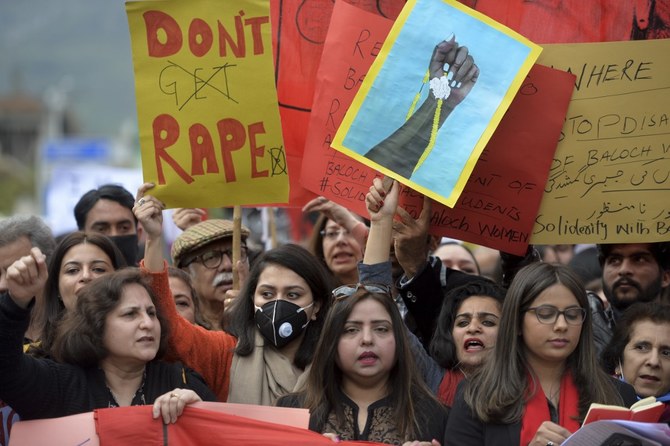

ISLAMABAD: Cries of shock and rage rung out across Pakistan on Thursday over the alleged rape of a woman by two ‘robbers’ in front of her children on a main highway, leading social media users and television pundits to call for the suspects to be publicly hanged.
Violence against women is endemic in Pakistan, but the brutality of the recent attack has shocked even those inured to the rising wave of sexual crimes and prompted thousands of people to speak up on social media, with #PublicHangingOfRapists becoming the top trend in the country on Thursday.
Local media reported that the woman was travelling from Lahore to Gujranwala, main cities in Pakistan’s populous Punjab province, on Tuesday night when her car developed a fault on the motorway.
“She got a call from a relative ... who asked her to call the police helpline for help while he also left from home to reach her,” the website of Pakistan’s Dawn newspaper reported. “When he reached the location, he found the woman terrified with her clothes stained with blood.”
Local media quoted police officials as saying two armed men who had found the woman alone on the road took her and her children to a nearby field and gang-raped her on gunpoint. Newly appointed Inspector-General of Punjab Police Inam Ghani said police had identified the village the suspects came from and secured “evidence” that would lead authorities to the culprits. He shared no further details.
Human rights minister Shireen Mazari wrote on Twitter that she had immediately sought an "action report" from police:
On the horrific Lahore Motorway entry point gang rape case, MOHR regional office immed asked for action report from police. FIR copy and progress report is with us at MOHR. I have removed the same from post to avoid sharing details of the victim.
— Shireen Mazari (@ShireenMazari1) September 10, 2020
Pakistan’s parliament passed a new law against child abuse in March this year, two years after the rape and murder of a seven-year-old girl that shocked the country.
Zainab Ansari’s body was found in a garbage dumpster in Kasur district near the eastern city of Lahore in 2018, sparking large protests and accusations of negligence by authorities.
While the new law will introduce a penalty of life imprisonment for child abuse, on Thursday, as news of the gang-rape incident spread, popular public opinion - reflected on social media sites and interviews by media with people on the streets - was that the culprits should be hanged.
Many took to Twitter to say that such a heinous crime could only be punished with the harshest of punishments which would send a strong signal to potential rapists that assaults on women would not be tolerated.
Azhar Mashwani, an advisor to the Punjab government on digital media, tweeted with the hashtags #PublicHangingOfRapists and #HangRapistsPublicly:
Update on #motorwayincident by IG Punjab @InamGhani:
▪ Village of culprits has been identified
▪ Extensive search operation going on
▪ 12 suspects arrested already
▪ Using modern/traditional techniques #HangRapists #hangrapistspublicly #PublicHangingOfRapists pic.twitter.com/CZC8MElEA6— Azhar Mashwani (@MashwaniAzhar) September 10, 2020
Other social media users expressed the same sentiment:
Raped in front of her children. Neither one of them will ever be able to forget or move on from this. Lives destroyed. For their justice and for safety of the rest of us women who use motorways/highways, PUNISH THE CULPRITS. #PublicHangingOfRapists
— m (@meemelif) September 9, 2020
#PublicHangingOfRapists
Rape cases are increases day by day, in This Islamic country no one is safe either she is women r a child. Hang the rapist in public and cut their organ into pieces. They have no right to live any more. Even hell is not enough for them....@ImranKhanPTI pic.twitter.com/JoHATYz7cJ— Rana Kamran(21 September Rania's) (@ShaheenIQBALka_) September 10, 2020
Some rights activists, however, refused to support the calls for public revenge, calling for reforms in the criminal justice system and better protections for women and children:
Journalist and researcher Nazish Brohi wrote:
“Okay, let's say we hang them. Who will you hang? Those convicted by court, right? Less than 4% of those accused of rape get convicted in Pakistan.”
Okay, let's say we hang them. Who will you hang? Those convicted by court, right? Less than 4% of those accused of rape get convicted in Pakistan.
Many don't report. Those who do, for many police won't file FIR, only kacha parcha. Those who make it past that (1/?)— Nazish Brohi (@Nazish_Brohi) September 10, 2020
Digital rights advocate and journalist Farieha Aziz wrote:
“The man convicted for Zainab's murder was hanged. Has that stopped child molestation, rape, murder? It never does.”
Here we ago again. Public hangings. The man convicted for Zainab's murder was hanged. Has that stopped child molestation, rape, murder? It never does. All you do with these demands is satiate your outrage. Does nothing for victims/survivors and the living, who remain targets.
— Farieha Aziz (@FariehaAziz) September 10, 2020
Sadaf Khan from Media Matters for Democracy said:
“Come on, let us all hang the symptoms and forget the disease. What matters is optics anyways.”
Come on, let us all hang the symptoms and forget the disease. What matters is optics anyways. In any case, rapes are about power, and challenging the power of men? Goes against logic, right?
Hang the (non-influential) losers who get caught & protect everything that creates them.— Sadaf Khan (@nuqsh) September 10, 2020